








































Categories
Blockchain DEFI

Real World Asset Tokenization: Everything You need to know

Blockchain technology is expanding at a fast pace and has revolutionized conventional finance. However, in this big difference, real-world asset tokenization is one feature now taking the lead. 

Real-world assets (RWAs) have a wide range of tangible (monetary, physical) and intangible (non-monetary, non-physical) assets. Tokenization is a way of converting these assets into tokens. 

So, in this blog, we will cover 360-degree concepts of real-world asset tokenization, what it is, its market size, what assets can be tokenized, examples, benefits, challenges, and more. 

Key Takeaways: 

  1. Real-World Asset Tokenization (RWA Tokenization): This process involves converting real-world assets into digital tokens on a blockchain, offering increased liquidity and accessibility.
  2. Benefits of RWA Tokenization: Beyond liquidity and accessibility, tokenization provides improved transparency, greater composability within the DeFi ecosystem, and the potential to revolutionize traditional finance.
  3. Challenges and Considerations: While promising, RWA tokenization faces hurdles like regulatory uncertainties, market adoption, security concerns, and increased education.
  4. Market Potential: According to Boston Consulting Group, the asset tokenization market is expected to grow significantly to a staggering $16 trillion by 2030, offering substantial opportunities for investors and businesses.
  5. Key Players: Companies like Ondo Finance, Mantra, Polymesh, OriginTrail, and Pendle are leading the way in RWA tokenization.

What is Real World Asset Tokenization?

Real-world asset tokenization refers to converting the assets into digital tokens and storing them on blockchain technology. Thus, the asset is converted into fractions, smaller and more affordable units to given distributed ownership. 

For physical assets, tokenization represents the ownership of the real-world asset. On the other hand, for digital assets, tokenization means turning digital rights or information into a token that can be traded.

Tokens are designed using standards like ERC-20 or ERC-721 to ensure easy trading and management on blockchain platforms like Ethereum, Binance, and Solana.

Which real-world assets can be tokenized? 

Both tangible (physical), including real estate, commodities, art, infrastructure, and natural resources,  and non-tangible (digital) assets, including intellectual property (IP), financial instruments, and royalties, can be tokenized. Below is the breakdown: 
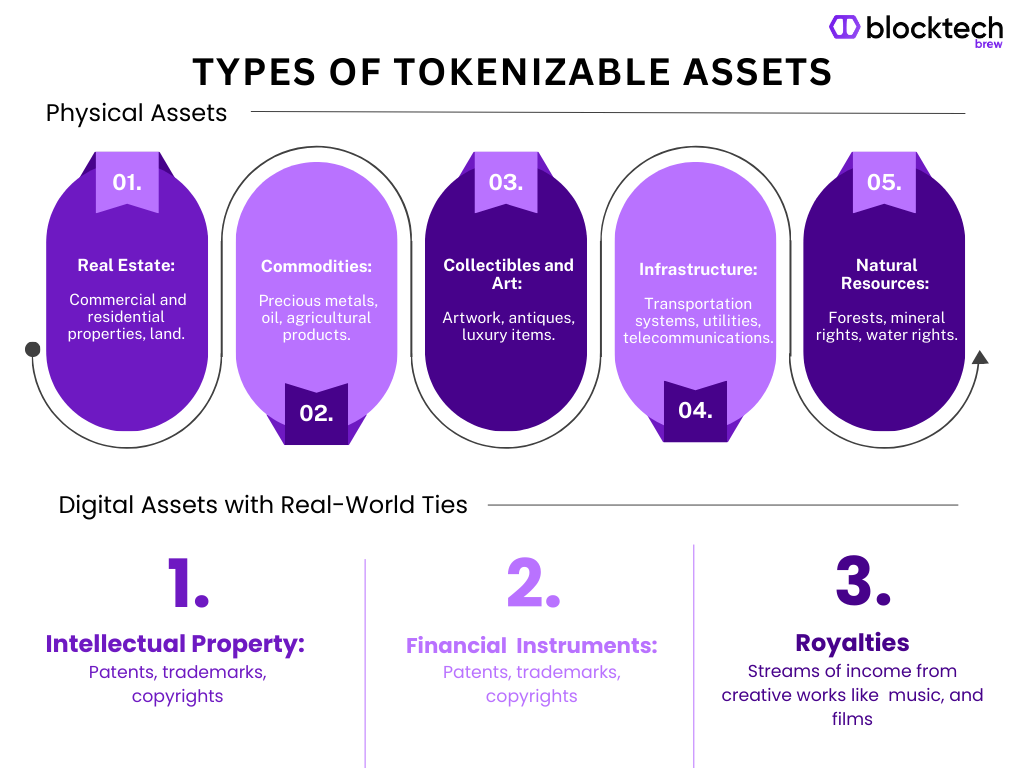
Types of Tokenizable Assets

Physical Assets

  • Real Estate: Commercial and residential properties, land.
  • Commodities: Precious metals, oil, agricultural products.
  • Collectibles and Art: Artwork, antiques, luxury items.
  • Infrastructure: Transportation systems, utilities, telecommunications.
  • Natural Resources: Forests, mineral rights, water rights.

Digital Assets with Real-World Ties

  • Intellectual Property: Patents, trademarks, copyrights, which are digital rights with real-world applications and value.
  • Financial Instruments: Stocks, bonds, and derivatives that exist in digital form but represent ownership or debt in real-world companies and projects.
  • Royalties: Streams of income from creative works like books, music, and films, which, while digital, are tied to real-world revenues.

How Big Is The Real-World Asset Tokenization Market?

According to Boston Consulting Group, the asset tokenization market is estimated to grow to a staggering $16 trillion by 2030. 

The fun fact here is that only 0.3% of the total market size is currently captured. Hence, it is an early state with low-level market penetration right now, which directly means that this is a diamond opportunity for forward-thinking investors, institutions, and managers to build technologies in asset tokenization fields or start new ventures. This will help you position yourself as the supreme brand in the industry, thus making huge profits. 
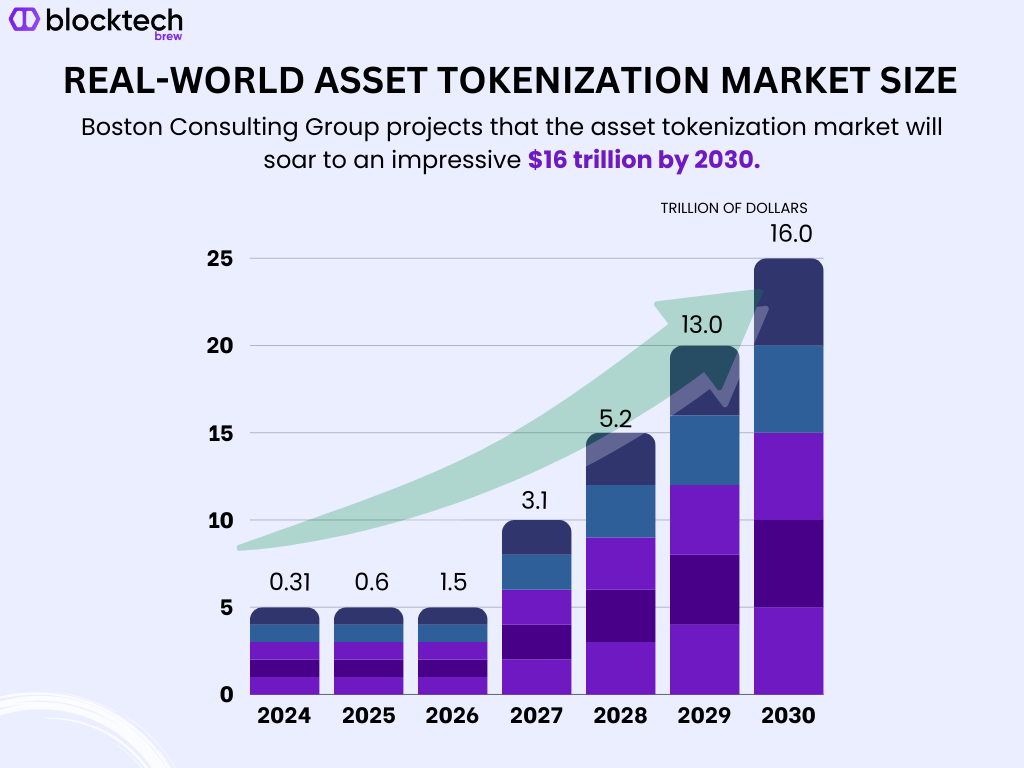
RWA tokenization market size

Reach out to BlockTech Brew to get your cost-effective and top-performing RWA tokenization platform developed. 

Examples of Real World Asset Tokenization in Crypto 

Following are some examples depicting how RWA tokenization works in crypto: 

Real Estate Tokens 

Real estate is one of the widely used and promising cases of tokenization. Tokenizing real estate involves breaking digital ownership into smaller digital tokens or pieces. Real estate transactions usually require large amounts of funds to make any investment. By tokenizing the property, it becomes easy to buy or sell shares in individual properties in small proportions without depending on intermediaries like banks for loans. 

Bonds Tokens 

Tokenizing bonds is a growing trend in asset tokenization. It simplifies the bond issuance process and automates tasks like interest payments and maturity settlements. This reduces intermediaries and transaction costs, making bond markets more efficient and accessible.

Carbon Credits Tokens 

Carbon credits allow businesses to emit some carbon dioxide or other greenhouse gases. They put a limit on such emissions to reduce air pollution. When a company emits less gas in proportion to carbon credits, it trades it to the company, which is expected to emit more such gases. Tokenizing carbon credits can make the market more transparent and efficient. It allows smaller companies to buy and sell fractional credits easily. This approach could increase participation in the green economy and create new opportunities.

Process of Real-World Asset Tokenization


The process of RWA tokenization involves the following steps: 

Step 1: Asset Identification & Regulatory Setup.

Step 2: Digital Token Creation.

Step 3: Smart Contract Deployment

Step 4: Token Distribution and Sale.

Step 5: Asset Management and Governance.

Step 6: Secondary Market Trading

Process of RWA tokenization

Below are the detailed explanations determining how tokenization works: 

Asset Identification & Regulatory Setup

Asset Identification & Regulatory Setup involves selecting a real-world asset to tokenize, such as real estate or commodities, and evaluating its suitability for digital representation. The regulatory setup ensures compliance with legal requirements, including property rights and financial regulations. This step establishes the legal framework needed to support the tokenization process and safeguard both the asset and its digital representation.

Create The Digital Token 

Creating digital tokens that represent the fractions of real-world assets is the first tokenization process. For this, one can set up a legal entity to own the property, with tokens representing its shares. Token holders are entitled to a portion of the property’s value and benefits, like rental income or appreciation. 

Smart Contract Implementation  

As the second step, a smart contract is implemented to tokenize the asset. Smart contracts are online digital contracts or programs that automate the transactions for blockchain operations. For instance, in real estate, smart contracts will be automated, carrying all the buy, sell, and trading operations like issuance, balance tracking, distribution of rental incomes, payouts, and payments associated with the maintenance of the property.   

Token Distribution & Sale  

Once the digital tokens are created and smart contracts are deployed, tokens are sold to investors. Different types of sales, like public sales, which are open to everybody, private sales for existing investors, or whitelist sales that combine these two are organized to attract investors. Thus, this third step allows more people to invest in the asset, creating a larger and more liquid market. 

Asset Management & Governance 

With each token the investor holds comes the authority to manage the asset, participate in related operations, and make decisions. For example, in real estate, token holders can take part in rental operations, property maintenance, renovations, tenant relations, and so on. The level of control given to token holders and the voting process must be detailed in the legal entity’s charter and programmed into the smart contracts. This ensures token holders know their rights and how to participate in decision-making. 

Secondary Market Trading  

After the initial launch, tokens representing shares in the real estate property can be traded on secondary markets. This is where the liquidity benefits become evident. Unlike traditional real estate, which can be difficult to sell, token holders have the flexibility to sell their shares at any time. This creates a more dynamic and accessible market, allowing token holders to find potential buyers more easily and explore different price points. This increased liquidity can make real estate investments more attractive and manageable.

What are the benefits of real-world asset tokenization?

The following are the benefits of real-world asset tokenization:

Increased Liquidity 

Tokenization has been seen to improve the liquidity of illiquid assets. With tokenization, an asset is broken down (digitally) into millions or billions of tokens, forming small fractions that are bought, sold, and traded easily. All these transactions are carried out using automated smart contracts, eliminating the need and costs for intermediaries like banks and third parties, thereby making the assets more liquid. 

Enhanced Accessibility 

In the real-world scenario, meeting the high financial demands of personal and commercial properties in the preferred geographical area is challenging. Tokenization works digitally and hence eliminates these geographical boundaries as well as financial constraints for people. When any property, especially commercial ones, gets tokenized and ownership is distributed, any person from any part of the world can invest in it and start new earning streams. 

Improved Transparency 

All the data on asset transactions gets stored on the blockchain ledger, immutably in a decentralized manner. This enhances the transparency, reliability, and availability of such data without compromising its security.

Greater Composability 

Composability in asset tokenization connects real-world assets to the decentralized finance (DeFi) ecosystem. This allows users to earn interest from tokenized assets, boosting DeFi liquidity and giving retail investors access to new investment opportunities. Asset tokenization will provide smart contract developers numerous opportunities to create synthetic assets, indexes, and token baskets by combining various tokens. Additionally, turning real-world revenue streams into collateral will further innovate the DeFi space.

Top Companies Dealing in Real-World Asset Tokenization: 

Now that we have understood the concept of exponential growth let us see some examples  of RWA tokenization:

Ondo Finance (ONDO) 

Ondo Finance is a leader in Real World Asset (RWA) tokenization, connecting traditional finance with decentralized finance (DeFi). It tokenizes real-world assets, making them accessible and liquid on blockchains. Key products include OUSG, the first tokenized US Treasuries product, and Flux Finance, a lending protocol using tokenized Treasuries as collateral in DeFi. The ONDO token is used for governance within the Ondo DAO, allowing holders to vote on the protocol’s future direction and development.

Mantra (OM) 

Mantra is a Layer 1 blockchain platform that tokenizes real-world assets (RWAs). After raising $11 million led by Shorooq Partners, a major investor in the MENA region, Mantra is set to advance RWA tokenization. The funding will help Mantra build regulatory-compliant infrastructure, provide tools for developers to create RWA protocols, and expand asset tokenization. Mantra aims to make investments more accessible, especially in the Middle East and Asia, by increasing market liquidity and promoting economic growth.

Polymesh (POLYX)

Polymesh is a specialized public permissioned blockchain designed to improve the security token industry. It focuses on tokenizing securities, adding real-world value to the market. Polymesh addresses key challenges like governance, identity, compliance, confidentiality, and settlement. This institutional-grade blockchain simplifies and secures the process of bringing real-world assets to the blockchain, promoting a more efficient and transparent market. It combines the reliability of private networks with the openness of public chains, creating a trustworthy ecosystem for all participants.

OriginTrail (TRAC) 

OriginTrail enhances trust and transparency in supply chains using its Decentralized Knowledge Graph (DKG). This technology combines blockchain and knowledge graph methods to create AI-ready Knowledge Assets. It ensures secure and verifiable data exchange across sectors like supply chains, healthcare, construction, and the metaverse. OriginTrail aims to improve data ownership, discoverability, and trust, combating misinformation. By organizing trusted AI-ready Knowledge Assets it supports a sustainable global economy and plays a key role in real-world asset tokenization.

Pendle (PENDLE)

Pendle is a decentralized protocol that changes how yield-bearing assets are managed in DeFi. It allows users to tokenize these assets into Principal Tokens (PT) and Yield Tokens (YT), enabling advanced yield management. Users can trade future yields and principal separately on Pendle’s Automated Market Maker (AMM). This offers new investment opportunities and flexibility in handling yield-bearing assets. By tokenizing the yield component, Pendle lets investors speculate on yield changes and optimize their yield strategies over time.

What are the challenges of RWA tokenization?

Though tokenization brings a lot of benefits for traders and investors, it is still important for the public to evaluate the challenges it brings. Here are the potential challenges stated: 

Regulatory Fluctuations 

In many countries, there are no strict regulations for blockchain and cryptocurrencies to be followed. Thus, building stable platforms for issuers and investors with secure cross-border transactions is a challenge. As blockchain is being adopted widely and is expecting tremendous growth in its market size, we can expect some stability in blockchain-related laws and regulations as well. 

Market Adoption & Liquidity 

Tokenized assets promise greater liquidity, but this relies on widespread adoption. If investors don’t trust tokenized assets or blockchain technology, or if the supporting infrastructure is lacking, building a robust market can be difficult. Establishing trust and developing the necessary systems are crucial for achieving the liquidity benefits that tokenization aims to offer.

Security Breaches 

Most of the crypto projects today have security threats, like decentralized finance protocols being hacked and many kinds of data breaches. Financial institutions can reduce these risks by using private blockchains, but this might limit the openness and decentralization benefits of tokenization.

Education Gap 

Blockchain and cryptocurrencies are taking over the world, but many investors and traders still do not know the depths of this field. Thus, to overcome this gap, it is necessary for people to educate themselves about blockchain, its working, benefits, and risks. 

Operational Complexity 

Many crypto platforms have complex user interfaces, which makes it harder for commoners to enter the blockchain world. Hence, if you work with a top blockchain company like BlockTech Brew, you can develop fascinating, user-friendly interfaces, which will eventually help you attract a lot of investors. 

To overcome all these challenges in your RWA solutions, you must collaborate with a company that has the right kind of knowledge and expertise to provide you with secure, user-friendly, and scalable solutions to grow your blockchain venture! 

If you are looking to launch your top-notch real-world asset tokenization app, then don’t miss your free consultation with the world’s best blockchain development company, BlockTech Brew. 

Here, you not only get delivered with high-end solutions, but our marketing team also helps you with 360-degree points of view to help you earn high returns from your business.  

Reach out to us via email: business@blocktechbrew.com to know more.

Categories
DEFI

Defi Llama: Gateway To Explore The DeFi Landscape

What is Defi Llama? 

DefiLlama is a DeFi data analytics platform that includes TVL (Total Value Locked) and APY (Annual Percentage Yield) data across all levels (L1 & L2) blockchains. In simple words, DefiLlama is a blockchain data aggregator platform that breaks down the crypto data from different crypto projects, including decentralized exchanges (DEXs), lending platforms, and liquid staking protocols into graphs, charts, and tables to simplify their understanding for developers, investors, and general users. As an open-source, public platform, it commits to transparent data collection methods.

DeFi Llama aims to make the world of decentralized finance open and transparent. It provides easy access to all the crucial information of the DeFi market to people. 

To understand it better, let us elaborate the terms TVL and APY: 

What is Total Value Locked (TVL)? 

Total value locked refers to the total assets or cryptocurrencies locked in a DeFi project and is expressed in USD, ETH, or project token. The higher the TVL, the more money is being deposited into DeFi protocols, which is generally seen as a sign of a healthy DeFi ecosystem.

What is Annual Percentage Yield (APY)? 

Annual Percentage Yield refers to the annual return on any crypto investment. DeFi platforms showcase potential returns on their cryptocurrency deposits. This metric helps users compare the profitability of different DeFi protocols. 

Key Features of DeFi Llama 

The following are the key features of DeFi Lllama: 

Comprehensive Data 

DeFi Llama gathers data on various DeFi projects and provides users with all types of information, including trading volumes, token prices, liquidity pools, and the stablecoin market in an organized manner. 

User-Friendly Interface 

DeFi Llama offers a simplified, smooth, and user–friendly interface that is feasible for newcomers and experienced DeFi users. Users can scroll through the interface, compare the performance of different crypto projects, and get insights to make intelligent decisions. 

Historical Data 

DeFi Llama not only shows the current data but also stores all the historical data of the included DeFi projects. Users can use this historical data to study the trends, get insights on the patterns, and thus make data-backed decisions. 

Multichain Tracking 

DeFi Llama tracks the DeFi activity across numerous blockchain networks despite their popularity. Thus, it provides a comprehensive overview of the project performance and compares its metrics on different blockchain networks. 

Community Engagement 

DeFi Llama maintains an engaging environment among users via social media feeds, discussion forums, and governance data. Using these, people actively engage in the DeFi Llama and get updates on different activities. 

Comparative Analysis

DeFi Llama allows users to compare trends of different projects based on various factors like fees, TVL, revenue, and active users across different blockchains in the form of charts and graphs for their easy interpretation. 

Accurate & Real 

When it comes to a leading DeFi data analytics provider platform, DeFi Llama stands at first. It not only shows the most up-to-date and accurate information but even maintains transparency with the users by citing all the sources of information.

Use Cases of DeFi Llama 

Following are the use cases of DeFi Llama:  

For Investors & Traders 

DeFi Llama shows a 360-degree overview of the Total Volume Locked (TVL) of various DeFi projects and provides insights into the ongoing trends. This assists traders and investors in identifying investment opportunities with potential growth and assist. 

For New Comers  

With a user-friendly dashboard and engaging environment, DeFi Llama provides the ultimate platform for new entrants in the DeFi world. It acts as a guide and allows new users to understand prominent DeFi projects and their market dynamics better. 

For Analysts & Journalists 

DeFi Llama’s charts, graphs, detailed reports, articles, and insights would be fruitful for analysts and journalists requiring accurate and latest information. DeFi Llama maintains transparency by referring to all the sources of the information, which makes the data and information credible and thus gains the people’s trust. 

For DeFi Project Teams 

DeFi project teams can use DeFi Llama to track the performance, growth, popularity, and areas of improvement in their crypto project. They can understand its highs and lows and compare it with other DeFi projects. The team can then analyze the gathered analytics to build intelligent future strategies, development goals, etc. 

Some New Additions in DeFi Llama 

Thus, sites like DeFi Llama show fact and data-based information instead of biased insights of a single project. As the anticipation of public increases for crypto and decentralized finance, such platforms have the potential to be the go-to place for investors, traders, and businesses. 

Apart from DeFi Llama, CoinMarketCap, CoinGecko, DappRader, DeFi Pulse, and EtherScan.io are some other DeFi analytics platforms that the public can use to gain insights into the decentralized finance market trends and more. 

If you are looking to build cutting-edge blockchain, metaverse, and AI solutions to grow your business, then contact Blocktech Brew for a free consultation! 

Categories
DEFI

Bitcoin Ordinals NFT Marketplace: A New Era Of Digital Collectibles

After Ethereum NFTs stand out as the supreme in the realm of digital assets, Bitcoin NFTs or ordinals are coming up as the trending way to purchase NFTs on the blockchain network. Introduced in January 2023, Bitcoin NFTs have created the buzz in this short period of time. So, in this blog, we will discover all about Bitcoin Ordinals, what they are, how they work, and how launching an Ordinals marketplace can benefit your business.

What are Bitcoin Ordinals?

Bitcoin ordinals are the non-fungible tokens (NFTs) created and managed on the Bitcoin blockchain network by attaching metadata like art, music, images, and videos to individual satoshis (smallest units of Bitcoin). Unlike other NFTs, ordinal NFTs do not have a separate layer on the blockchain. Instead, they work on the logical ordering system called ordinal theory. In this, each satoshi is given a unique number, and hence, bitcoin ordinals do not check the Bitcoin protocols and function smoothly without the addition of any extra layers. 

How do they work? 

To have a comprehensive understanding of how Bitcoin Ordinals work, let us first go through the key terms: 

Ordinals 

Ordinals are the numbering scheme to number each individual satoshi. They are necessary in order to identify and track each satoshi and its associated data uniquely. A “satoshi,” often abbreviated as “sat,” equals the one hundred millionth of a single Bitcoin, thus representing the smallest unit of Bitcoin.

Inscriptions 

All the data, including images, text, art, or digital artifacts, which are put into satoshis are called inscriptions. This is done by encoding the data into the witness portion of the Bitcoin transaction, thus “inscribing” it onto the Bitcoin blockchain and marking a permanent history. 

These ordinals and inscriptions come together for the creation of NFTs on the Bitcoin blockchain, and each satoshi can be treated as a unique digital collectible, similar to NFTs on other blockchains like Ethereum.

Bitcoin Ordinals NFT Marketplace 

A Bitcoin ordinal NFT marketplace allows the creators (who create a piece of art) and collectors (who buy or trade that piece of art as NFTs) to surf, buy, and sell different inscriptions (NFTs) on the Bitcoin blockchain network. Ordinals marketplace offers its unique collection of non-fungible tokens and has specific wallet compatibility. 

As the spark of Bitcoin NFTs rises, it has gained the attention of artists, investors, and collectors to engage in the NFT marketplace. Moreover, the unique numbers given to the individual satoshi have brought a turn in the functioning of conventional NFT marketplaces and ensured that each asset in Bitcoin’s NFT marketplace would be irreplaceable, unique, and easy to track and transact. 

How does Bitcoin Ordinals NFT Marketplace work? 

Bitcoin Improvement Proposal (BIP) 174 introduced a Partially Signed Bitcoin Transaction (PSBT) solution to do transactions across Bitcoin ordinal marketplaces. This solution tends to smoothen and fasten the multi-party transactions, those transactions that require authentication from more than 1 signatory or party before they get put into the Bitcoin NFT marketplace. 

Below is the flow in which Bitcoin Ordinals NFT Marketplace functions: 

Initiate Transaction 

To initiate the transaction, a group member creates a PSBT file which includes majorly two sorts of information, inputs and outputs. Inputs refer to the UTXOs (Unspent Transaction Outputs) that are being spent. UTXOs are the pieces of Bitcoin that would be used in the transaction. Outputs mostly contain the receiver’s address and the amount they’d receive. However, at this stage, the transaction is incomplete as the necessary signatures to authorize and validate the transactions haven’t been done. 

Authentication Transaction

To authenticate the transaction, the user created PSBT file is sent to all the members of the group where they sign the transaction after reviewing its details. Signatures of each group member are necessary to validate and proceed with the transaction for the next step. 

Finalize Transaction 

Once all the signees validate the transaction, it finally moves forward to the next step, where the complete PSBT file is converted into fully signed transactions, which is in a format that can be processed by the Bitcoin network and it can read all the relevant details.  

Broadcast Transaction 

In the final step, the fully signed transaction is broadcasted into the blockchain network. It is sent to various nodes across the Bitcoin blockchain for inclusion, and it finally gets recorded on the Bitcoin blockchain. 

Benefits of launching Bitcoin Ordinals NFT Marketplace for businesses

Bitcoin Ordinals is a new player in the trending world of NFTs that has truly taken over the NFT trading talks unbelievably. This high time can greatly benefit businesses looking to launch their own Bitcoin Ordinals NFT marketplace. 

Here are some potential benefits of launching a Bitcoin Ordinals NFT Marketplace for businesses:

First-Mover Advantage 

Bitcoin Oridnals marketplace is relatively new as Ethereum NFT marketplaces are already set and growing. Therefore, adopting this new, trending, and top-notch opportunity for any business that wants to build its base in the field of NFT marketplace would definitely provide an edge over this industry. This first-mover advantage would allow businesses to establish their own brand and become a go-to-destination for creators, investors, collectors, and traders. 

Attracting Creators & Brands 

With the first-mover advantage, where the competition to attract the attention of target participants would be less, the opportunity to attract different creators and brands to create, buy, sell, and trade NFTs would be sky-high, and allow both the participants and the business to flourish and grow their digital assets. 

Transaction Fees &  Revenue Generation 

By facilitating the buying and selling of ordinal NFTs between creators and collectors, revenue is generated through transaction fees, listing fees, or other monetization models. As the ecosystem grows, revenue generation for the business will also increase. 

Integration & Partnerships 

By establishing a prominent presence in the Ordinals NFT space, businesses can explore potential integrations and partnerships with other companies, projects, or protocols within the broader crypto and blockchain ecosystem. This can lead to collaborative opportunities, cross-promotion, and the development of new products or services.

Growth Through Data & Insights 

By analyzing the generated data through the Bitcoin Ordinals NFT marketplace, businesses can have insights into the market trends, user behaviors, and popular ordinals categories and collections, which they can utilize to further grow their business by identifying new opportunities within the Ordinal marketplace. 

To launch an Ordinals NFT marketplace, careful planning, execution, and deep understanding of the market is necessary, for which you can collaborate with an expert blockchain development company which would help you establish a strong position in this emerging digital economy. 

Ready to Develop your Bitcoin Ordinals NFT marketplace? Contact BlockTech Brew today to get started and stay ahead in the digital asset revolution!

Categories
DEFI

DeFi Insurance Explained: Shield Your Crypto Investments

Decentralized Finance is coming up as the future of finance. However, the higher the DeFi industry grows, the higher it will be associated with risks. Therefore, adopting safety means to protect your digital assets is crucial to prevent any losses. 

In this blog, we will discover about DeFi Insurance, the ultimate solution to scams and frauds in the crypto world and discover how it enhances the investor’s trust and security. 

What is DeFi? 

Decentralized finance is the digital finance which operates on the blockchain network. Unlike traditional finance systems, which had a middleman (banks) to do transactions, decentralized finance allows people to deal with their finances directly, which in turn reduces the extra fees. 

However, as the field of DeFi is constantly evolving, it is raising concerns regarding the management of associated risks with cryptocurrencies; let us understand these risks first: 

Risks associated with DeFi

Price Fluctuations 

Crypto assets undergo extreme price swings in short periods of time. Their prices are affected by various factors like market sentiments, regulatory news, technological advancements, and trends. 

Scams & Fraudulent Schemes 

Scams and fraudulent practices are very common in the crypto world. Promising high returns with little risks is how fraudsters attract a high number of investors. 

Security Risks 

The DeFi ecosystem is vulnerable to cyber-attacks and data breaches. Also, there might be flaws in the code of smart contracts that also cause security risks and operational disruptions. 

Thus, to control all these risks, certain protection and security are required to retain people’s trust in DeFi and let them invest their money trustfully and safely. 

What is DeFi Insurance?

DeFi insurance is the solution that safeguards the investor’s money in different types of crypto assets. Similar to traditional insurance, investors pay a certain amount of fees periodically (monthly, annually), and they get protection for their investments for various types of risk coverages; DeFi insurance has brought this kind of security to the digital finance world. 

How DeFi Insurance Works? 

DeFi insurance works by collecting pool funds from investors through smart contracts to cover the losses. Investors pay premiums to safeguard their investments and cover their potential risks, which are used by the insurance platform to create a money pool. Whenever any investor suffers a loss of money in a way that the loss is covered in the insurance, they will get paid for their losses using the pool funds. 

In DeFi insurance, a third party is replaced with a cooperative (co-op) model, and any person who is paying the premium has a say in all the claims and operations of the insurance company. To get insurance coverage, any person must purchase a part of the co-op, a stake in the protocol. People paying this premium can actively take part in the decision-making, and they will vote for different cases depicting their opinion on whether the claim should be given for a certain situation or not. However, if the board keeps on denying legitimate claims, people will eventually lose trust, and this will definitely backfire on members of the co-op. 

Types of Defi Insurance 

DeFi insurance does not work in a “one shoe fits all” manner. It ensures that each insurance coverage is tailored to the loss and its impact. Below given are the three categories that cover falls into: 

Protocol Cover: 

It covers the losses that arose from the fault in DeFi’s protocol, like exploitation of smart contracts, data breaches, economic design failure, and governance failure (when evil-intentioned players gain the power to modify contract rules, leading to network failure). 

Stablecoin Depeg Cover:

Stablecoins are supposed to have a stable value against a real-world asset. However, stablecoin depeg cover takes care of the situation when the stablecoin loses its value or its peg against its intended asset. 

Yield Token Cover 

Yield tokens are the tokens that gain interest over time. The interest they are supposed to gain is called their face value. However, sometimes, the price at which they are sold (market value) is a significant drop compared to their face value, and yield token cover protects the investors against this type of loss. 

DeFi insurance is not considered the standard protection policy in finance, which is why it is called out with different names like “cover,” insurance alternatives, or DeFi fund protection. 

Pay Out Systems For Coverage in DeFi Insurance

There are two models which cover the asset losses; let us discuss them in detail: 

Discretionary Insurance Model 

The Discretionary Insurance Model is the non-contractual model in which the claim would be given purely on the basis of the judgment of the provider. This type of model does not guarantee the reimbursement of the claim, even if it falls in the valid category. Moreover, the process of reimbursement is long and complex as a detailed evaluation is done to validate the policy’s scope. 

Parametric Insurance Model 

The parametric insurance model has clear and binary terms (parameters) that are used to trigger payouts. In this type of model, the pre-defined circumstances or events that happened are considered rather than the loss; for example, in the case of an earthquake, the earthquake’s magnitude will be considered rather than the damage it did, which makes the reimbursement process quite quick and simple. The parametric insurance model is beneficial for certain risks in the blockchain space.  

Use Cases of DeFi Insurance 

Now that we have understood the basics of DeFi insurance let us move forward to its use cases. 

Smart Contract Coverage 

For the last eight years, Ethereum smart contracts have been targetted by hackers, due to which investors have lost significant amounts of money. To handle this situation, Ethereum introduced its defense mechanism, Smart Contract Cover, which provides protection to investors against any unintended code use that results in financial loss. Thus, by guaranteeing safety, Ethereum has successfully gained the investor’s and developer’s trust, as the blockchain now has an added layer of security for both parties. 

Collateral Protection Insurance 

This type of insurance provides protection against collateralized crypto loans through an insurance contract. It provides both the lender and the borrower with security in case the collateral against which the loan is sanctioned gets stolen or lost; hence, collateral protection insurance is a great deal for cryptocurrency lending networks, and it benefits in boosting stakeholder’s trust for lending or borrowing in crypto space.  

Crypto Insurance 

It is no surprise that the crypto market is vulnerable to fraud and scams, and many such incidents happen every day. Therefore, crypto insurance is the solution that provides a wholesome security to the whole scenario. With the help of crypto-insurance, the investor can get reimbursement for any type of loss like loss due to exchange hacks, custodian failure, price volatility, and so on.  

Crypto Wallet Protection 

Crypto wallet theft due to security breaches is another challenge that the crypto market experiences. Safeguarding your digital assets is as important as saving your real-world assets. Users should keep strong passwords and should not share any privacy keys. Also, insurance may cover different hacks, depending on the insurance provider’s policies. 


Benefits of DeFi Insurance 

Now let us brief about the benefits of DeFi insurance into three main points: 

Evaluating Risks

In decentralized insurance systems, all the risks and losses are calculated automatedly which reduces human errors and provides reimbursement to the investor for every penny they lose. This system has the edge over the traditional insurance system where risk assessment is done manually, and thus, helps in saving time for both parties. 

Ensuring Security 

Most people make fraud claims which would result in insurance companies providing extra money to these fake claims and fraudsters. Therefore, with the help of decentralized insurance systems, the data and transactions would be kept transparent and automated, which would reduce the chances of fraudulent activities and external manipulation and thus prove beneficial for the claim providers. 

Enhancing Automation 

By using automation for payments, decentralized insurance systems streamline claim procedures and do timely settlements that add the cherry on the cake for people who actively invest in crypto and enhance their trust in the crypto industry, ensuring its wide spread adoption. 

Thus, the crypto industry is growing at a rapid pace, and the only obstacle it has on the way is its vulnerability to frauds and scams, which stop people from freely engaging and investing in crypto-related activities. However, DeFi insurance or crypto insurance is the one wholesome solution that would help the crypto businesses to promote wider adoption of crypto by safeguarding the digital assets of the investors and reimbursing any losses they might face. 

Categories
DEFI

DeFi and the Future of Traditional Banking

Decentralized Finance, or DeFi, has emerged as a disruptive force in the financial industry, challenging traditional banking models and offering new possibilities for the future. As the DeFi ecosystem continues to grow and mature, it raises the question: Can decentralized finance and traditional banking coexist harmoniously, and if so, how might they bridge the gap between their distinct worlds?

The Rise of DeFi

DeFi represents a paradigm shift in financial services, leveraging blockchain technology to create open, permissionless, and transparent systems. The decentralized nature of these platforms eliminates the need for intermediaries, providing users with greater control over their financial assets and transactions. From lending and borrowing to decentralized exchanges and yield farming, DeFi offers a wide array of services that were traditionally exclusive to banks.

Challenges and Opportunities

While DeFi presents exciting opportunities, it also faces challenges that must be addressed for it to seamlessly integrate with traditional banking. First, let’s take a look at the challenges of adopting DeFi.

  • Smart Contract Vulnerabilities

DeFi relies heavily on smart contracts, which are self-executing contracts with the terms of the agreement directly written into code. However, the code is not infallible, and vulnerabilities can lead to exploits. High-profile incidents, such as the notorious DAO hack, highlight the need for robust security measures.

  • Regulatory Uncertainties

The regulatory environment surrounding DeFi is still evolving. Governments and regulatory bodies are grappling with how to classify and regulate these decentralized, global financial systems. Lack of clear regulations can create uncertainty for both developers and users, hindering mainstream adoption.

  • Market Volatility

DeFi tokens and assets are often subject to extreme price volatility. While this volatility can present opportunities for traders, it also poses risks, especially for less experienced users who may not fully understand the market dynamics. Sudden and significant price fluctuations can result in financial losses.

  • Scalability

Many DeFi platforms operate on blockchain networks, and scalability remains a significant challenge. Network congestion and high gas fees can lead to slower transaction processing times and increased costs, limiting the scalability of DeFi applications.

While challenges in the DeFi space are significant, the opportunities are equally compelling. Addressing challenges through technological innovation, regulatory clarity, and industry collaboration can unlock the full potential of decentralized finance, paving the way for a more inclusive and efficient financial ecosystem. Now let’s see what opportunities DeFi brings to the table.

Opportunities for DeFi

  • Financial Inclusion

DeFi has the potential to significantly enhance financial inclusion by providing access to financial services for individuals who are unbanked or underbanked. With just an internet connection, users can participate in lending, borrowing, and other financial activities without relying on traditional banking infrastructure.

  • Global Accessibility

Decentralized finance operates on blockchain networks, making it accessible to anyone with an internet connection. This global accessibility breaks down geographical barriers, enabling users from different parts of the world to engage in financial transactions without the need for intermediaries.

  • Innovative Financial Products

DeFi encourages the creation of innovative financial products and services. Decentralized exchanges, liquidity pools, and yield farming are examples of novel concepts that have emerged. These products can provide users with new ways to manage, grow, and utilize their assets.

  • Efficiency and Automation

Smart contracts enable the automation of financial processes, reducing the need for intermediaries and streamlining operations. This efficiency can result in lower costs for users and faster transaction settlement times. Automated processes also contribute to increased transparency and reduced risk of human error.

  • Collaboration with Traditional Finance

Rather than seeing traditional finance as a competitor, DeFi presents an opportunity for collaboration. Traditional banks can explore partnerships with DeFi projects or integrate blockchain technology into their operations. This collaboration can lead to the development of hybrid financial services that combine the strengths of both systems.

  • Decentralized Governance

Many DeFi platforms utilize decentralized governance models, where users can participate in decision-making processes. This democratization of governance allows users to have a say in the evolution of the platform, fostering a sense of community and shared ownership.

Enhancing Financial Inclusion

One of the key promises of DeFi is its potential to enhance financial inclusion on a global scale. Traditional banking systems often exclude a significant portion of the population due to barriers such as geographical limitations, lack of documentation, and the absence of a banking history. DeFi protocols, operating on blockchain networks, have the potential to reach the unbanked and underbanked, providing them with access to financial services without the need for a traditional bank account.

Collaboration and Competition

Rather than viewing DeFi as a threat, forward-thinking traditional banks are exploring ways to collaborate with or integrate aspects of decentralized finance. This collaboration could take various forms, such as partnerships with DeFi projects, the adoption of blockchain technology, or the issuance of digital assets by traditional financial institutions. By embracing innovation, banks can stay competitive and offer their customers enhanced services.

Regulatory Considerations

Regulatory clarity is crucial for the successful integration of DeFi and traditional banking. As decentralized finance operates in a global, borderless manner, regulatory frameworks need to adapt to this new paradigm. Clear guidelines and collaboration between regulators, banks, and DeFi projects can foster an environment that encourages innovation while ensuring consumer protection and financial stability.

  • Legal Status and Classification

Regulatory bodies face the challenge of determining the legal status and classification of decentralized finance platforms and their associated tokens. Questions arise regarding whether certain tokens should be classified as securities, commodities, or something else entirely. Clarity on these classifications is essential for applying appropriate regulatory frameworks and ensuring compliance.

  • Anti-Money Laundering (AML) and Know Your Customer (KYC) Compliance

DeFi platforms operate in a pseudonymous environment, where users interact with the system using blockchain addresses rather than traditional personal information. This poses challenges for enforcing anti-money laundering (AML) and know your customer (KYC) regulations, which are designed to prevent illegal activities such as money laundering and terrorist financing. Regulators need to strike a balance between privacy and the need for identity verification.

  • Cross-Border Regulatory Coordination

DeFi operates on a global scale, transcending traditional borders. Regulatory bodies in different jurisdictions must coordinate to address the cross-border nature of decentralized finance effectively. Harmonizing regulatory approaches and fostering international cooperation are crucial to creating a consistent regulatory environment and preventing regulatory arbitrage.

These regulatory considerations highlight the complexity of integrating DeFi into the existing legal and regulatory framework. Striking the right balance between fostering innovation and protecting users and the financial system requires collaborative efforts between regulators, industry participants, and the broader community.

The Road Ahead

The future of finance may well be a hybrid ecosystem where traditional banking and DeFi coexist and complement each other. As both sectors continue to evolve, collaboration and innovation will be key drivers in bridging the gap between decentralized finance and traditional banking. The result could be a financial landscape that combines the security and stability of traditional systems with the efficiency and inclusivity of decentralized finance.

Wrapping it up

DeFi is not merely a disruptor; it’s a catalyst for positive change in the financial industry. The future holds the promise of a harmonious relationship between decentralized finance and traditional banking, creating a more inclusive, efficient, and innovative financial ecosystem. As these two worlds converge, the winners will be the users, who stand to benefit from a diverse range of financial services that cater to their evolving needs.

Categories
DEFI

Decentralized Identifiers (DIDs): Everything You Need to Know

It’s understandable that you might have read the term decentralized identifiers (DIDs) very often but aren’t aware of them. Here, we will cover all the aspects associated with DIDs to make it a full-fledged DID guide.

In layman’s terms, decentralized identifiers are identifiers that share complete control with users, i.e., individuals or organizations, over their digital identity.

 Unlike traditional identifiers like a government-issued driver’s license, passport, or other identity, DIDs are not issued and regulated by a central authority.

These DIDs are securely stored on a decentralized network, like a blockchain. DIDs are protected from security breaches and verified without the interference of any central regulations.

History of DIDs

 In 2017, DIDs were first introduced by the World Wide Web Consortium (W3C), providing a decentralized and secured method for identities.

W3C observed the requirement for a new type of identifier that puts control in the hands of individuals and organizations. Since their launch, DIDs have gained attention from several industries and are being developed more effectively using W3C standardization.

DIDs: A solution to privacy and identity theft

The lack of control over identifiers significantly led to maleficent activities where accessing the information could cause financial fraud and identity theft. DIDs preserved in blockchains provide a secure solution to this problem.

With decentralized identifiers, secured encryption, and cryptography that is verifiable, identity theft can be easily prevented. The most advanced nature of Web3 offers a promising solution for identity management as it works thoroughly on decentralization.

What are decentralized identifiers (DIDs)?

Decentralized identifiers are a type of unique identifier that allows entities to be recognized as verifiable, persistent, and without any centralized registry. DID implies a new model of decentralized digital identity that is also known as self-sovereignty identity.

DID uses blockchain cryptographic techniques to identify and verify individuals and entities. Cryptography plays a significant role in the development of DIDs. It provides a secure and verified way to store the information. Inclusively, DIDs offer a unique feature called ‘controller’, where a person or organization gets full control over their identity.

 Here are some key features of DIDs:
  • No third-party involvement: DIDs are thoroughly managed and regulated by users without the intervention of any third party.
  • Regulated by owners: DIDs allow their owners to share their complete control over them.
  • Don’t breach information: DIDs don’t contain any personal information about individuals or organizations to protect privacy.

Decentralized identifiers are one among three pillars of Self-Sovereign Identity that give individuals and organizations complete control over their digital identity. 

What are the major types of decentralized identifiers (DIDs)?

DIDs provide several functionalities and mechanisms, and they are achievable with a variety of decentralized identifiers. Here are some leading DIDs mentioned below:

1: Ledger-Based DIDs

This ledger-based DID falls under the blockchain category, such as Ethereum and Bitcoin networking. Based on this concept, a decentralized system needs to be built rather than a centralized one.

2: Ledger Middleware DIDs

These DIDs are paired with blockchain-distributed ledgers with additional storage mechanisms. This layer of blockchain enables data updates among thousands of DIDs. These DIDs are more efficient, smoother, and cost-effective than others.

3: Peer IDs

Peer DIDs include only a few participants, which leads to a territorial resolution of DIDs. Using the advanced agent protocols, two or more people can easily maintain their DIDs. These provide high security, privacy, and secrecy for digital identities.

4: Static DIDs

These DIDs are limited to the basic functions of creation and resolution. In general, it works on basic keys that help it convert into DID formatting.

What are the core properties of DIDs? 

Under the World Wide Web Consortium (W3C), Decentralized verifiers have four core components. Here are they: 

1: Persistence: DIDs are introduced to be permanent storage of digital identity that is based thoroughly on the blockchain. 

2: Resolvable: DIDs are easy to update by users. They can easily locate the information, details, and identities associated with DIDs.  

3: Verifiable:  DIDs work on cryptographic algorithms that improve the security and authenticity of digital identity. 

4: Decentralised: DIDs operate on a decentralized database and are not regulated by a centralized authority. 

Cryptography: The Backbone of DIDs

 Cryptography is known as the foundation of the DID ecosystem. It ensures the security and privacy on which DID relies. Cryptography includes coding and algorithms to protect the data, messages, and communication channels of intended recipients.

It also ensures the encryption of data, which converts the message into a non-readable format during transmission.

Decryption also takes place when the information is retrieved into human-readable versions. These processes are vital for DIDs that require verifiable credentials using cryptography.

Cryptography has four major standards that work perfectly with DIDs and Web 3.0.

  • Confidentiality 
  • Integrity 
  • Non-repudiation 
  • Authentication

What are the advantages of decentralized identities?

  • Organizations: For organizations, DIDs offer instant verification without any requirement of the organization’s internal management. It cost-effectively provides efficient solutions.
  • Individuals: DIDs offer complete ownership and control over individuals’ digital identities. Here, the owner can also add privacy to their data by having people view it.
  • Developers: For developers, DIDs ease them by eliminating the need for password usage and inefficient authentication. It requests data from users without hampering privacy.

What are the use cases of DIDs?

1: Healthcare: In online health data management, technology integrates DID and verifiable credentials, enabling health providers to secure the patient’s medical data. It allows compliance and privacy regulation securely. 

2: Real Estate: In the real estate business, companies frequently hire workers, and they don’t have enough time to verify each job applicant. Construction and training institutes issue a fraud-proof certificate to their graduates, and they have DIDs for that authentication to avoid future misrepresentation.

3: Education & Learning: DIDs are used by companies to track employees’ skill development. Every employee has a unique DID that is registered with the company, and when they complete their workplace diversity program and other advanced learning, they get verifiable DID credentials.

4: Authenticity Management: If users buy some special edition from globally recognized identifiers they are assured with DIDs that they are buying authentic products. Moreover, if the owner of the product changes, the title can easily be transferred as a verifiable credential. 

5: Issuing IDs: DIDs allow people to carry their digital identities everywhere on their phones. As this is formulated on the Web3 and blockchain, it is highly secure and easily accessible by owners.

How to manage DIDs with Blocktech wallet?

Blocktech’s wallet allows users to secure their identities by efficiently creating, exporting, and importing their DIDs. Having a wallet ensures you have complete control over your DIDs with verifiable credentials. Blocktech DIDs allow multiple keys, ensuring different purposes. Here are some reasons why issuers use DIDs:

1: Employees get verifiable credentials. 

2: Authenticate the genuine credentials from manufacturers. 

3: Provides a secure channel to communicate and engage. 

4: It is easy to remove credentials once the task has been accomplished.

In Conclusion

At present, when all forms of transactions, communication, and businesses are running online, it is difficult to protect the privacy and data relevant to sharing. To avoid such problems in a centralized system, the DIDs concept was introduced. 

This is an emerging solution to address the potential threat of identity theft, forgery, and alteration in databases. The smart implementation of blockchain and Web 3 solutions brings DID as a full-fledged, secured solution for all organizations, individuals, and developers to secure their digital identities.

FAQS

1: What are decentralized identifiers?

Decentralized identifiers (DIDs) are a form of digital identity a person uses to prove their presence online without any association with a centralized government.

2: What are the differences between centralized and decentralized identifiers? 

Centralized Identifiers
  • Identifiers provided by centralized identifiers can be shut down or withdrawn whenever they are owned by the provider.
  • They can also track the online behavior of the user.
  • They are considered less secure connections.
Decentralized Identifiers (DIDs)
  •  DIDs created on decentralized blockchain-based processes are completely owned by the user.
  • DIDs can be generated in n numbers, so tracking is not possible or easy to analyze.
  • It enables unique and secure connections between parties.

3:  What are public v/s private decentralized identifiers?

Public decentralized identifiers are useful for organizations or parties that need to have publicly identifiable digital identities, like government-issued ID cards. Whereas private decentralized identifiers can be easily exchanged between parties, this creates a secure channel for them. It prohibits the accessibility of all unauthorized persons who try to cease the channel.

4: How is self-sovereign identity related to DIDs?

Decentralized identifiers are among the three pillars of self-sovereign identity. It shares complete control with individuals and organizations over their digital identities without relying on any third party.

Categories
DEFI

Everything You Need to Know About the CeDeFi

Currently, the financial system presents two blockchain-based controlled and decentralized systems. To buy, sell, earn, and engage in cryptocurrency asset trading, stakeholders must decide for themselves. But, why pick one over the other when you may have both in one?

What is CeDeFi?

CeDeFi refers to a centralized decentralized finance system that features both financial systems together creating a hybridized approach.

CeDeFi showcases the advanced combined characteristics of both CeFi and DeFi. It promises several distinctive ways to enable crypto-savvy, secure exchanges while allowing high liquidity projects.

In September 2020, the CEO of Binance first introduced the acronym CeDeFi during the launch of Binance Smart Chain. For instance, users prefer smooth accessibility with DeFi and security control similar to what CeFi provides.

Now, CeDeFi allows companies to utilize DeFi products and its services. These include decentralized exchange platforms (DEX), lending protocols, liquidity pools, and others that can help lower transaction costs.

It enables smart contracts ranging services from one platform to another eliminating business risk and speeding up the transaction process. Using CeDeFi, users can easily benefit from liquidity, depth, transaction, network, and withdrawal fees. It allows KYC stipulations to discover the right asset, reduce slippage, and secure transactions. 

CeDefi acts as a middle ground, surpassing restrictions imposed on cryptocurrencies. It allows traders and companies to use regulated security tokens. This platform can easily change the landscape of global payments, making them functional and affordable to use. 

Centralized Decentralised Finance adds growth to crypto impacting the traditional market impacting smooth trading, and high liquidity projects. 

Are you looking for a top DeFi development company to help you create a CeDeFi platform? Click here to get in touch with us. We provide dApp development services that guarantee efficient transaction processes. 

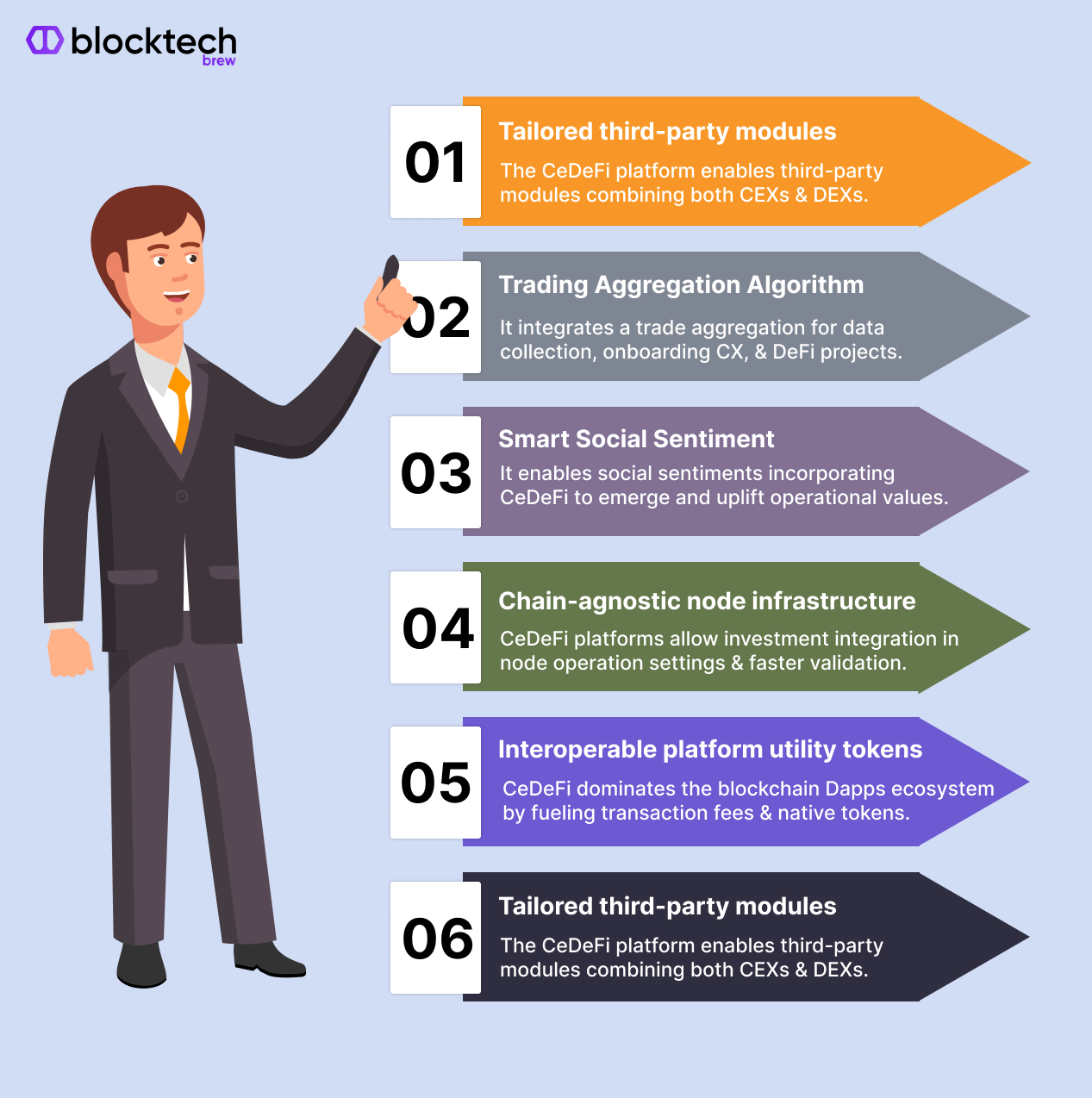
Key Features of CeDeFi Technology

Key Features of CeDeFi Technology

Tailored Third-Party Modules

The order book of centralized exchanges integrates into CeDeFi platforms using third-party modules because of CeDeFi technology. CeDeFi combines both CEXs and DEXs to provide its users with pooled liquidity.

Trading Aggregation Algorithm

This cutting-edge technology, which incorporates a trade aggregation mechanism, will increase the adaptability of CeDeFi platforms.

It guarantees data-collection-intensive trading from original CX, onboarded CEXs, and DeFi projects, as well as bespoke and third-party modules.

The trade aggregation method allows CeDeFi systems to provide efficient transaction execution and settlement.

Smart Social Sentiment

The CeDeFi platform considers the role of sentiments and their impact analysis in the crypto market. Smart social sentiments incorporate CeDeFi tech to emerge and uplift operational value.

To provide CeDeFi users with the greatest value over social sentiments CeDeFi platforms are developing components that enable custom indexes that track the state of general crypto and market segments. 

Chain-agnostic node infrastructure

CeDeFi platforms enable massive investments in node operational infrastructure. Running these nodes enables faster validation of the blockchain. It reduces time while transacting and assists in the chain for faster confirmation. Participating in the direct CeDeFi consensus process helps set competitive staking rewards for its users.

Interoperable platform utility tokens 

CeDeFi projects create a platform for token-supported tokenomics. Based on deflationary factors, it dominates Ethereum’s blockchain in the Dapps ecosystem. It mirrors the Binance smart chain concept, which converts into a BEP-20 token using ERC-20 to BEP-20 bridges.

It fuels innovation with the CeDeFi ecosystem’s transaction fees and platforms’ native tokens. For vetted participation, it enables governance, DAO, staking, and seed funding for early-stage projects.

DAO Governance

CeDeFi offers core decentralization components with decentralized governance. This platform pioneers new organizations structuring commercial entities and quasi-anonymous DAO work. It helps determine, influence, and control the direction of financial institutions.

How Does it Work?

The CeDeFi platform embodies the best aspects of decentralized financial systems. It makes lending, borrowing, exchanging, and using stablecoins simple.

Additionally, it has access to well-functioning, centralized finance. DeFi is significantly less secure than centralized decentralized finance (CDF). It doesn’t rely only on blockchain technology.

By offering an incredibly better user experience, CeDeFi combines the benefits of both DeFi and CeFi.

Benefits of CeDeFi

CeDeFi enables the creation of new tokens using smart contracts, allowing users to rely only on platforms for loans and borrowing and securing derivatives trading.

Higher Accessibility: People who access the Ethereum wallet can efficiently utilize centralized decentralized finance.

More Flexibility: Using centralized and decentralized protocols, CeDeFi can easily allow the development of various derivative products.

Fail-Safe Mechanism: CeDeFi protocols are led by Ethereum technology and are single-point of failure resistant.

Interoperability: CeDeFi has strong connectivity to communicate over several Ethereum-based protocols.

Lower risks of fraud: CeDeFi only offers projects that have been thoroughly reviewed, increasing the likelihood that fraud and other criminal activity get slowed.

Easy Deployments: Dapp allows developers to function over cross-chain functionalities by swiftly integrating application features.

Top CeDeFi Projects To Know More About

Binance Smart Chain

Binance Chain is among the largest crypto exchange platforms and a visionary for CeDeFi. It tackles the problem of blockchain scalability.

Binance enables a Proof of Stake Authority (PoSA) consensus mechanism and offers reliability, safety, and security.

Additionally, it commands strong compatibility with Ethereum Virtual Machines (EVMs) facilities’ performance level in the CeDeFi landscape.  

OpenOcean

OpenOcean is also another CeDeFi project that is gaining popularity among traders. It is the world’s first aggregation protocol, enabling cross-chain swaps and trading liquidity. This platform allows APIs and a customizable trading interface. It aggregates DEXs and CEXs across Ethereum, the Binance smart chain, Solana, HECO, Ontology, and TRON.

Coinzoom

A CeDeFi crypto exchange platform called Coinzoom facilitates simple trading in more than 30 digital assets. It also allows Visa debit cards for crypto spending.

It bridges the gap between traditional finance and the new crypto world through Zoom. Its Ethereum-based token enables users to interact in a decentralized ecosystem.

It supports earning with a lot of DeFi benefits with a hybrid infrastructure that combines both CeFi and DeFi.

FAQs

What is CeDeFi?

CeDeFi is an innovative combination of DeFi and CeFi that can seamlessly integrate the advantages of both types of services. Compared to typical DeFi platforms, it guarantees top-notch DeFi services including loan, liquidity, and yield farming. 

How does CeDeFi work?

CeDeFi is a consolidated network that better integrates the products across networking. It allows easy and faster updates, lower transaction costs, and more liquidity. Its decentralization allows users to access it across countries.

What are the advantages of CeDeFi?

  • Comparable platforms’ transaction costs are significantly higher than those of CeDeFi systems. In contrast to conventional banking systems, it enables strong security that is challenging to infiltrate into the CeDeFi network.
  • Everyone can readily use CeDeFi. Anyone with access to the Ethereum wallet can use CeDeFi protocols with ease. It doesn’t have entry hurdles for less experienced users. 
  • These platforms can adapt to the needs of users.  It is now simpler to utilize greater benefits due to the integration of CeFi and DeFi services.
  • Users can quickly obtain a detailed roadmap of their lending, borrowing, or staking activities. These changes to CeDeFi platforms provide total control and transparency over operations.

What are the examples of CeDeFi protocols?

CeDeFi protocols include MakerDAO, synthetic, and compounds that are capable of sharing De-Fi-like capabilities. These platforms are all built on top of the Ethereum blockchain. 

Categories
DEFI

Decentralized Finance (DeFi): All About DeFi Explained

The term DeFi first appeared in an August 2018 Telegram chat between Ethereum developers & entrepreneurs. They were trying to come up with a term referring to the movement of open financial applications being built on Ethereum.

Meaning of Decentralized Finance

DeFi allows anyone with an internet access to borrow, lend and bank without involving any middlemen. So, you can directly get a loan from your peers. No wonder the P2P platform has been touted as a possible solution to lower the entry barrier for those who struggle to access bank accounts.

One of the best things about DeFi solutions is that anyone can create DeFi apps and anyone can use them. DeFi apps are financial products that run on a public blockchain like Ethereum. These products don’t use third parties. Instead, everything is automated into the protocol through smart contracts.

DeFi is global, not routed through a centralized system, pseudonymous, and open to all.

Want to bet on Bitcoin futures and other derivatives? No need to involve a bookie. Let the protocol handle it. Need to swap one asset for another? Decentralized exchanges help you carry out the transaction without taking a huge cut.

Other Features of DeFi Solutions

You don’t need to “open” an account to get going with DeFi. To use decentralized finance apps, all you have to do is create a wallet. There’s no need for you to display your personal information like name and address. 

Second, you do not need to wait for the bank transfer to clear the funds. You can move your assets anywhere at any time, without asking for permission. Further, there are no expensive fees. 

Third, DeFi apps work along with each other like Money Legos. This composability allows anyone to make, change, mix and match, link, or build on top of an existing DeFi product without permission.

Fourth, the rates are much better than those at traditional banks. However, note that the transaction costs vary, based on the blockchain network. Besides, the interest rates and rewards often update rapidly (as quickly as every 15 seconds).

How does DeFi work?

Consider that today, you put your funds in an online savings account and earn a 0.50% interest rate on your money. The bank then lends that money to another customer at 3% interest and pockets the 2.5% profit.

With DeFi, you will lend your savings directly to others. So, that 2.5% profit loss will be cut out and you will earn the full 3% return on your money.

DeFi vs Traditional Financial System

  • With DeFi, building an entirely new financial system from scratch becomes possible. Because of this, many investors are attracted to the sector’s wide open, blank slate potential. This kind of creative capacity is not inherent in the traditional banking system. Also, unlike the decentralized ecosystem, decentralized finance has the potential to help you make a lot of money very soon.
  • Even in terms of technological sophistication, blockchains are superior to the existing banking system; much of it runs on ancient databases and outdated code.
  • On DeFi platforms, people are willing to trade all kinds of crypto assets for almost any other crypto asset, with no central entity’s approval needed. In the traditional financial system, it is not possible for a DAO to create a membership token out of nothing and use it to raise millions of dollars.
  • In our current financial system, the big Wall Street banks have a lot of power over our economy and markets. In decentralized finance, this power lies in the hands of the participants themselves.

How is DeFi different from Bitcoin?

Bitcoin is a decentralized digital currency that operates on its own blockchain and is mostly used to store value. Meanwhile, DeFi is a concept that describes financial services that are built on public blockchains like Bitcoin and Ethereum. These blockchains enable users to earn interest or borrow against their cryptocurrency holdings. 

Looking to Hire DeFi Solutions Developers?


What can you do with DeFi?

Decentralized Borrowing & Lending

It is part of the DeFi ecosystem and is a notch above the traditional credit system in many ways – collateralization of digital assets, instant settlement of transactions, zero credit checks, and potential standardization in future.

These lending services are built on public blockchains & have the assurance of cryptographic verification methods. The other benefits of these lending marketplaces are cheaper borrowing and lending, reduced counterparty risk, and faster availability of loans to more people.

Monetary Banking Services

Issuing stablecoins, insurance, and mortgages – all is possible through decentralized finance apps. Traditionally, many intermediaries are involved in the process of getting a mortgage. As a result, it becomes very expensive and time consuming. Using smart contracts, legal and underwriting fees can be significantly reduced.

With the blockchain industry maturing every day, the focus on the creation of stablecoins is increasing.

What are stablecoins?

Stablecoins attempt to offer price stability by maintaining reserve assets as collateral or through algorithmic formulas that are supposed to control supply.

These are crypto assets that are often pegged to a real-world asset and can be digitally transferred with relative ease. With cryptocurrency prices rapidly fluctuating, decentralized stablecoins can be adopted for everyday use as digital cash that is not issued & monitored by a central authority.

Insurance on the blockchain eliminates the need for intermediaries and evenly distributes risk between several participants. It can result in lower premiums with the benefactors getting the same quality of service.

Decentralized Marketplaces

This segment of DeFi gives maximum room for financial innovation. Some of the most crucial DeFi solutions or apps are decentralized exchanges (or DEXes). These platforms enable the users to trade digital assets without involving a trusted intermediary – the exchange – to hold their funds.

With the help of smart contracts, trades are directly made between user wallets. As compared to centralized exchanges, decentralized exchanges require way less maintenance and have lower trading fees.

Crowdfunding

DeFi helps the users reap the benefits of crowdfunding while keeping them financially secure.

Features of a DeFi Crowdfunding Platform
  • Tax benefits offered to the donors.
  • Withdrawal facility of funds directly to the user’s bank account.
  • The presence of a highly customized fundraising calendar.
  • Several fundraising options are available on the platform and divided based on the category and purpose.
  • Users get real-time notifications round the clock.
  • Free PR and marketing across multiple communication channels are provided for the participants to popularize their fundraising campaign in the market.
  • Minimum usage charges for utilizing the platform.
  • Low operational risks.
  • Easily manageable collaboration tools.
  • Fundraising supported for multiple causes.
  • Acceptance of multiple payment methods.
  • A dedicated smart dashboard keeps a real-time track of the platform activity.
  • 24×7 technical support is provided in several languages.
  • Cryptocurrencies can be traded anonymously and 24/7.
  • Users can indulge in the trade of tokenized versions of investments such as stocks, funds, NFTs, and other financial assets.

What is Total Value Locked in DeFi?

TVL is the overall value of crypto assets deposited in a decentralized finance protocol – or in DeFi protocols generally. It has emerged as a key metric for gauging interest in the specific sector of the crypto industry.

Total Value Locked includes all the coins deposited in all of the functions that DeFi protocols offer, including staking, lending, and liquidity pools. 

Note that it doesn’t reflect the yield that these deposits are expected to earn. It only means the current value of the deposits themselves.

The Mechanism

A project’s TVL doesn’t only change when users make new deposits or withdraw their assets. It is constantly changing in line with the fluctuating dollar value of all those assets in the cryptocurrency market.

Some or even all of a DeFi protocol’s deposits may be denominated in its native token. When its native token appreciates in value, the protocol’s TVL grows in tandem.

Investors can look at TVL when assessing whether a DeFi project’s native token is valued appropriately. The market cap of the token may be high or low relative to the TVL of the project. The more extreme the relationship, the more overvalued or undervalued the token may appear.

DeFi protocols can operate on just one network or spread themselves across many, in which case they have an independent TVL on each of the networks. 

The largest network by DeFi TVL is Ethereum, accounting for almost half of the total volume across the world. 

TVL in Five Different Decentralized Finance Segments on the Ethereum Blockchain as of March 29, 2022

How to generate passive income through DeFi?

There are three primary ways:

Staking

In this process, you lock tokens into a smart contract & in return, earn more of the same token. Such a token is usually the blockchain’s native asset, like ETH in the case of Ethereum.

Blockchains that are secured by Proof of Stake (POS) rely on users locking their assets into smart contracts. These are controlled by the network validators whose duty is to uphold the blockchain’s consensus rules & ensure that no one tries to cheat the system. Violators are penalized by losing a part of their stake.

Validators or stakers are tasked with processing transactions, storing information and adding blocks to the Beacon Chain – the new consensus model of Ethereum. 

As a reward for their active involvement in the network, validators receive interest on their staked coins, denominated in ether. This method of Ethereum staking serves as a passive income opportunity for contributors and helps them secure the next iteration of the Ethereum network, Ethereum 2.0.

Yield Farming

When you provide liquidity in a DeX like Uniswap, you get tokens that denote your pool share. These tokens can then be locked into yield farms; DeFi protocols that reward you with more of the same token or with a different one.

Yield Farming across DeFi is facilitated by smart contracts. So, while your pooled assets are earning a share of all fees in Uniswap, your Liquidity Pool tokens can also be earned. 

Calculating Yield Farming Returns

Expected yield returns are usually annualized. The prospective returns are calculated over the course of a year.

Two often-used measurements are Annual Percentage Rate (APR) and Annual Percentage Yield (APY). APR does not account for compounding — reinvesting gains to generate larger returns — but APY does.

However, the two measurements are merely projections and estimations. Even short-term advantages are difficult to forecast with accuracy. Why? Yield Farming is a highly competitive, fast-paced industry with rapidly changing incentives.

If a Yield Farming strategy succeeds for a while, other farmers will flock to take advantage of it. This will ultimately stop yielding significant returns.

Because APR and APY are outmoded market metrics, DeFi will have to construct its own profit calculations. Weekly or even daily expected returns make more sense due to DeFi’s rapid pace.

Become a Liquidity Provider

Decentralized exchanges like Uniswap and SushiSwap support swaps between token pairs, like ETH & USDT. The liquidity comes from pooled tokens belonging to liquidity providers. These are ordinary DeFi users who place their tokens into the smart contract controlling the pool. 

As you do this, you earn a 0.3% fee from all swaps in proportion to your pool share on Uniswap’s DeX. The more trades done via that pool, the more you earn.

Launch Your Own Crypto Wallet.

Final Note

Last year, the digital assets assigned to DeFi were worth more than $250 billion. This indicates that the time is ripe for banks, FinTechs, and anyone else wanting to get ahead of the curve to leverage the power of DeFi.

DeFi protocols can be used to deploy innovative, differentiated products and services rapidly. In fact, this is why the DeFi space was able to gain so much traction and innovate as fast as it did.

The great thing about decentralized finance is that much of the tech being created is at the infrastructure and middleware level. This is allowing people or organizations to build valuable applications that quickly serve specific use-cases.

For more information about how to invest in DeFi, talk to us. We’re always here at your disposal.

Our Trusted Partners

Meet Our Allies In Building Innovative Solutions Fuelling Growth & Unbeatable Results

Collaboration is key to building innovative solutions that deliver unbeatable results. Our trusted partners and allies share our vision and values, allowing us to work towards common goals. By leveraging each other's strengths and expertise, we can create a powerful force for growth and success.

haken
haken
haken
haken
haken
haken
haken
haken
haken
haken
haken
haken
haken
haken
haken
haken
haken
haken
haken
haken
haken
polygon
haken
haken
haken
haken
haken
bians
Lg-3
Lg-3
Lg-3
bians
Lg-3
Lg-3
bians
Lg-3
Lg-3

Have A Vision?

Share Your Idea Now & Step-Ahead With Innovative Blockchain Solutions.

Let’s Fire Up Your Business!

Team Up With Us Today For An Unforgettable Service Experience

Dubai

Level- 26, Dubai World Trade Centre Tower,
Sheikh Rashid Tower, Sheikh Zayed Rd, Dubai, UAE

business@blocktechbrew.com

+971 55 473 8790

India

Plot no I - 36, Sector 83 Alpha,
Mohali SAS Nagar 140308

business@blocktechbrew.com

+91 771-966-6171

Mexico

Av. Miguel Hidalgo y Costilla 1995, Arcos
Vallarta, 44600 Guadalajara, Mexico

business@blocktechbrew.com

+1 (332) 233-6033

USA

401 Park Avenue South, 10th Floor
New York, NY 10016

business@blocktechbrew.com

+1 (332) 233-6033

UK

2nd floor, College House, 17 King Edwards Rd,
London HA4 7AE, UK

business@blocktechbrew.com

+44 (20) 82644493