






































Categories
Artificial Intelligence Blockchain Blog

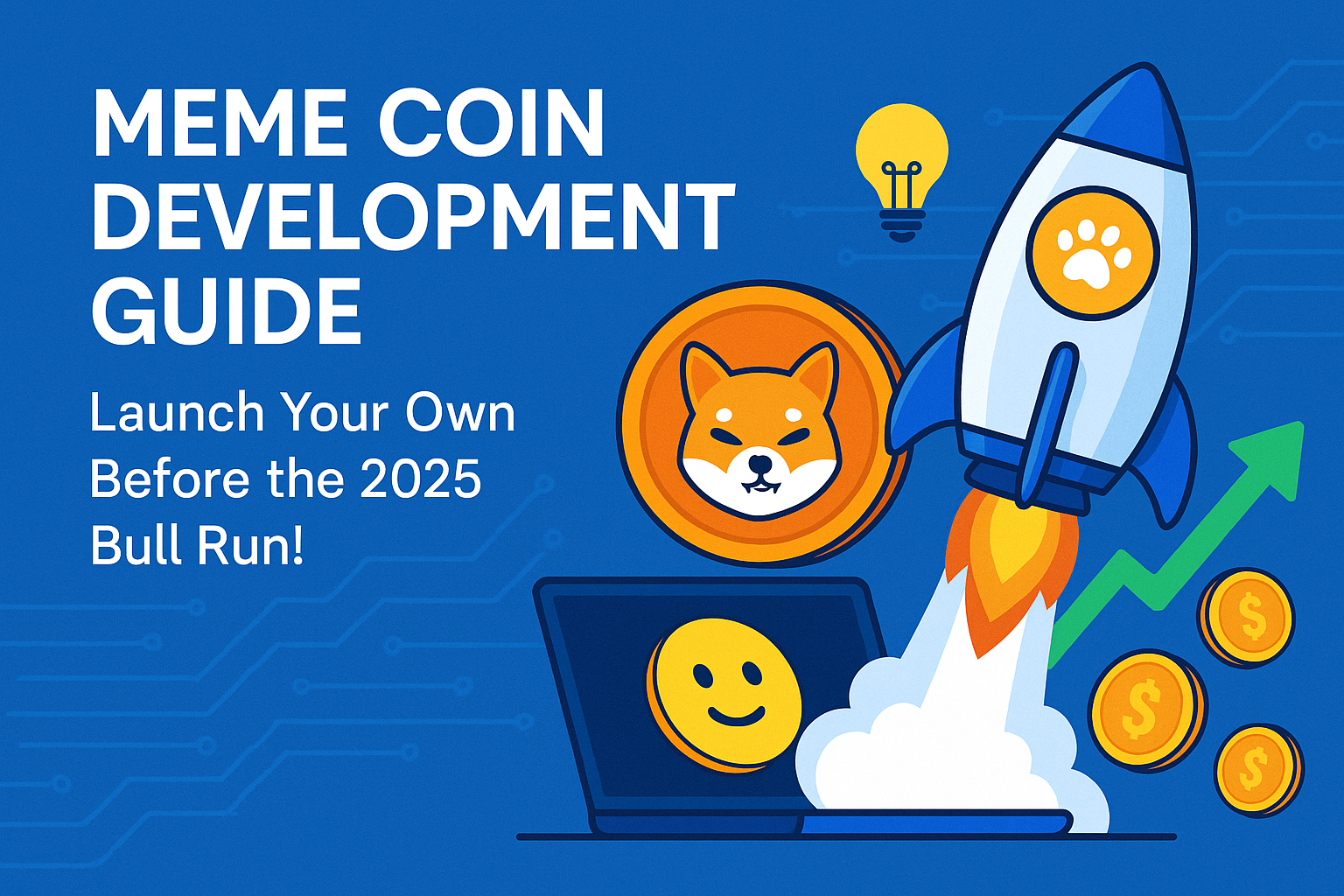
Meme Coin Development Guide: Launch Your Own Before the 2025 Bull Run!

The meme coin development market is gaining massive momentum as the 2025 bull run approaches, unlocking a multi-million-dollar opportunity for entrepreneurs and crypto innovators. Once dismissed as internet fads, meme coins have matured into a powerful segment of the crypto industry, combining viral culture with strong community backing and even real-world utility.

From North America to the Middle East and Asia Pacific, adoption rates are climbing at record speed, creating a global appetite for unique, community-driven tokens. For startups, investors, and blockchain developers, this makes meme coin development one of the most promising ventures of 2025.

In this guide, we’ll explore the complete roadmap to meme coin development—covering ideation, tokenomics, smart contract creation, and community-building strategies—so you can launch your project at the right time and maximize its potential before the bull market takes off.
The Cultural Phenomenon: Why Meme Coins Are More Than a Trend

In the fast-paced, ever-evolving crypto landscape, meme coins have captured the imagination of millions, not just in North America and Europe, but globally. Their success isn’t solely based on a cute mascot or a funny name; it’s a testament to the power of community, virality, and collective enthusiasm. 

These tokens, like Dogecoin and Shiba Inu, have built passionate followings, proving that the crypto market is driven by more than just cutting-edge technology it’s driven by culture.

The 2025 market is predicted to be a $70+ million industry, with some top-performing meme coins generating an average ROI of 150%, significantly outperforming many traditional investments. 

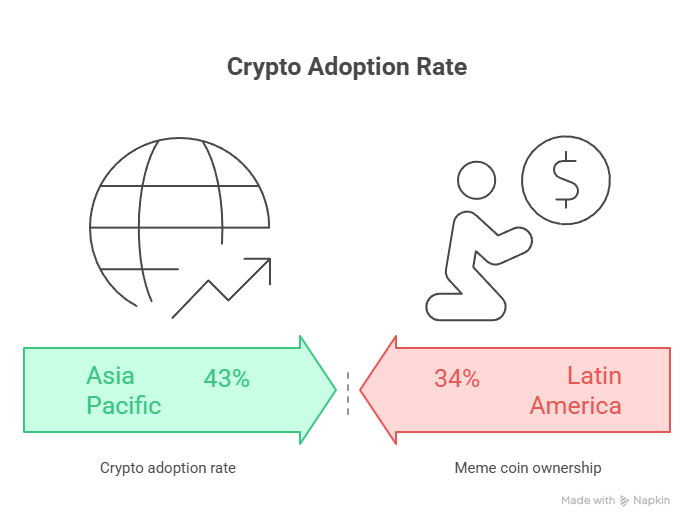
This growth is fueled by a global surge in crypto adoption, with key regions showing strong interest. Asia Pacific leads with a 43% crypto adoption rate, while Latin America has a remarkable 34% meme coin ownership. 

Understanding these geographic trends and the cultural nuances of these markets provides a crucial competitive advantage for any aspiring entrepreneur.
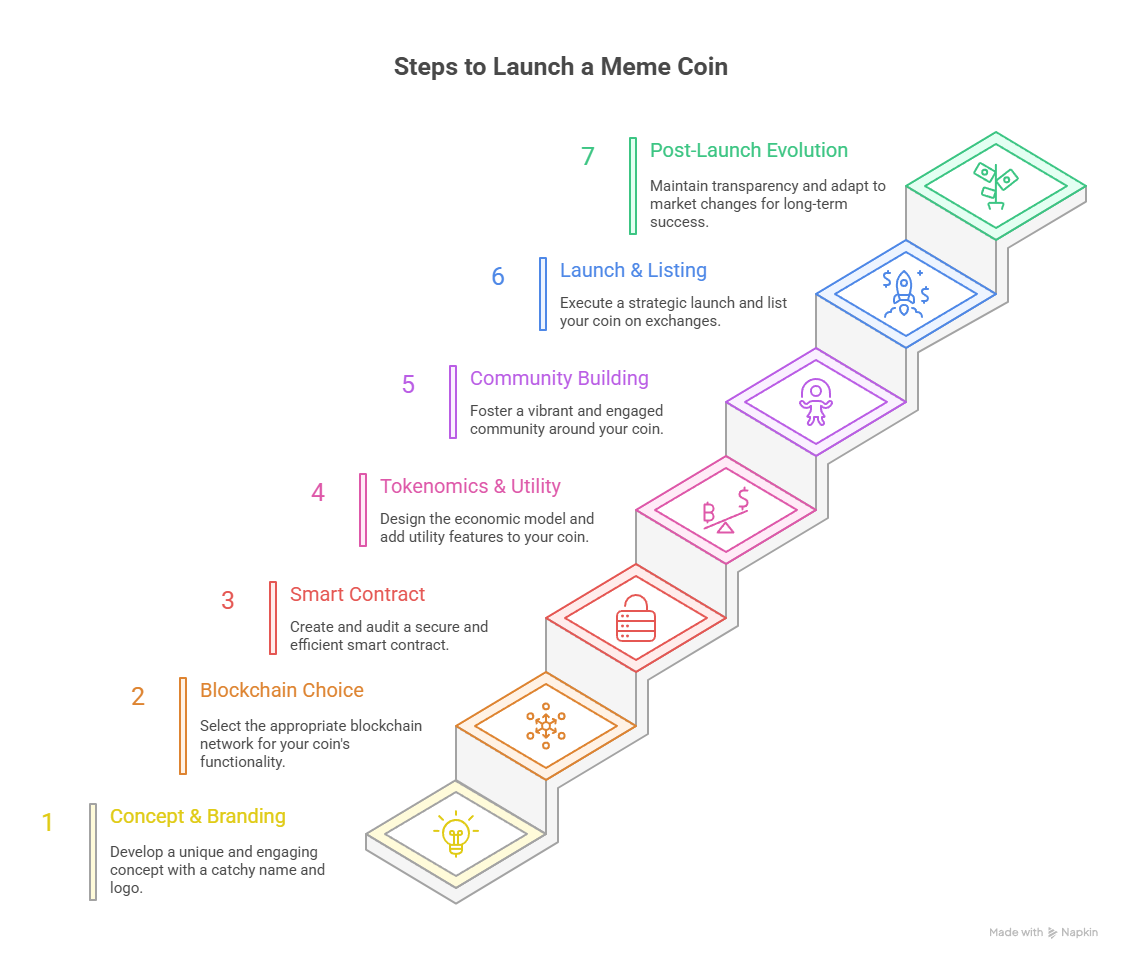
 

The Essential Steps to Your Meme Coin Development Journey

Launching a meme coin requires careful planning and flawless execution. It’s not just about coding a token; it’s about building a brand, fostering a loyal community, and creating a sustainable ecosystem. 

Here are the detailed, actionable steps to follow on your meme coin development journey:

1. The Big Idea: Concept, Niche, and Branding

The foundation of any successful meme coin is a strong, humorous, and relatable concept. Your coin needs a unique identity that resonates with a specific community.

  • Find Your Niche: What kind of humor, satire, or cultural moment can you tap into? A coin based on a trending internet meme, a beloved cartoon character, or a satirical take on current events can go viral. The more unique and engaging your concept, the more likely it is to attract a dedicated following.
  • Create a Catchy Name and Logo: Your coin’s brand is its first impression. The name and logo should be memorable, visually appealing, and directly related to your concept. A strong brand identity is crucial for standing out in a crowded market.
  • Tell a Story: The most successful meme coins have a story or lore that the community can rally behind. Whether it’s a story of a dog going to the moon or a group of digital warriors fighting for a cause, a compelling narrative keeps people engaged.

2. Choosing the Right Blockchain Network

The blockchain you choose will determine your coin’s functionality, security, scalability, and transaction costs. While Ethereum is the most popular, it can come with high gas fees and slower transaction times during peak network congestion.

  • Ethereum (ETH): The gold standard for token creation. Offers a robust, secure, and widely adopted ecosystem with a vast network of developers and tools.
  • Solana (SOL): Known for its high speed and low transaction fees, making it a great choice for projects that require quick, cheap transactions and a user-friendly experience.
  • Binance Smart Chain (BSC): A popular alternative with a large user base, lower fees compared to Ethereum, and a familiar development environment.
  • Polygon (MATIC): An excellent layer-2 solution for Ethereum, offering faster transactions and significantly reduced costs, while leveraging Ethereum’s security.

3. Smart Contract Development and Comprehensive Audit

The smart contract is the code that governs your meme coin’s existence. It dictates everything from token supply and distribution to transaction rules and security features.

  • Code for Success: The smart contract must be secure, efficient, and error-free. Due to the complexity and potential for large-scale financial implications, it’s highly recommended to work with professional developers who specialize in smart contract creation and auditing.
  • The Audit is Non-Negotiable: 0 Before launching, a comprehensive, third-party audit of your smart contract is crucial. This process identifies and fixes potential vulnerabilities and security flaws, building essential trust with your community and protecting investors from potential exploits. A certified audit provides a stamp of credibility that can be a major differentiator.
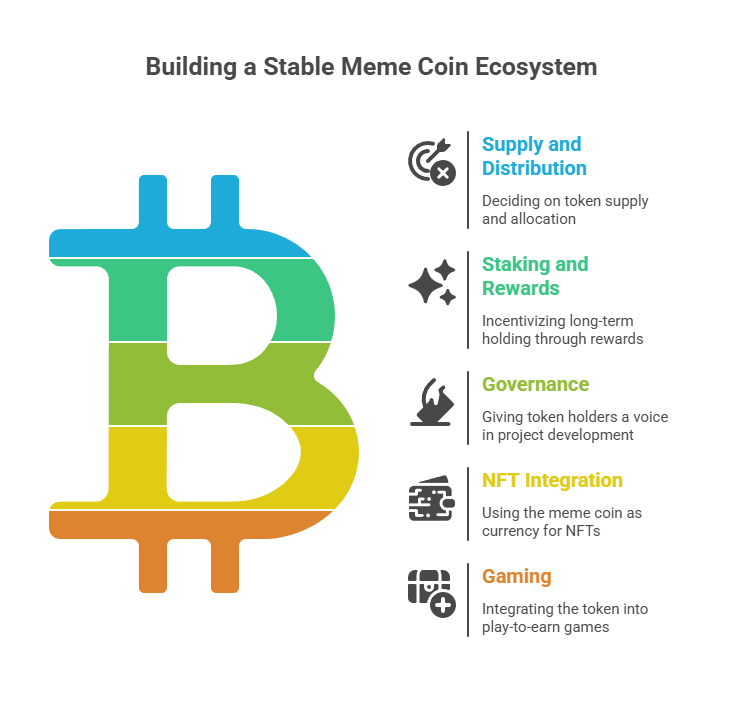

4. Designing Your Tokenomics and Utility

Tokenomics is the economic model of your meme coin—how it’s created, distributed, and used. While many meme coins are purely speculative, adding utility can create a more stable and engaged ecosystem.

  • Supply and Distribution: Decide on the total token supply and how it will be allocated. Will a portion be set aside for marketing, development, a presale, or a liquidity pool? Consider the impact of capped vs. uncapped supply on the token’s long-term value.
  • Utility Features: Consider adding features that give your token a purpose beyond speculation. Examples include:
    • Staking and Rewards: Allow users to stake their tokens to earn rewards, incentivizing long-term holding.
    • Governance: Give token holders a voice in the project’s future development.
    • NFT Integration: Use the meme coin as the native currency for a collection of NFTs.
    • Gaming: Integrate the token into a play-to-earn game.

5. Community Building: The Heart of Your Project

Meme coins thrive on a vibrant, passionate community. Without a strong, engaged following, your project is just a token. Community building should start long before the launch.

  • Engage on Social Media: Platforms like Twitter, Telegram, Discord, and Reddit are your primary tools. Create channels, host frequent AMAs (Ask Me Anything), and share regular updates and sneak peeks to keep your community excited.
  • Create Viral Content: Develop high-quality, engaging, and shareable meme content and graphics that relate to your coin’s theme. A good meme can be a powerful marketing tool that spreads your brand organically.
  • Collaborate with Influencers: Partner with crypto influencers and content creators to reach a wider, targeted audience and build trust and credibility.
  • Host Giveaways and Contests: Run engaging contests and giveaways to attract new followers and incentivize them to participate.

6. The Launch: From Presale to Exchange Listing

Once your token is ready and your community is buzzing with anticipation, it’s time to launch. This phase requires careful timing and coordination.

  • Strategic Presale: A presale can generate initial funding and create early excitement. Ensure the process is transparent and fair, providing clear instructions on how to participate.
  • Liquidity and Listings: After the presale, you’ll need to provide liquidity on a decentralized exchange (DEX) like Uniswap or PancakeSwap. This allows users to buy and sell the token. A listing on a centralized exchange (CEX) can be a major milestone, providing a massive boost in visibility, trading volume, and credibility.
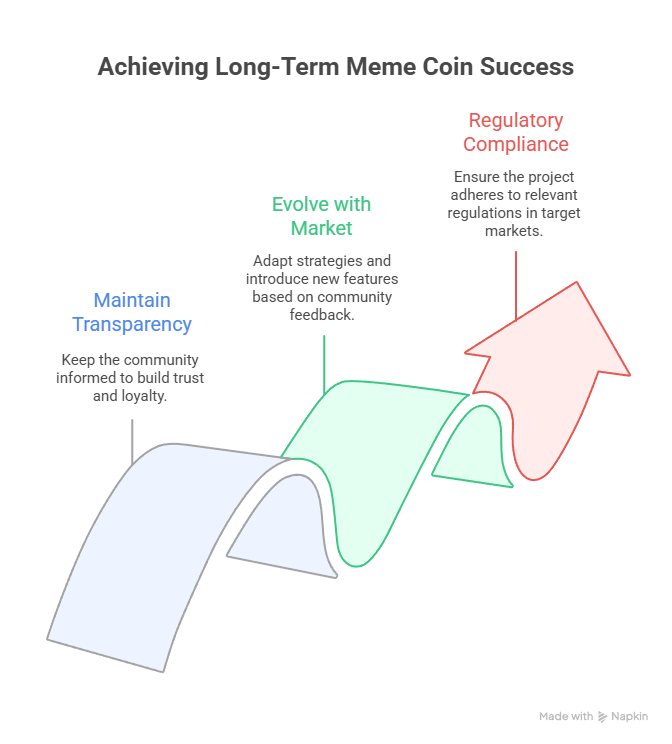
7. Post-Launch: Scaling, Transparency, and Evolution

The launch is just the beginning. The long-term success of your meme coin depends on continuous development, transparent communication, and community engagement.

  • Maintain Transparency: Keep your community informed about new developments, partnerships, and milestones. Transparency builds trust and loyalty.
  • Evolve with the Market: The crypto world is constantly changing. Be prepared to adapt your strategy, introduce new features, and stay ahead of the curve. Listen to your community’s feedback and use it to guide your project’s evolution.
  • Regulatory Compliance: As the crypto space matures, so does regulatory oversight. Ensure your project complies with relevant regulations in your target markets, such as KYC/AML (Know Your Customer/Anti-Money Laundering) procedures.

FAQs on Meme Coin Development

Q1: How much does it cost to develop a meme coin?
A1: The cost varies depending on blockchain choice, tokenomics, marketing, and development. It can range from $1,000 to $20,000 or more for professional-grade coins.

Q2: Can anyone launch a meme coin?
A2: Yes! Meme Coin Development is accessible to individuals and businesses alike. However, success requires technical knowledge, marketing, and community-building skills.

Q3: How long does it take to launch a meme coin?
A3: With a professional team, a basic meme coin can be developed and launched in 2–4 weeks. Marketing and community growth will continue after launch.

Q4: Which blockchain is best for meme coins?
A4: Ethereum, Binance Smart Chain, and Solana are popular choices. Ethereum is secure and widely used, BSC is cost-effective, and Solana offers fast transactions.

Q5: How can I make my meme coin go viral?
A5: Focus on storytelling, memes, social media engagement, influencer collaborations, and timing your launch with trending events.

Conclusion: Seize the Moment

The meme coin market is a land of opportunity, where a single viral idea can turn into a financial phenomenon. By following this comprehensive guide on meme coin development, you can transform your vision into a reality. The 2025 bull run is approaching, and the time to act is now. The combination of a solid technical foundation, a compelling brand, and a dedicated community is your recipe for success.

Categories
Blockchain

How Much Does it Cost to Make a Crypto Wallet App?

According to a recent market study by Grand View Research, the global digital currency market is expected to reach nearly 75 billion USD by 2030, propelled largely by growing adoption of decentralized finance and user-friendly crypto wallet apps. That figure alone signals the accelerating pace of crypto innovation, and it underscores why so many businesses are now seeking to build custom crypto wallet solutions. Yet before jumping on board, many ask the same question: “What is the crypto wallet app development cost, and how can I ensure it stays within budget?” Let’s delve into that.

Crypto Wallet App Development Cost: A Comprehensive Overview

Developing a crypto wallet app involves more than coding a simple interface for transferring coins. It comprises careful planning, robust security, platform choices, ongoing updates, and a lot more. In this post, we’ll uncover the major factors that influence the price tag for creating such an application. We’ll also discuss ways to optimize your budget without compromising on essential features.

By the end, you’ll have a crystal-clear idea of what a  crypto wallet is, how much to develop a crypto wallet (including typical cost ranges), plus how to set realistic expectations for the entire development process. Let me explain this further as we explore each topic step by step.

What Is a Crypto Wallet App?

A crypto wallet app is software that allows users to store, send, and receive digital assets like Bitcoin, Ethereum, or various altcoins. Think of it like an online banking app, except it’s dealing with decentralized currencies that use  blockchain technology. These wallets can be either “custodial” (where a third party holds the private keys) or “non-custodial” (where users have full ownership of their private keys). Businesses may choose one type over the other depending on their compliance and user experience objectives.

Key Functions of a Crypto Wallet


  • Balance Tracking: Displays real-time crypto balances.
  • Transaction Management: Allows sending and receiving crypto to and from other addresses.
  • Private Key Storage: Manages encryption keys for secure authorization.
  • User Authentication: Protects access with PIN, biometrics, or multifactor mechanisms.
  • Integration with Exchanges: Some wallets let users buy or sell crypto via exchange APIs.

If your business hopes to offer a custom wallet instead of relying on third-party providers, the cost-to-develop a crypto wallet spans a large range. The ultimate figure depends on your user interface, the level of security you implement, platform coverage (web, mobile, or both), and your ongoing maintenance strategy.

Factors Influencing Crypto Wallet Development Cost

Here’s a closer look at the primary factors driving crypto wallet app development cost. Understanding these elements can help you create a well-planned budget and steer your project in the right direction from day one.

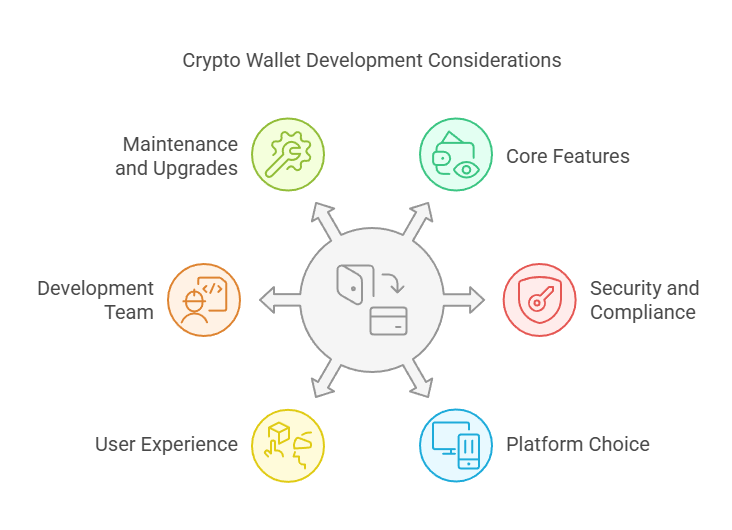
1. Core Features and Complexity

Every additional feature you add to your wallet has a cost attached to it. A bare-bones wallet may only allow you to view balances and allow basic transfers. But more advanced functionalities, such as integrated exchanges, cross-chain compatibility, in-app staking, or NFT support, quickly raise complexity. If you’re trying to figure out how much to develop a crypto wallet that includes multi-signature protection and sophisticated charting features, expect the cost to go up accordingly.

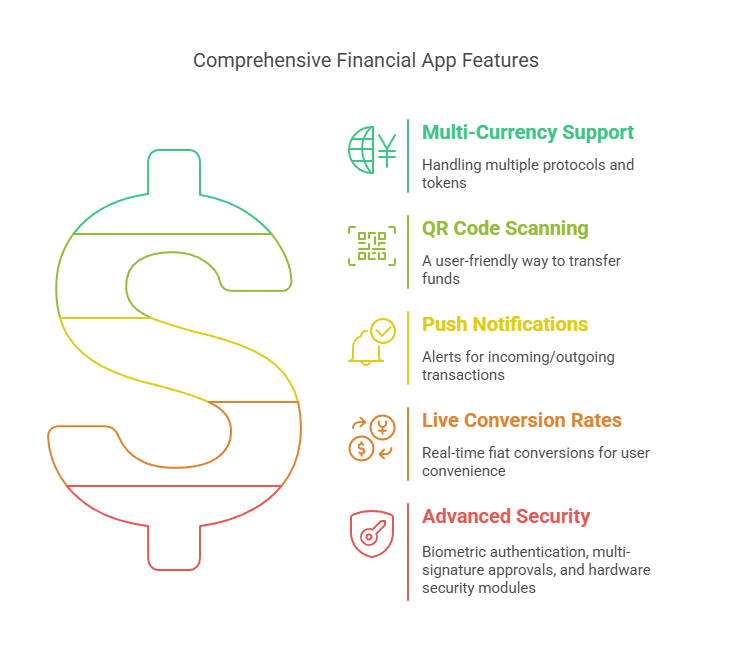
Common Features that Impact Cost

  • Multi-Currency Support: Handling multiple protocols and tokens.
  • QR Code Scanning: A user-friendly way to transfer funds.
  • Push Notifications: Alerts for incoming/outgoing transactions.
  • Live Conversion Rates: Real-time fiat conversions for user convenience.
  • Advanced Security: Biometric authentication, multi-signature approvals, and hardware security modules.

Including advanced capabilities from day one can be tempting, but there’s a cost-savings strategy: start with a minimum viable product (MVP). You can focus on a few key features, release early, and gather feedback before investing in more add-ons.

2. Security and Compliance

Crypto applications are frequently targeted by cybercriminals. Data breaches or hacks can severely damage your brand and user trust. Because of the high stakes, wallet developers invest in advanced security mechanisms. That includes robust encryption, secure key management, and sometimes even custom protocols to ensure funds remain safe at all times.

Realistically, security expenses can eat up a significant portion of your budget. That said, do not cut corners here. Even small vulnerabilities can be exploited, leading to substantial losses. If you’re aiming to build trust, you might consider:

  • End-to-end encryption and secure user authentication
  • Regression testing across multiple scenarios
  • Auditing and penetration tests by third-party specialists
  • Compliance with regulatory standards in relevant jurisdictions

Spending money on security up front could save you from costly reputational repairs later. Actually, I’d like to refine that statement: it will almost certainly save you from catastrophic incidents in the future.

3. Platform Choice and Integration

The phrase “crypto wallet app development” often implies mobile applications for iOS and Android. However, a comprehensive solution sometimes includes a web dashboard or desktop variant as well. Each platform brings development costs related to design, front-end engineering, and testing. If your plan is to cover all major operating systems, budget accordingly.

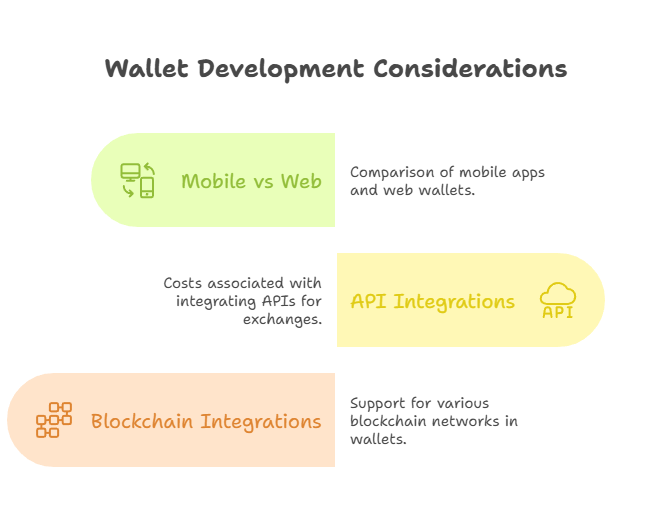
  • Mobile vs Web: Mobile apps usually require separate codebases for iOS and Android (unless you go for a cross-platform framework). Web wallets might be simpler if you only need a responsive interface.
  • API Integrations: Integrating with crypto exchange or payment gateways can introduce additional expenses.
  • Blockchain Integrations: Some wallets support not just top-tier blockchains (Bitcoin, Ethereum) but smaller networks too. Each blockchain has its own data structures and quirks, often handled via specialized libraries.

4. Design and User Experience

In the crypto space, a well-crafted user experience can be the difference between user adoption and abandonment. You want design that’s intuitive so new users aren’t intimidated by private keys, addresses, or transaction hashes. The cost of UI/UX design can vary based on the level of customization you require.

If you’d like to stand out in a crowded market, investing in a unique look and feel is a good idea. This typically means employing a specialist design team who can craft consistent branding across screens. On the other hand, if your budget is tight, you might opt for simpler, template-based approaches until you validate your product’s market fit.

5. Development Team and Location

Hiring top-quality developers can be pricey, particularly if your project requires specialized blockchain expertise. Developer rates vary dramatically by region. Hiring from North America and Western Europe typically commands higher hourly wages. Meanwhile, working with experienced teams in Eastern Europe or Asia can reduce overhead.

A wise approach might be to evaluate a team’s portfolio rather than focusing solely on cost. After all, a subpar developer might require more rework later. Businesses also have the choice of building an in-house team or outsourcing to a specialized firm like Blocktech Brew. While hiring an external vendor shifts more control away from your immediate supervision, it often speeds up timelines due to the vendor’s specialized knowledge.

6. Maintenance and Upgrades

Once your wallet is live, you’ll have to maintain it. Blockchain protocols are always evolving, security patches are continuous, and your user base might request new coin support. Furthermore, if you offer 24/7 customer service, keep in mind that user queries can be complex in the crypto realm.

Planning a post-launch budget for updates and support is important. Some organizations choose to handle maintenance internally, while others prefer to partner with a development firm on a retainer basis.

Typical Cost Breakdown

To help you visualize the approximate crypto wallet development cost, let’s examine a hypothetical breakdown of expenses. Naturally, actual figures will depend on project scope, complexity, and developer rates. The table below offers a rough idea:

Feature / Stage Estimated Cost Range
Basic Wallet Functionality $15,000 – $30,000
Advanced Security (Multi-sig, Biometric, etc.) $5,000 – $20,000
UI/UX Custom Design $10,000 – $15,000
Platform Development (iOS & Android) $10,000 – $25,000 per platform
Integration with Exchanges or Payment Gateways $5,000 – $15,000
Testing & QA $3,000 – $8,000
Ongoing Maintenance (Yearly) >$8,000

These numbers are not one-size-fits-all. A simple MVP crypto wallet for a single platform might land near the lower end. A multi-platform, cross-chain wallet with advanced features can climb much higher. You might wonder: “Can I launch a functional wallet for less than $20,000?” The answer is yes, but it will likely have a bare-minimum feature set and rely on third-party libraries for many parts of the experience.

Overcoming Implementation Challenges

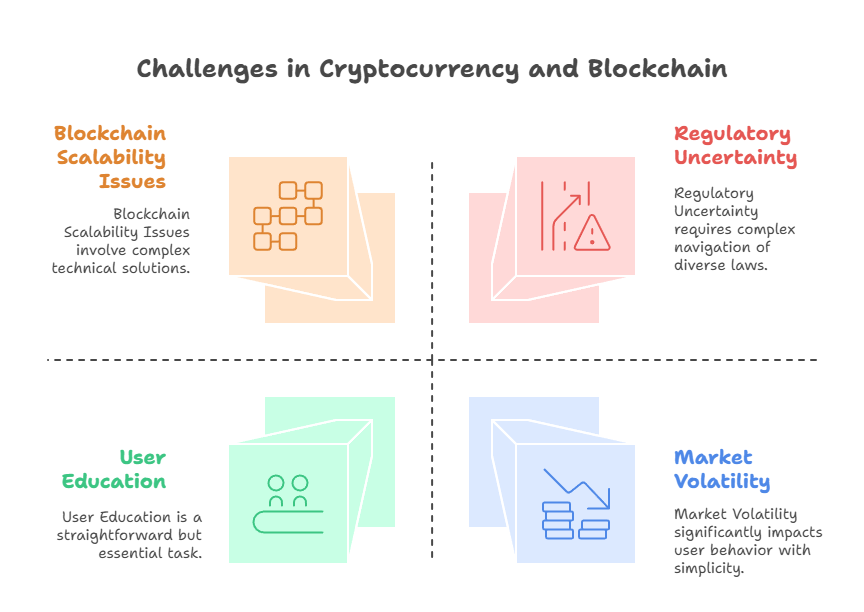
Building and launching a crypto wallet isn’t always sunshine and rainbows. Unexpected hurdles can inflate development costs if you’re not prepared. Below are some common stumbling blocks:

  1. Regulatory Uncertainty: Crypto regulations vary widely depending on jurisdiction. If you’re targeting multiple regions, you’ll need legal counsel to ensure compliance.
  2. Blockchain Scalability Issues: Some networks get congested, leading to delayed transactions and user frustration.
  3. User Education: Blockchain is still new to many, so offering tutorials or live support might be crucial for smooth onboarding.
  4. Market Volatility: Dramatic price swings can affect user sentiment. Some might blame your app for transaction delays or fees.

When you plan your crypto wallet app development, remain flexible. If new protocol rules or user demands appear, you want your app to adapt without requiring a total rebuild. In my opinion, the more modular your architecture is, the more future-proof your wallet becomes.

Cost-Saving Strategies

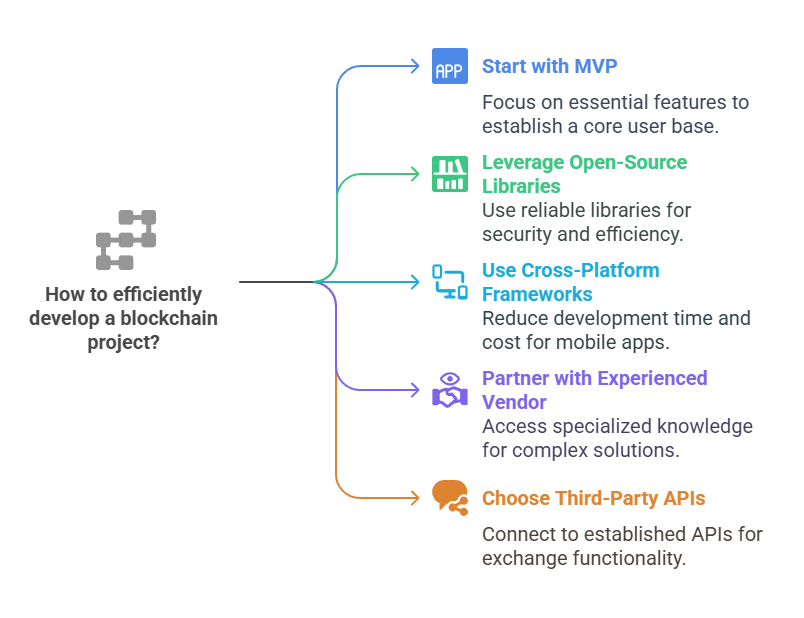
  • Start with an MVP: Implement only essential functionalities (like sending, receiving, and displaying balances) in the initial release. Add advanced features once your core user base is established.
  • Leverage Open-Source Libraries: Many reliable blockchain libraries exist to handle token transfers, transaction signing, and more. Just be sure to vet them for security and update them regularly.
  • Use Cross-Platform Frameworks: Rather than building separate iOS and Android apps from scratch, frameworks like React Native or Flutter can cut development time (and cost) considerably.
  • Partner with an Experienced Vendor: Tapping into specialized knowledge often ends up cheaper in the long run than trying to build a complex blockchain solution in-house.
  • Choose Third-Party APIs Wisely: Need exchange functionality? Rather than building your own exchange from zero, connect to established APIs.

It might be tempting to skip advanced security or testing to lower the upfront bill, but be cautious. Remember: a single hack can cost hundreds of thousands (or more) in stolen funds and reputational loss. Always keep baseline security as a non-negotiable part of your plan.

The Development Timeline and Stages

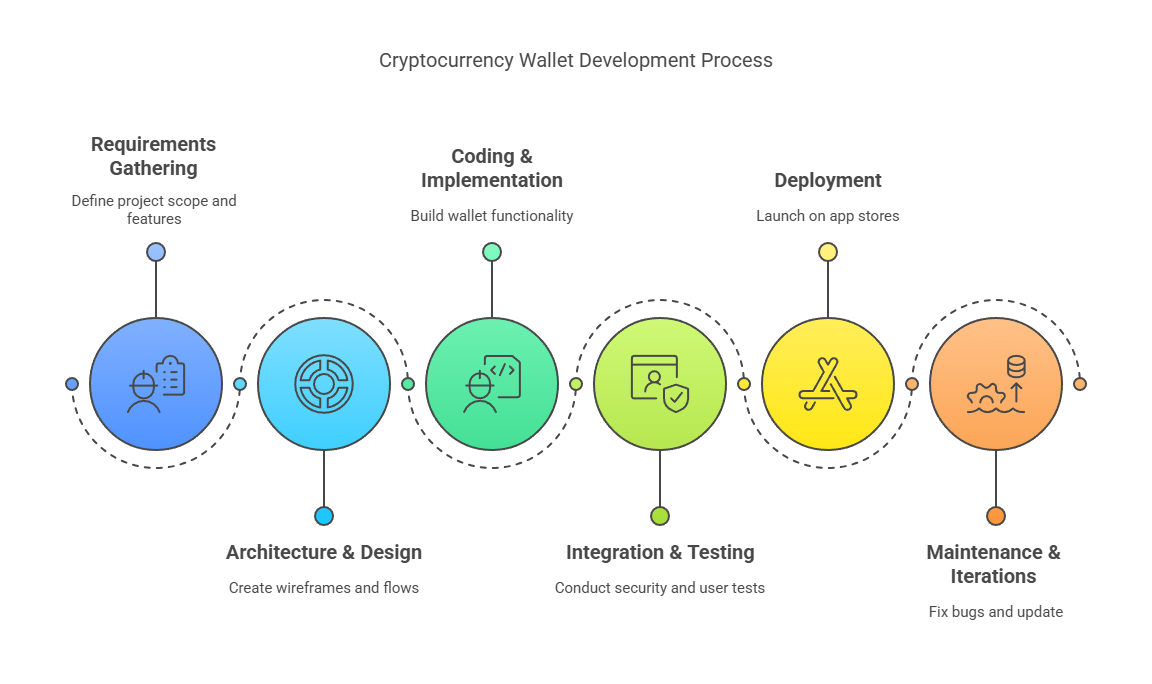
  1. Requirements Gathering: You and your development team define the project scope, preferred features, and security standards.
  2. Architecture & Design: Wireframes, navigational flows, and user journeys are created. Technical tasks like choosing the appropriate blockchain libraries get finalized.
  3. Coding & Implementation: The actual wallet functionality is built, from front-end design to back-end integration and blockchain logic.
  4. Integration & Testing: Third-party APIs, security audits, penetration tests, and user acceptance testing typically happen here.
  5. Deployment: Launch the wallet on app stores or your preferred distribution channel.
  6. Maintenance & Iterations: Bugs are fixed and new updates are rolled out according to user feedback and evolving blockchain standards.

The total timeline can range from a few months for a simpler project to over a year for a large-scale, multi-platform wallet. Naturally, a longer development cycle increases staffing costs, so it’s wise to keep project sprints well-organized.

A Real-World Example

Imagine a mid-sized fintech company wanting to launch a branded crypto wallet to support three major cryptocurrencies (Bitcoin, Ethereum, and USDC). They want a user-friendly design, two-factor authentication, and the ability to check real-time exchange rates. They choose to build both an iOS and Android version. They also want a basic admin dashboard so their support team can look into any issues that arise.

  • They hire a skilled blockchain-focused firm.
  • The entire project takes around 6 months.
  • They prioritize minimal design but do incorporate advanced security measures like multi-sig approvals.

Their total crypto wallet development cost might land around $80,000 – $120,000, inclusive of all design, backend services, and a small contingency for unforeseen complexities. Once the wallet is live, they pay a monthly retainer for ongoing maintenance and updates.

One Less Obvious Consideration: Localization

Crypto is global by nature. If you anticipate a worldwide user base, you might consider multi-language support. Adding extra languages can raise your development cost, as it involves translating text strings, adjusting layouts for right-to-left languages, and possibly customizing region-specific compliance. But this investment opens your product to a broader audience. It’s a factor that many businesses overlook initially, only to implement later at a higher cost.

A Practical Tip for Businesses

Consider pilot testing with a small group of users or loyal customers before a full-scale launch. This helps you identify usability pain points, gauge whether your security measures are intuitive, and see if your transaction speeds meet expectations. Not only does this approach help ensure you’re delivering a quality product, it also saves money by spotting major issues early (rather than rectifying them after a widespread release).

Challenges We’ve Helped Clients Overcome

At Blocktech Brew, we’ve seen wallet projects run into sudden compliance changes, third-party API failures, or unexpectedly high user traffic after a marketing campaign. In one instance, a client’s exchange integration was abruptly restricted by the exchange provider’s updated terms. We quickly pivoted to a more reliable API and streamlined the wallet’s architecture for faster response times. When you collaborate with teams and solutions that have weathered these storms, you reduce the chance of messy scenarios popping up mid-development.

Feel like discussing these finer points with someone who’s been there? Don’t hesitate to reach out for a conversation. Sometimes, a quick chat with an experienced blockchain team can spare you weeks of frustration.

Building on an Earlier Point with a New Insight

We talked about the significance of advanced security, but it’s worth emphasizing that even the type of cryptography you employ can affect your overall project budget. Some businesses stick to elliptic-curve cryptography, while others might require post-quantum algorithms for future-proofing. The latter demands specialized knowledge and more robust cryptographic libraries, which drives up development cost. If your target market prioritizes cutting-edge security, anticipating these requirements from the outset sets the right direction for development.

A Brief Aside on Blockchain Trends

I’m sure you’ve heard the buzz around alternative Layer-2 solutions that promise faster transactions at lower fees. While these are exciting technologies, integrating them early—before they’re widely adopted—can be tricky. If you plan to future-proof your wallet, keep an eye on these scaling solutions, but also weigh the cost of integrating them compared to sticking with proven blockchains. Many businesses discover that supporting multiple blockchains from the get-go is more complex than they initially assume.

Returning now to our main discussion: understanding and planning for these trends can ensure your crypto wallet remains agile without inflating your initial budget unnecessarily.

Let’s Talk Wallet Strategy

  • If you’re ready to map out the specifics of your project, explore our wallet development services—a quick initial consultation can refine your product roadmap.
  • Curious how your existing infrastructure could integrate with a custom wallet? Drop us a message to learn about streamlining user sign-up and transaction flows.
  • Considering an MVP approach? Our consultants can show you how focusing on core features first can lead to a successful phased rollout.
  • If you need a second opinion on your security plan, our dedicated security auditing team is ready to recommend proven safeguards for your wallet.
  • Worried about full-scale development due to budget constraints? We’re happy to discuss creative solutions that guide you toward a cost-effective, robust wallet that grows with your business.
  • If you’re comfortable building some parts in-house but need a partner for specialized features, let’s talk about collaborative development.

Conclusion

When it comes to planning your crypto wallet app development cost, no two projects are exactly alike. The final tab relies on your scope, security plans, platform choices, and maintenance needs. But with thoughtful planning, you can control expenses while still delivering a secure, feature-rich product that satisfies your users.

Looking at current industry trends, we can expect the global appetite for crypto wallet solutions to keep climbing. People worldwide increasingly prefer direct control over their digital assets. By building a high-quality wallet that meets their expectations, you’ll carve out a slice of this expanding market. And yes, if all this still feels overwhelming, you can always discuss your roadmap or concerns with our team.

About Blocktech Brew

We’ve been at the forefront of blockchain, Web3, and AI developments, having successfully delivered 1000+ projects across 150+ countries. Our approach balances robust technology with user-centric design, ensuring businesses thrive in the fast-evolving crypto landscape. Led by our founder, Gagandeep Singh, our global team has a deep track record in creating innovative, compliant, and secure solutions that drive growth. Whether you’re building a simple wallet MVP or a multi-chain enterprise wallet, we’re here to guide you every step of the way.

Have a wallet concept in mind? Reach out and let’s see how our expertise can help you turn that idea into a powerful, user-friendly reality.

Categories
Artificial Intelligence Blockchain

The Future of Animation: Ghibli & AI Integration

By 2025, more than 60% of animation studios will have either started investigating or already included generative AI technologies into their workflows. It is anticipated that this widespread adoption will increase efficiency and promote innovation by reducing production time and costs by about 30%.Additionally, it is anticipated that the market for generative AI in animation will extend from $1.75 billion in 2024 to $2.39 billion in 2025, representing a compound annual growth rate (CAGR) of 36.6%. Artificial intelligence in animation is having a profound impact, and this important trend is changing economic strategies for both established studios and up-and-coming content providers.

Studio Ghibli AI Integration: Fusing Handcrafted Aesthetics with Cutting-Edge Automation

Immediately, the idea of “Studio Ghibli AI integration” evokes the recognizable narrative and unique aesthetic of the venerable studio that created Spirited Away and My Neighbor Totoro. However, how can one blend contemporary AI-powered tools with the delicate, handcrafted artistry of Ghibli’s renowned animation? Let me elaborate.

Essentially, the goal is to use technology to improve visual fidelity, expedite procedures, and assist animators with tedious work—all while maintaining the distinctively artistic flair. Ghibli’s signature style is, after all, the hand-drawn, impressionistic look that fans all over the world still enjoy.

How can we, then, combine the distinctive creativity that millions adore with sophisticated automation? And how can studios, businesspeople, and fans who want to advance the industry take use of this? This may make you question whether it’s even possible.

Below, we’ll explore how AI integration in animation can complement the Ghibli style, the challenges it can help solve, and what future-forward steps businesses can take to remain relevant. We’ll also venture into the interesting ways AI might expand artistic possibilities rather than hinder creativity. So, let’s jump right in.

Why AI Makes Sense in Animation

Animation is resource-intensive. Traditional 2D animation, the kind Ghibli excels at, calls for thousands of carefully crafted frames. Even 3D animation can involve huge complexities—texture mapping, lighting, rigging, and more. AI’s ability to automate certain tasks is a game-changer if done thoughtfully. Here are a few reasons studios and startups alike are turning to AI:

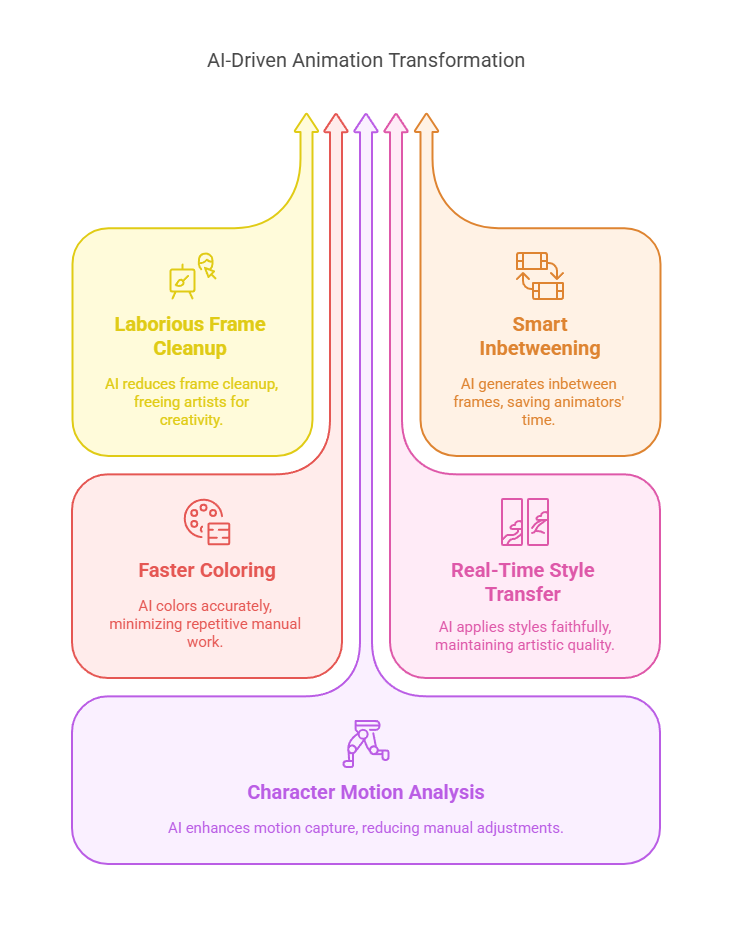
  1. Laborious Frame Cleanup – Hand-drawn frames often need cleaning to remove noise or pencil marks. AI image processing can reduce that drudgery, giving artists more time for design and storytelling.
  2. Smart Inbetweening – Instead of animators manually creating inbetween frames, an AI can generate some of them automatically. This allows expert artists to refine key poses instead of spending hours on repetitive transitional work.
  3. Faster Coloring – AI-driven coloring tools can apply color palettes accurately, reducing time spent filling in repeated color cells. The human eye remains essential, but you minimize the tedium involved.
  4. Real-Time Style Transfer – Imagine having a neural network trained on specific Ghibli backgrounds or color palettes. AI can apply that style to new scenes with surprising fidelity, preserving the tactile quality fans expect.
  5. Character Motion Analysis – In 3D contexts, AI can interpret and adapt motion capture data more fluidly, lessening the time spent manually refining movements.

These capabilities underscore a pressing reality: if you’re not integrating at least some aspects of automation or AI, you’re risking inefficiency. Seeking guidance on how to incorporate the right tools and processes can ensure your animation pipeline remains cost-effective and creatively free.

Defining Ghibli and Artificial Intelligence Goals

Ghibli—in a broader sense—represents careful craftsmanship and an emphasis on emotive storytelling. No one wants to see that vanish just because we have new technology on board. Therefore, the primary mission in merging AI integration development with the Ghibli style is to preserve artistry while automating repetitious tasks. A second priority is bridging modern production requirements (meeting tight deadlines, working with remote teams, etc.) in a way that doesn’t muddy the hallmarks of a handcrafted aesthetic.

Achieving this balance isn’t always straightforward. Studios must decide which processes to automate and which tasks demand the human touch. Though it’s feasible to delegate frame-by-frame creation almost entirely to machines, animators often prefer to keep a guiding hand on every detail. And that’s understandable—nobody wants the final product to look like run-of-the-mill digital cutouts.

The Power of AI Integration in Animation: A Tiered Overview

Below is a brief snapshot of how artificial intelligence can add value across different stages of animation production in a Ghibli-like setting:

Production Stage AI Application Value Proposition
Pre-production Concept art generation; script analysis; mood board creation Accelerates ideation and ensures consistent style references
Production Automated inbetweening; color fill; style transfer Cuts down on manual labor; upholds visual consistency
Post-production Noise reduction; image stabilization; final color grading Enhances clarity, speeds revision cycles
Marketing Personalized trailer editing; social media snippet creation Increases output for promotional content with less manual overhead

By dividing your pipeline into these distinct categories and applying AI where it makes sense, studios can significantly reduce repetitive work. If you’re thinking about adopting a similar structure, it’s wise to map out your production tasks and pinpoint exactly where an AI-driven boost might help the most.

Setting Up a Strategy: Steps to Merge AI and Ghibli Aesthetics

Here’s a straightforward outline to guide studios or startups interested in seamlessly mixing Ghibli’s charm with AI-driven techniques:

  1. Identify the Core Aesthetic – Pin down the particular Ghibli style or the style reminiscent of Ghibli that you want to preserve. Is it the watercolor-like backdrops? Soft, expressive character lines? Gentle palette transitions? Document these visuals thoroughly.
  2. Choose Appropriate AI Tools – Evaluate existing AI-based solutions in animation. Some focus on inbetweening, others handle color correction, and some do high-level style transfer. Dig into user reviews, talk to other professionals, and possibly run pilot tests.
  3. Partner with Experts – Consider collaborating with AI developers who have a background or interest in animation. You’ll want a team that understands how to adapt machine learning algorithms to your exact style specifications.
  4. Test in Limited Production – Start small. Run AI trials on a test project or a specific sequence rather than an entire feature film. Observe how well it replicates your desired aesthetic, and gather input from animators, directors, and (if possible) a small group of viewers.
  5. Iterate and Refine – AI models are only as good as the data you feed them. Continuously refine style references, line thickness presets, color palette data, and lighting to polish your final product. AI integration in animation is seldom a one-and-done process.
  6. Maintain Human Oversight – Without a thoughtful human eye, AI can produce subpar or artificial-looking results. Keep that final pass for human artists to ensure the output remains genuinely magical.

If you’d like tailored advice on establishing your own AI-driven pipeline, we’re more than happy to share our experiences helping major studios do exactly that. It might sound complex, but working with a specialized team can reduce trial and error significantly.

Integrating AI into Hand-Drawn Animation: A Real-World Example

Let’s consider the scenario of a mid-sized animation studio aiming for that painterly look. Their biggest challenge is time spent on cleaning up frames and consistently coloring characters across extended scenes.

  • Step One: They gather all current color references, line art examples, and background pastels. By structuring these into a dataset, the studio “teaches” an AI model the ins and outs of the style.
  • Step Two: The team sets up an automated coloring engine based on a neural network. Each time a frame is scanned, the engine attempts to fill color according to the designated style references.
  • Step Three: A small group of in-house artists reviews each batch of frames in progress. If the AI miscolored or oversimplified a texture, they correct it. Those corrections feed back into the model, improving accuracy.
  • Result: Within a month, the AI is coloring frames with around 90% accuracy to the original style. Animators can now refocus on emotive storytelling, interesting camera angles, and fine detail work. The artistry stays intact, but menial tasks are drastically reduced.

Overcoming Implementation Challenges

No technology integration is without hurdles, particularly when we talk about Ghibli and artificial intelligence. Will the AI inadvertently produce frames that feel sterile? Will it lose the nuance of hand-drawn lines? Actually, these concerns are valid.

  • Data Quality: AI depends on well-curated data. If your reference materials or training sets are disorganized, your model might fail to replicate the essence of Ghibli’s aesthetic.
  • Time Investment: Training neural networks can be time-consuming, especially in the early phases. Some teams expect overnight results, but real-world experiences often differ.
  • Artistic Control: There’s a chance your creative team might feel overshadowed by AI. Clear communication about the role of AI (support rather than replacement) helps keep morale high.
  • Cost Considerations: Setting up robust AI-driven workflows requires hardware, software, and skilled professionals. For smaller studios, financial constraints might mean a phased rollout.

Yet, there’s more to it than just these direct obstacles. AI also has the potential to spawn new creative directions. For instance, a director might harness generative AI to propose concept sketches that an artist can refine. It becomes a healthy collaboration rather than an unwelcome intrusion.

Common Misconceptions

Many assume AI will replace animators outright, leading to a flood of soulless, mass-produced cartoons. But that’s a misconception. AI is essentially a tool built to follow (and sometimes learn from) the guidance of skilled artists. It won’t spontaneously conjure up the emotional resonance of a meticulously hand-drawn Ghibli sequence unless a human crafts that vision in the first place.

Another misconception is that AI integration in animation is a quick fix for any bottleneck. But this process requires patience. Like with any creative technology, you want to allow enough time for model testing, user feedback, and multiple rounds of iteration. Instant results might be tempting to chase, but they rarely produce the kind of refined aesthetic that loyal audiences expect.

A Thoughtful Aside on Tech Adoption

Some in the art community worry about the “robotic invasion” of creativity. While caution can be healthy, knee-jerk rejections of new technology can limit a studio’s future viability. Anecdotally, studios that adapt to new production methods are likelier to thrive, and those that remain rigid risk being overshadowed by faster, more agile competitors. Still, every adoption plan should reflect a studio’s unique artistic philosophy. At times, a full-blown AI pipeline might not make sense, and that’s perfectly acceptable too.

Best Practices for AI Integration Development

  1. Establish Clear Project Goals: Define what you want to achieve with AI: faster production times, a new distinct style, or better post-production workflows.
  2. Be Ready to Pivot: Your initial model might underperform. Don’t see this as a failure but as part of the iterative journey. Sometimes smaller, targeted AI modules (like colorization alone) might be more helpful than an all-encompassing approach.
  3. Respect the Original Artwork: Ghibli and artificial intelligence can coexist, but never let software entirely override your original vision. Provide your AI with the right references and keep close watch to ensure it aligns with your studio’s core style.
  4. Encourage Cross-Disciplinary Collaboration: Animators, AI engineers, and directors should communicate regularly. Breaking down silos fosters synergy and ensures both artistic and technical elements advance together.
  5. Plan for Upgrades: AI in animation is rapidly evolving. Keep an eye on new releases and updates. By continuously refining your workflow, you avoid stagnation and maintain a competitive edge.

Have questions about tackling these best practices head-on? Don’t hesitate to connect with our team for further tips suited to your specific production environment. When you tap into real-world experiences, you’ll skip many of the missteps studios commonly make.

Market Opportunities and Potential Business Models

Beyond the production floor, AI integration services opens up exciting commercial opportunities. For instance, a studio known for using advanced AI might collaborate with major game developers or transition into an AI-driven service provider. They could license out proprietary styles or custom algorithms that replicate a beloved Ghibli inspiration. Some entrepreneurs are even launching AI-based content marketplaces where animators can sell or exchange specialized model configurations.

If you see a niche your company can fill—maybe a specialized motion detection tool for 2D frames or a plugin that seamlessly merges 2D and 3D data—this could be a golden moment. Indeed, AI integration in animation is becoming a hot domain for startups eager to support established studios that lack the in-house capacity to build everything from scratch. Opening dialogues with studios that love classic animation but also crave modern solutions can lead to fruitful partnerships.

Planning for the Future: Building on Earlier Points

Earlier, we talked about how shifting mundane tasks to AI frees up animators to focus on art direction and emotional nuance. Wait, there’s more. This approach might even help recapture some of the magic from older eras of animation. Instead of being buried under time-consuming tasks, small teams can channel their energy into telling compelling stories that mimic the full depth and warmth of a classic Studio Ghibli film. That’s the deeper purpose behind AI animation tools: to uplift human creativity, not stifle it.

Practical Tip: Train AI on Original Hand-Painted Cells

One lesser-known consideration is to gather actual hand-painted cells and concept sketches from archived or older works. Feed these physical or scanned assets into an AI model. This approach better captures the natural brush strokes and color nuances that standard digital artwork might miss. By referencing real paint textures, your AI can create animations that feel surprisingly organic. It’s a subtle trick, but it often yields results that fans describe as “handcrafted yet modern.”

The Need for Expert Guidance

It’s one thing to read about all these possibilities; it’s another to integrate them into a real pipeline. If you’re searching for a reliable partner to consult on everything from data preprocessing to model deployment, or even to figure out how to maintain a cohesive brand identity when shifting to AI-driven processes, consider an introductory session with our specialists. We’ve guided studios through these transitions before, helping each define a smooth approach that respects their budget and workflow constraints.

You don’t have to conquer AI-powered animation alone. When you pair with professionals who understand the intricacies of AI integration development, you’ll dodge common pitfalls and streamline your process from day one.

Conclusion: Where Do We Go From Here?

Studio Ghibli AI integration services combines the beloved, delicate style of handcrafted 2D animation with the efficiency of advanced machine learning. We’re witnessing a new era where tasks that have historically demanded ungodly hours can be handled in a fraction of the time. Best of all, this shift needn’t cost the soul of animation—that intangible, heartfelt quality cherished by fans and fueling box office success. By thoughtfully deploying AI, studios can continue to surprise audiences with breathtaking visuals, mesmerizing storylines, and that nostalgic wonder reminiscent of a timeless Ghibli masterpiece.

If you’re eager to delve deeper and uncover the best AI solutions for your specific animation goals, we’d love to share our perspective. Innovators, studio owners, and even freelance artists can all benefit from establishing robust AI-driven workflows that cut down on busywork and maintain the highest artistic standards. Partnering wisely is the key to ensuring technology works for you, rather than becoming a distraction.

So why not explore these opportunities further? Discover new ways to produce high-quality animated features faster, keep your artistic identity intact, and appeal to a global audience that appreciates both tradition and innovation.

About Blocktechbrew

Blocktechbrew has been at the forefront of leveraging emerging tech in creative industries, bringing together visionaries and experts to propel projects beyond the ordinary. Founded by Gagandeep Singh, our firm has supported clients in 150+ countries, covered 1000+ successful projects, and continues to champion the marriage of artistry with technology. Our team’s dedication to clarity, transparency, and top-tier execution has helped businesses thrive in competitive digital realms. From blockchain innovations to AI-powered solutions for animation, we’re committed to ushering forward-thinking companies into the next chapter of content creation.

Have questions or simply curious about how AI might revolutionize your animation pipeline? Get in touch. We’d be happy to walk you through best practices, proof-of-concept demos, or whatever else you need to animate your dreams—Ghibli style and beyond.

Categories
Blockchain

How To Tokenize an Asset?

Tokenization has taken a big boom in the past two years, and this growth is expected to grow even higher by 2030. So, this is the high time that crypto enthusiasts or investors geeks focus more on tokenizing their assets, and unlock their growth to a financially free future!

In this blog, we will uncover the concept of asset tokenization, and how any individual can tokenize an asset.

What Is Asset Tokenization?

Asset tokenization is the process of turning assets into digital tokens that can be traded globally through blockchain.

Traditional way of doing investments in assets like gold, silver, art, real estate required huge amount of money. Also if people wanted to invest in something that is located in some other country or region, they had to go through the complicated legal procedure, or had geographical barriers. Tokenization breaks down all these budgets, geographical, and regulatory constraints, allowing users to invest in tokenized assets that are present across the globe.

These assets would include assets such as real estate, art, commodities, or infrastructure. Let us see the types of assets that can be tokenized in detail:

Types Of Assets That Can Be Tokenized

Asset tokenization allows physical and digital assets to be represented as blockchain-based tokens, making them more accessible, divisible, and tradable. Here are the main types of assets that can be tokenized:

1. Real-World Assets (RWA)

Real world assets include assets that exist in the physical world itself like real estate properties, carbon credits, gold, silver, paintings, rare artifacts, luxury items, patents, copyrights, and corporate bonds can be tokenized.

2. Financial Instruments

Financial instruments like shares in companies, ETFs, investments funds, startup shares, investment funds, insurance policies, swaps on blockchain, and claims can be tokenized.

3. Digital & Virtual Assets

Digital currencies like BTC, ETH, digital art, gaming assets, music, collectibles, decentralized identity solutions, metaverse assets, in-game assets, can be tokenized.

4. Utility & Governance Assets

Apart from all the above, tokenized loyalty programs, reward points, governance tokens, memberships, SaaS access, premium digital content can also be tokenized.

Thus, unlike real world, asset tokenization allows ownership of both liquid, and illiquid assets.

How To Tokenize An Asset?

Here is the step-by-step guidance to tokenize an asset:

Step 1: Identify The Asset For Tokenization

Step 2: Assess Regulatory and Compliance Requirements

Step 3: Verify Asset Ownership

Step 4: Determine The Asset’s Value

Step 5: Prepare Legal Documentation

Step 6: Choose A Blockchain Platform

Step 7: Select The Token Standard and Type

Step 8: Design The Tokenomics Model

Step 9: Develop And Deploy Smart Contracts

Step 10: Mint And Distribute The Token

Step 1: Identify The Asset For Tokenization

To begin with the process of tokenization, you first must choose the asset that you would like to tokenize. These assets can include real estate, collectibles, gold, silver, and more. To keep it easy, you can choose an asset that can be easily divided into smaller units. Also, if you have, try to choose art and collectibles as they are high in demand, and attract different investors from across the globe.

Step 2: Assess Regulatory and Compliance Requirements

The next step is to understand the legal and regulatory necessities required for tokenization, and ensure your asset aligns with the rules. You should start by first identifying crypto and tokenization related laws in your own country. Different countries have different laws, so it is preferred to consult a lawyer, or an experience blockchain develop company, like Blocktech Brew for a reliable consulting.

Step 3: Verify Asset Ownership

For tokenization you would need to verify who is the legal owner of the asset. So, collect all the legal or related documents that can verify that the asset totally belongs to the respective owner or have multiple owners. These documents can include purchase documents, registration papers, certificates, and more. For this, you can also take help from the lawyer, and blockchain consulting firms, like Blocktech Brew.

Step 4: Determine The Asset’s Value

Once ownership is verified, the next step is to figure out how much the asset is worth. You can do this by checking market prices, getting expert opinions, or comparing similar assets. A fair price makes the token more attractive to investors and avoids overpricing or underpricing. It’s a good idea to ask financial experts for help to get an accurate value.

Step 5: Prepare Legal Documentation

Now prepare legal documents to ensure the tokenized asset follows all rules and regulations. These documents should confirm ownership, explain how the asset can be traded, and protect investor rights. It’s best to work with a lawyer or a blockchain consulting firm, like Blocktech Brew, to make sure everything is legally secure and transparent.

Step 6: Choose A Blockchain Platform

Now explore different blockchain platforms like Ethereum, Solana, Binance Smart Chain etc., and analyse their security, scalability, fees, interoperability. Consider all the key factors and see which of the blockchain aligns the best with your needs. Every blockchain has its own unique features, operational mechanism, and its own pros, and cons. Hence, you will do a comprehensive analysis of each platform and compare them with each other to be able to choose the best-suited blockchain platform for you.

Step 7: Select The Token Standard and Type

Now, choose the right token standard and type based on your asset and blockchain network. Common standards include ERC-20 for fungible tokens, ERC-721 for unique NFTs, and ERC-1155 for multi-use tokens. If you’re using blockchains like Binance Smart Chain, Solana, or Polygon, they have their own token standards like BEP-20 and SPL. The choice depends on factors like use case, compatibility, and investor needs.

Step 8: Design The Tokenomics Model

Plan how your token will work, including total supply, pricing, and distribution. Decide how tokens will be used, such as for transactions, staking, or rewards. A well-structured tokenomics model attracts investors and ensures long-term value. It should also include mechanisms like burns or incentives to maintain demand.

Step 9: Develop And Deploy Smart Contracts

Smart contracts are basically the code that is written to transparently automate the buying and selling of tokenized assets. They play a very crucial role in facilitating all the transactions, thus smart contracts must be created error-free to avoid any security breached. Blocktech Brew offers advanced smart contract development services, along with smart contract auditing to help businesses create fast smart contracts for their blockchain projects.

Step 10: Mint And Distribute The Token

Create (mint) the tokens on the blockchain once everything is ready. Then, distribute them to investors, exchanges, or platforms as planned. Ensure the process is secure and follows regulations to avoid legal issues. Transparency in token distribution helps build trust with investors.

Benefits For Tokenizing An Asset

Explosively Growing Market

A study by Statista estimated the asset tokenization market size to reach at USD 11 Billion by 2030. This is a massive boom itself and brings a golden opportunity for investment enthusiasts. Moreover, this study has shown that out of all the assets real estate will be covering 1/3rd of the asset tokenization market.

Global Accessibility

Tokenized assets get exposed to global investors without any geographical barriers. Thus, your asset will have global demand which might directly increase its value, yielding higher returns.

Low Barrier To Entry

Unlike the real world where any investment domestic or global takes a long-complicated process, full of hassle and paperwork, tokenizing assets is way more easier, better, and yield high returns. You just need to have some basic documentation for verifying asset ownership, and legal compliance, the rest remains sorted.

Improved Transparency, And Security

Since all transactions happen on the blockchain, it enhances transparency and security, allowing investors easy and safe access to assets. Moreover, blockchain’s immutable ledger ensures that records cannot be altered, providing trust and reliability.

Cost Effective Transactions

Tokenization uses cryptocurrencies for smooth cross-border transactions through tokenization platforms. Since there are no banks or intermediaries, transaction costs are much lower. While banks charge high fees, tokenization platforms offer a more affordable alternative.

Fractional Ownership

Asset tokenization allows investors to own fraction of tokens. This eliminates the need of huge capital required and investors can start investing from small. This attracts wide investors from across the globe that come together to buy tokenized assets like a highly commercial property at a posh location.

The Best Way to Tokenize Your Asset – Partner with Blocktech Brew

Tokenizing an asset can feel overwhelming with all the legal, technical, and security aspects involved. The easiest and most reliable way to do it? Partner with Blocktech Brew!

From choosing the right blockchain to setting up smart contracts and ensuring legal compliance, we do everything for you! Whether it’s real estate, art, or any other asset, we make the process smooth, secure, and cost-effective.

With Blocktech Brew, you get expert guidance, a hassle-free setup, and access to a global market. Let’s turn your assets into digital tokens the right way!

Conclusion

Asset tokenization is transforming the way people invest by making assets more accessible, secure, and cost-effective. It removes traditional barriers like high capital requirements, legal complexities, and geographical limitations. With blockchain ensuring transparency and security, tokenized assets open up new opportunities for global investors. As this market continues to grow, businesses and individuals can benefit from increased liquidity, fractional ownership, and seamless transactions. Now is the right time to explore asset tokenization and leverage its potential for financial growth.

Categories
Blockchain

Blocktech Brew Join Hands With Qila To Promote Web3 Services Across Industries!

Blocktech Brew is thrilled to announce a new partnership with Qila, marking a significant step towards making Web3 technology more accessible, scalable, and transformative for businesses worldwide. This collaboration merges Blocktech Brew’s proven expertise in blockchain, Web3, metaverse, and AI development with Qila’s powerful Web3 infrastructure, aiming to lead digital transformation across finance, healthcare, and supply chains.

About Blocktech Brew

Blocktech Brew has been at the forefront of blockchain innovation, providing cutting-edge digital solutions for businesses around the world. With 10 years of experience, 300 vetted developers, 1,000+ solutions delivered, and a client base spanning 150 countries, Blocktech Brew has the skills and experience needed to push Web3 technology to the next level. Our expertise extends across a range of fields, including blockchain, Web3, the metaverse, and artificial intelligence, giving us a unique advantage in delivering effective, innovative solutions for our clients.

About Qila

Our partner, Qila, is a recognized leader in Web3 infrastructure development. Qila’s platforms, ARK and ARK+, feature multi-tenancy architectures and managed networks designed to streamline Web3 application implementation. With a strong reputation for simplifying complex blockchain infrastructure, Qila is dedicated to making Web3 accessible and scalable for businesses ready to embrace digital transformation. Together, we’re positioned to create an ecosystem that brings the benefits of blockchain technology within reach for companies across sectors.

Purpose of the Partnership

This partnership was born from a shared mission: to make blockchain technology accessible and efficient for businesses of all sizes. Blocktech Brew will focus on creating industry-specific Web3 applications that meet the unique needs of various sectors. Our experienced developers will design custom blockchain solutions, empowering companies to leverage the benefits of Web3 with minimal investment in new infrastructure. Meanwhile, Qila will provide the secure infrastructure that supports our applications, ensuring that these solutions are both scalable and reliable.
The collaboration will also include developing case studies to demonstrate successful use cases for private networks and cryptocurrency tokens in various industries. By showcasing real-world applications, we aim to offer valuable resources for companies considering Web3 adoption, helping them make informed choices with confidence.

A Future Shaped by Web3 Innovation

Looking ahead, this partnership represents more than just a collaboration—it’s a unified approach to advancing blockchain technology. Unlike other partnerships that focus solely on technology or application, the Blocktech Brew and Qila alliance is designed to combine both, ensuring seamless technology integration with practical, real-world solutions. By simplifying blockchain complexities, we’re paving the way for more businesses to tap into the potential of Web3, driving forward a future where blockchain is a key element of digital transformation.

Blocktech Brew CEO Sukhchain Singh Gill shares, “With Qila’s infrastructure and our industry-specific applications, we’re set to accelerate Web3 adoption across multiple sectors. Our goal is to show, through joint case studies and real-world use cases, just how transformative blockchain can be for businesses everywhere.”
Together, Blocktech Brew and Qila are not only pushing for greater Web3 adoption but also setting the standard for integrated, accessible blockchain solutions. This partnership marks an important milestone in the journey toward a future where decentralized technology is mainstream, unlocking new opportunities and empowering companies around the globe.

Categories
Blockchain DEFI

Real World Asset Tokenization: Everything You need to know

Blockchain technology is expanding at a fast pace and has revolutionized conventional finance. However, in this big difference, real-world asset tokenization is one feature now taking the lead. 

Real-world assets (RWAs) have a wide range of tangible (monetary, physical) and intangible (non-monetary, non-physical) assets. Tokenization is a way of converting these assets into tokens. 

So, in this blog, we will cover 360-degree concepts of real-world asset tokenization, what it is, its market size, what assets can be tokenized, examples, benefits, challenges, and more. 

Key Takeaways: 

  1. Real-World Asset Tokenization (RWA Tokenization): This process involves converting real-world assets into digital tokens on a blockchain, offering increased liquidity and accessibility.
  2. Benefits of RWA Tokenization: Beyond liquidity and accessibility, tokenization provides improved transparency, greater composability within the DeFi ecosystem, and the potential to revolutionize traditional finance.
  3. Challenges and Considerations: While promising, RWA tokenization faces hurdles like regulatory uncertainties, market adoption, security concerns, and increased education.
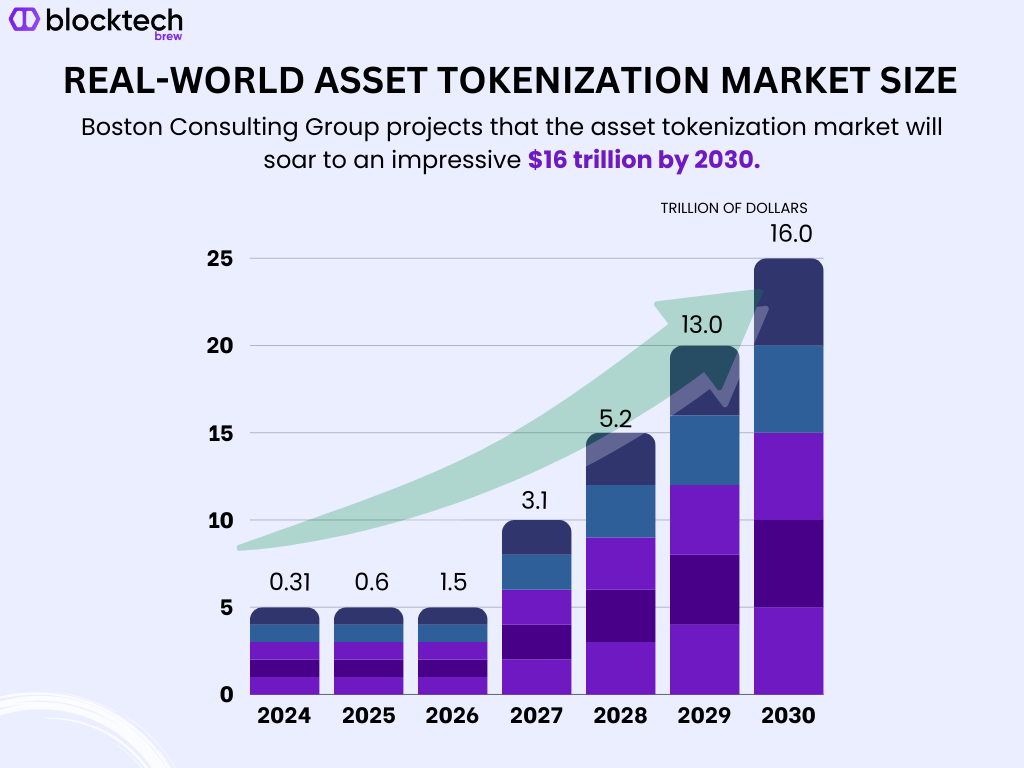
  4. Market Potential: According to Boston Consulting Group, the asset tokenization market is expected to grow significantly to a staggering $16 trillion by 2030, offering substantial opportunities for investors and businesses.
  5. Key Players: Companies like Ondo Finance, Mantra, Polymesh, OriginTrail, and Pendle are leading the way in RWA tokenization.

What is Real World Asset Tokenization?

Real-world asset tokenization refers to converting the assets into digital tokens and storing them on blockchain technology. Thus, the asset is converted into fractions, smaller and more affordable units to given distributed ownership. 

For physical assets, tokenization represents the ownership of the real-world asset. On the other hand, for digital assets, tokenization means turning digital rights or information into a token that can be traded.

Tokens are designed using standards like ERC-20 or ERC-721 to ensure easy trading and management on blockchain platforms like Ethereum, Binance, and Solana.

Which real-world assets can be tokenized? 

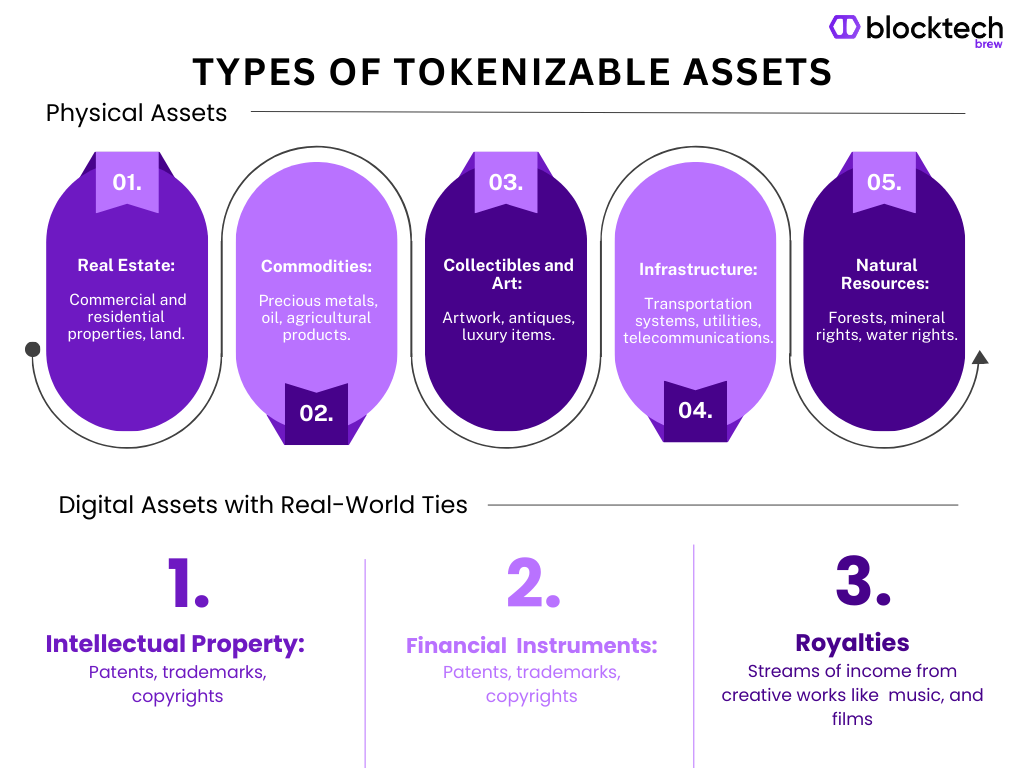
Both tangible (physical), including real estate, commodities, art, infrastructure, and natural resources,  and non-tangible (digital) assets, including intellectual property (IP), financial instruments, and royalties, can be tokenized. Below is the breakdown: 

Types of Tokenizable Assets

Physical Assets

  • Real Estate: Commercial and residential properties, land.
  • Commodities: Precious metals, oil, agricultural products.
  • Collectibles and Art: Artwork, antiques, luxury items.
  • Infrastructure: Transportation systems, utilities, telecommunications.
  • Natural Resources: Forests, mineral rights, water rights.

Digital Assets with Real-World Ties

  • Intellectual Property: Patents, trademarks, copyrights, which are digital rights with real-world applications and value.
  • Financial Instruments: Stocks, bonds, and derivatives that exist in digital form but represent ownership or debt in real-world companies and projects.
  • Royalties: Streams of income from creative works like books, music, and films, which, while digital, are tied to real-world revenues.

How Big Is The Real-World Asset Tokenization Market?

According to Boston Consulting Group, the asset tokenization market is estimated to grow to a staggering $16 trillion by 2030. 

The fun fact here is that only 0.3% of the total market size is currently captured. Hence, it is an early state with low-level market penetration right now, which directly means that this is a diamond opportunity for forward-thinking investors, institutions, and managers to build technologies in asset tokenization fields or start new ventures. This will help you position yourself as the supreme brand in the industry, thus making huge profits. 

RWA tokenization market size

Reach out to BlockTech Brew to get your cost-effective and top-performing RWA tokenization platform developed. 

Examples of Real World Asset Tokenization in Crypto 

Following are some examples depicting how RWA tokenization works in crypto: 

Real Estate Tokens 

Real estate is one of the widely used and promising cases of tokenization. Tokenizing real estate involves breaking digital ownership into smaller digital tokens or pieces. Real estate transactions usually require large amounts of funds to make any investment. By tokenizing the property, it becomes easy to buy or sell shares in individual properties in small proportions without depending on intermediaries like banks for loans. 

Bonds Tokens 

Tokenizing bonds is a growing trend in asset tokenization. It simplifies the bond issuance process and automates tasks like interest payments and maturity settlements. This reduces intermediaries and transaction costs, making bond markets more efficient and accessible.

Carbon Credits Tokens 

Carbon credits allow businesses to emit some carbon dioxide or other greenhouse gases. They put a limit on such emissions to reduce air pollution. When a company emits less gas in proportion to carbon credits, it trades it to the company, which is expected to emit more such gases. Tokenizing carbon credits can make the market more transparent and efficient. It allows smaller companies to buy and sell fractional credits easily. This approach could increase participation in the green economy and create new opportunities.

Process of Real-World Asset Tokenization


The process of RWA tokenization involves the following steps: 

Step 1: Asset Identification & Regulatory Setup.

Step 2: Digital Token Creation.

Step 3: Smart Contract Deployment

Step 4: Token Distribution and Sale.

Step 5: Asset Management and Governance.

Step 6: Secondary Market Trading

Process of RWA tokenization

Below are the detailed explanations determining how tokenization works: 

Asset Identification & Regulatory Setup

Asset Identification & Regulatory Setup involves selecting a real-world asset to tokenize, such as real estate or commodities, and evaluating its suitability for digital representation. The regulatory setup ensures compliance with legal requirements, including property rights and financial regulations. This step establishes the legal framework needed to support the tokenization process and safeguard both the asset and its digital representation.

Create The Digital Token 

Creating digital tokens that represent the fractions of real-world assets is the first tokenization process. For this, one can set up a legal entity to own the property, with tokens representing its shares. Token holders are entitled to a portion of the property’s value and benefits, like rental income or appreciation. 

Smart Contract Implementation  

As the second step, a smart contract is implemented to tokenize the asset. Smart contracts are online digital contracts or programs that automate the transactions for blockchain operations. For instance, in real estate, smart contracts will be automated, carrying all the buy, sell, and trading operations like issuance, balance tracking, distribution of rental incomes, payouts, and payments associated with the maintenance of the property.   

Token Distribution & Sale  

Once the digital tokens are created and smart contracts are deployed, tokens are sold to investors. Different types of sales, like public sales, which are open to everybody, private sales for existing investors, or whitelist sales that combine these two are organized to attract investors. Thus, this third step allows more people to invest in the asset, creating a larger and more liquid market. 

Asset Management & Governance 

With each token the investor holds comes the authority to manage the asset, participate in related operations, and make decisions. For example, in real estate, token holders can take part in rental operations, property maintenance, renovations, tenant relations, and so on. The level of control given to token holders and the voting process must be detailed in the legal entity’s charter and programmed into the smart contracts. This ensures token holders know their rights and how to participate in decision-making. 

Secondary Market Trading  

After the initial launch, tokens representing shares in the real estate property can be traded on secondary markets. This is where the liquidity benefits become evident. Unlike traditional real estate, which can be difficult to sell, token holders have the flexibility to sell their shares at any time. This creates a more dynamic and accessible market, allowing token holders to find potential buyers more easily and explore different price points. This increased liquidity can make real estate investments more attractive and manageable.

What are the benefits of real-world asset tokenization?

The following are the benefits of real-world asset tokenization:

Increased Liquidity 

Tokenization has been seen to improve the liquidity of illiquid assets. With tokenization, an asset is broken down (digitally) into millions or billions of tokens, forming small fractions that are bought, sold, and traded easily. All these transactions are carried out using automated smart contracts, eliminating the need and costs for intermediaries like banks and third parties, thereby making the assets more liquid. 

Enhanced Accessibility 

In the real-world scenario, meeting the high financial demands of personal and commercial properties in the preferred geographical area is challenging. Tokenization works digitally and hence eliminates these geographical boundaries as well as financial constraints for people. When any property, especially commercial ones, gets tokenized and ownership is distributed, any person from any part of the world can invest in it and start new earning streams. 

Improved Transparency 

All the data on asset transactions gets stored on the blockchain ledger, immutably in a decentralized manner. This enhances the transparency, reliability, and availability of such data without compromising its security.

Greater Composability 

Composability in asset tokenization connects real-world assets to the decentralized finance (DeFi) ecosystem. This allows users to earn interest from tokenized assets, boosting DeFi liquidity and giving retail investors access to new investment opportunities. Asset tokenization will provide smart contract developers numerous opportunities to create synthetic assets, indexes, and token baskets by combining various tokens. Additionally, turning real-world revenue streams into collateral will further innovate the DeFi space.

Top Companies Dealing in Real-World Asset Tokenization: 

Now that we have understood the concept of exponential growth let us see some examples  of RWA tokenization:

Ondo Finance (ONDO) 

Ondo Finance is a leader in Real World Asset (RWA) tokenization, connecting traditional finance with decentralized finance (DeFi). It tokenizes real-world assets, making them accessible and liquid on blockchains. Key products include OUSG, the first tokenized US Treasuries product, and Flux Finance, a lending protocol using tokenized Treasuries as collateral in DeFi. The ONDO token is used for governance within the Ondo DAO, allowing holders to vote on the protocol’s future direction and development.

Mantra (OM) 

Mantra is a Layer 1 blockchain platform that tokenizes real-world assets (RWAs). After raising $11 million led by Shorooq Partners, a major investor in the MENA region, Mantra is set to advance RWA tokenization. The funding will help Mantra build regulatory-compliant infrastructure, provide tools for developers to create RWA protocols, and expand asset tokenization. Mantra aims to make investments more accessible, especially in the Middle East and Asia, by increasing market liquidity and promoting economic growth.

Polymesh (POLYX)

Polymesh is a specialized public permissioned blockchain designed to improve the security token industry. It focuses on tokenizing securities, adding real-world value to the market. Polymesh addresses key challenges like governance, identity, compliance, confidentiality, and settlement. This institutional-grade blockchain simplifies and secures the process of bringing real-world assets to the blockchain, promoting a more efficient and transparent market. It combines the reliability of private networks with the openness of public chains, creating a trustworthy ecosystem for all participants.

OriginTrail (TRAC) 

OriginTrail enhances trust and transparency in supply chains using its Decentralized Knowledge Graph (DKG). This technology combines blockchain and knowledge graph methods to create AI-ready Knowledge Assets. It ensures secure and verifiable data exchange across sectors like supply chains, healthcare, construction, and the metaverse. OriginTrail aims to improve data ownership, discoverability, and trust, combating misinformation. By organizing trusted AI-ready Knowledge Assets it supports a sustainable global economy and plays a key role in real-world asset tokenization.

Pendle (PENDLE)

Pendle is a decentralized protocol that changes how yield-bearing assets are managed in DeFi. It allows users to tokenize these assets into Principal Tokens (PT) and Yield Tokens (YT), enabling advanced yield management. Users can trade future yields and principal separately on Pendle’s Automated Market Maker (AMM). This offers new investment opportunities and flexibility in handling yield-bearing assets. By tokenizing the yield component, Pendle lets investors speculate on yield changes and optimize their yield strategies over time.

What are the challenges of RWA tokenization?

Though tokenization brings a lot of benefits for traders and investors, it is still important for the public to evaluate the challenges it brings. Here are the potential challenges stated: 

Regulatory Fluctuations 

In many countries, there are no strict regulations for blockchain and cryptocurrencies to be followed. Thus, building stable platforms for issuers and investors with secure cross-border transactions is a challenge. As blockchain is being adopted widely and is expecting tremendous growth in its market size, we can expect some stability in blockchain-related laws and regulations as well. 

Market Adoption & Liquidity 

Tokenized assets promise greater liquidity, but this relies on widespread adoption. If investors don’t trust tokenized assets or blockchain technology, or if the supporting infrastructure is lacking, building a robust market can be difficult. Establishing trust and developing the necessary systems are crucial for achieving the liquidity benefits that tokenization aims to offer.

Security Breaches 

Most of the crypto projects today have security threats, like decentralized finance protocols being hacked and many kinds of data breaches. Financial institutions can reduce these risks by using private blockchains, but this might limit the openness and decentralization benefits of tokenization.

Education Gap 

Blockchain and cryptocurrencies are taking over the world, but many investors and traders still do not know the depths of this field. Thus, to overcome this gap, it is necessary for people to educate themselves about blockchain, its working, benefits, and risks. 

Operational Complexity 

Many crypto platforms have complex user interfaces, which makes it harder for commoners to enter the blockchain world. Hence, if you work with a top blockchain company like BlockTech Brew, you can develop fascinating, user-friendly interfaces, which will eventually help you attract a lot of investors. 

To overcome all these challenges in your RWA solutions, you must collaborate with a company that has the right kind of knowledge and expertise to provide you with secure, user-friendly, and scalable solutions to grow your blockchain venture! 

If you are looking to launch your top-notch real-world asset tokenization app, then don’t miss your free consultation with the world’s best blockchain development company, BlockTech Brew. 

Here, you not only get delivered with high-end solutions, but our marketing team also helps you with 360-degree points of view to help you earn high returns from your business.  

Reach out to us via email: business@blocktechbrew.com to know more.

Categories
Blockchain Crypto Coin

Solana Actions and Blinks: Ultimate Guide 2024

Solana is a widely adopted blockchain network in various areas like finance, transactions, gaming, etc. Solana is a scalable blockchain optimized with user preferences; hence, developers can develop their blockchain applications to achieve product-market fit. Unlike blockchains with slow response times and high costs, Solana is a low-fee platform with a 400ms confirmation time and high throughput that helps build user-friendly applications.

In this blog, we will explore Solana Actions and Blinks, the features of Solana that further enhance the user experience of decentralized applications (dApps) and services on the network.

What are Solana’s Actions?  

Solana actions act as APIs (Application Programming Interfaces) that allow developers to define how to create Solana transactions on the blockchain. They provide a way to pass transactions from the application directly to the user. These actions can embed different functionalities within the Solana ecosystem into the applications. Transactions in Solana work in two ways: 

  • GET Request: The client sends a GET request to the Action URL to get information about available actions, like the program name, icon, and actions. This helps in creating a user interface for the actions.
  • POST Request: After the user selects an action, the client sends a POST request to the Action URL to get a transaction or message for signing. The user’s wallet signs it and sends the transaction to the blockchain.

Key points about Solana’s Actions: 

Predefined Operations 

Actions are pre-defined instructions or programs that are executed on the Solana blockchain, such as transferring tokens, interacting with smart contracts, or staking.

Metadata-Rich 

Each Action contains metadata that describes what it does, making it easier for users and applications to understand and interact with it.

Integration with Blinks 

Actions have integrated blinks (blockchain links) that allow Solana actions to be shared across various platforms and be easily accessed.  

Client Support

Actions require supporting client applications, such as browser extension wallets or bots, to facilitate the user’s interaction with the blockchain. These clients help users sign transactions and ensure the secure execution of Actions.

Web and Social Media Interaction

Solana actions can be integrated into social media and web platforms, allowing users to access the platforms directly from these interfaces without navigating to separate dApps. 

How do Solana’s Actions work?

The client initiates the GET request to fetch metadata about available actions on the URL, and the user interface gets displayed to the user so they can choose the desired action. The user selects an action, and the client sends a POST request to obtain the transaction. 

Action URL generates and forwards an encoded transaction as selected by the user. The user’s wallet signs the transaction, and is finally sent to the blockchain network.

Advantages of Solana Actions 

The following are the advantages of Solana Actions: 

Fast Processing 

Solana has a smooth and efficient pathway to execute actions and thus performs faster processing in a large-scale network, ensuring users experience minimal waiting times. 

Minimal Delays

Solana’s architecture minimizes delays, ensuring that transactions are confirmed and finalized swiftly. This low-latency environment enhances the user experience by providing real-time interactions and immediate feedback.

High Flexibility 

Solana offers a versatile framework that can be opted for a wide range of applications and use cases. With such flexibility, developers can create customized solutions tailored to specific needs, making it easier to integrate and deploy various blockchain-based functionalities.

Solana Blinks 

Solana actions get converted into metadata-rich links called Blockchain Links or Blinks. They make the actions shareable, enabling the clients to showcase more functions to users. Website blinks can instantly show transaction previews in wallets without any redirection to decentralized applications (dApps). 

Solana Blinks are integrated with wallets like Phantom, Backpack, and Solflare, allowing websites and social media platforms to start Solana transactions directly. Hence, like HTTP URLs, any website can execute Solana transactions using Blinks. 

Key points about Solana’s Blinks:

Smooth User Experience 

By enabling users to access actions flexibly from social media platforms without navigating to decentralized apps, blinks provide users with a smooth and hassle-free experience to users. 

Functionality Expansion 

In platforms like Discord, bots can expand Blinks into interactive buttons, providing users with more functionality and easier access to blockchain interactions.

Web 2 and Web 3 Integration 

Blinks bridge the gap between Web 2 and Web 3 applications, making it easier to incorporate on-chain interactions into existing web interfaces.


How do blinks detect actions?  

Blinks detect Actions through the Solana Action URL scheme. Here’s how it works:

Actions URL Scheme 

The URL follows a specific format:

solana-action:<link>

Here, <link> is the Action API URL that contains the necessary information about the Action.

Parsing the URL

When a Blink is clicked or accessed, the supporting wallet or client application parses the URL to identify the Solana action scheme.

Decoding the Action 

The client application decodes the URL-encoded Action API link to extract the necessary metadata and details about the Action.

Executing the Action 

Once the Action details are obtained, the client application can display the relevant information to the user and initiate the appropriate blockchain transaction or interaction. This could involve displaying a transaction preview, requesting user approval, and submitting the signed transaction to the Solana blockchain.

Conclusion:

Hence, Solana’s actions and blinks revolutionize the way people interact with the blockchain network, making it easier for users to integrate solana transactions on the blockchain. Moreover, like web links, the action API can be accessed from any third-party platform, further contributing to Solana’s wide adoption and scalability. 

Are you seeking to develop innovative and efficient Blockchain solutions? Stop your hunt here! Blocktech Brew, a leading Blockchain developer has everything you need to turn your vision into reality. 

Reach out to us at business@blocktechbrew.com, and let us introduce you to a new world of blockchain possibilities.

Categories
Blockchain

Node Sales Explained: A Beginner’s Guide

Similar to fundraising mechanisms for crypto like ICOs and ILOs, node sales are another popular capital-raising model for blockchain networks. In this blog, we will understand the concept of node sales and open doors for you to explore this innovative fundraising approach. 

Role of Nodes in Blockchain 

Before diving into the depths of node sales, let us review what nodes are and their role in a blockchain network. 

Blockchain is a decentralized network that has various nodes that are interconnected to each other. Nodes in a blockchain network are physical devices like computers that store key information, including metadata of all types of transactions in the blockchain. Having data stored in a distributed manner, the node ensures security and transparency across the blockchain network.  

Nodes can be of two types: Full nodes and Lightweight nodes. As the name says, full nodes are the ones that store all the validated transactions, including the past and present ones. Whereas lightweight nodes do not have a record of all the blockchain transactions, they can extract the required transaction data from full nodes. 

What are Node Sales? 

Node sales are a fundraising way out for blockchain and crypto projects in which buyers (individuals or entities) purchase a license (Node License) to operate on one or more nodes in a blockchain network. This process can be an initial sale during the launch of a network or an ongoing opportunity for new participants. Moreover, many projects that launch node sales structure price tier, which means prices are lower at first and then rise over time. This develops FOMO (fear of missing out) among the participants, leading to quick sellouts of nodes. 

Examples of Node Sales

Let us go through examples of some successful node sales: 

XAI 

XAI is a Layer 3 game built on Arbitrum that launched the first node sale in November 2023, through which they sold around 34,000 nodes and raised a capital of $40 million in three months. XAI gave 50% of their tokens as rewards to the node operators and supplied over 1 million XAI tokens to the early sale participants as tokens of rewards for free. 

Aethir 

Aethir node sale was launched in March 2024 and is one of the major successes in the Web 3 decentralization era. It overperformed XAI node sales and sold around 73,800 checker nodes, raising $120 million in capital in just one month. 

Sophon 

Sophon is a modular Layer 2 chain with an entertainment ecosystem that leverages zkSync’s Hyperchain technology and uses Celestia for its Data Layer. Like Aethir, Sophon also gained immense success through its node sale launched in May 2024. Sophon raised around $60 million by selling 121,000 nodes in less than a month. 

Examples of Node Sales 

Node Sale  Launched In?  Number of Nodes Sold  Fund Raised 
XAI  November 2023  34,000 nodes  $40 million (3 months) 
Aethir  March 2024  73,800 nodes  $120 million (1 month)
Sophon  May 2024  121,000 nodes  $60 million (less than a month)

Examples of node sale

Why Node Sales? 

Apart from high capital-raising capacity, node sales benefit both users and projects. The given points below signify why users and projects should participate in the node sale: 

For Users 

  • Golden opportunity to become a stakeholder in a potentially growing project. 
  • Financial rewards given in the node sales can contribute to the user’s passive income. 
  • Users can have voting rights and decision-making authority in the project’s decisions and governance. 

For Projects 

  • Through node sales, projects can raise funds, distribute network control, and encourage decentralization. 
  • Node sales ensure that no single entity has full control over the network, enhancing the project’s security and resilience. 
  • Node sales have broader public participation, which helps the business to promote the project and attract a dedicated user base, leading to long-term success. 

Hence, all the above advantages of node sales contribute to its popularity, making it fascinating for new ventures in the blockchain field. 

Who can launch Node Sale?

Node sales can be launched by various entities within the blockchain and cryptocurrency ecosystem, each with specific purposes and target audiences. 

  • Blockchain Projects: Startups and existing networks.
  • DeFi Platforms: Decentralized Finance Platforms.
  • Infrastructure Providers: Staking-as-a-service companies.
  • DAOs: Decentralized Autonomous Organizations.
  • Consortiums and Alliances: Industry-specific groups.
  • Investment Firms: Blockchain-focused investors.

Who can participate in the Node Sale? 

Participation in a node sale is open to all. Individuals interested in blockchain and crypto projects or businesses can invest in node sales. 

  • Individuals: Cryptocurrency enthusiasts and investors.
  • Staking Service Providers: Manage nodes for clients.
  • Developers and Validators: Contribute to network operations.
  • Institutional Investors: Various funds and firms. 
  • DAOs: Decentralized Autonomous Organizations.
  • Community Members: Blockchain enthusiasts.
  • Governments: Explore blockchain technology.
  • Partnerships: Collaborative blockchain initiatives.

How Node Sales Work?  

Most of the projects that launch node sales follow Structured Pricing Tiers. This means that node licenses are first sold at low prices, and prices are raised over time to create a sense of urgency among the public, which helps rapidly sell nodes. 

The node license is the right and authority given to the participant to operate on one or more nodes. Every node license has a set Non-Transformable Period from a few months to a year that ensures the dedication and stability of the participants in the network. 

Also, different types of sales, like Public Sales and Whitelist Sales, are thrown in to attract as many participants as the project can. The public sale is open to all, while a whitelist sale is a private sale where an already-approved list of participants is given access to special benefits during the sale. Hence, businesses reward the early contributors and participants for their support. 

To operate on the nodes, users must download and install it. Moreover, different project nodes have specific Software Requirements tailored to their networks. Users who do not know how to run nodes can opt for Nodes-as-a-Service (NaaS), which will facilitate the process at a nominal fee.

Any project that launches node sale follows a Reward Structure where a specific percent or portion of their token supply is reserved to be given as rewards to node operators. For instance, 15% of the token supply was reserved in Aethir for checker node rewards. The reward for each node operator is proportional to the number of active nodes across the network. These rewards are given gradually over time to ensure participants’ longer commitment. However, if a party withdraws their rewards early, they may incur a penalty or forfeiture of benefits.  

Process of Node Sales  


The following are the steps involved in node sales: 

Process of Node Sales

Announcement & Registration 

The project first announces the node sale details, dates, benefits, and financial and technical requirements. Interested participants register for the node sale and complete KYC/AML verification if required.

Node Purchase & Setup 

Participants purchase tokens through smart contracts or token sale platforms to acquire nodes. They then download and install the software required to run the node. 

Node Activation & Governance 

Nodes get activated, allowing participants to engage in network activities, decision-making, voting, contributing to its operations, governance, and security. 

Earning & Withdrawing Rewards 

Node operators are given rewards through transaction fees and block rewards gradually over the vesting period. Some may withdraw the rewards early after paying a penalty fee or forfeiting benefits. 

Ongoing Engagement 

Node operators continue to engage with the project community, contributing to growth and stability and participating in governance. 

Benefits of Node Sales 

Node sales bring several benefits that are mentioned below: 

Improved Decentralization & Security 

Earlier nodes offered a limited profit potential and had more infrastructure expenses. But now, nodes have become profitable and thus gain popularity. Broader adoption of nodes reduces the chances of few entities controlling the network, which reduces the risk of centralization. Hence, this distributed authority promotes decentralization, security, and network transparency. 

Increased User Involvement & Engagement

In the past, token holders and node operators were separate groups, and the latter were smaller due to technical barriers and consensus mechanism constraints. However, today’s projects release many node licenses, attracting many node sale participants. Moreover, the reserved token rewards and decision-making authority promote broader and deeper engagement of node operators.  

Efficient Fundraising  

Unlike other fundraising mechanisms, node sales avoid distributing many tokens to private investors and ensure that a significant portion stays reserved for the community. Also, the node sale funding attracts only dedicated blockchain and crypto enthusiasts who invest in the project for the long run. Thus, node sales are an efficient fundraising way out that benefits both the participants and the projects. 

Risk & Challenges 

With numerous benefits of node sales also come some risks and challenges, which both parties must know: 

  • Market Fluctuations: Like any other crypto project, the value of tokens and rewards keeps fluctuating and is prone to losses. Therefore, investors must thoroughly research before investing in a node sale event. 
  • Regulatory Challenges: There are no set standards and regulations related to node sales, and thus, compliance with law and taxation remains uneven, and changes occur frequently. 
  • Operational Risks: Software engineers and computational resources would be required to perform continuous monitoring and improvement to ensure the smooth working of the nodes.

Hence, node sales are a great option for any new startups in the blockchain and cryptocurrency domain. It would not only. They would not only raise loads of funds for the project but also build a loyal customer base that would contribute to the project’s success in the long run. 

To get consultations about node sale launch and participation, you may get in touch with Blocktech Brew via email at business@blocktechbrew.com 

We are known to deliver the best blockchain, metaverse, and AI projects worldwide! 

Categories
Blockchain

How to build a blockchain app: Step-by-Step Guide

Are you curious about developing a blockchain app? Then stop your hunt now, as this blog is for you! From the basics of blockchain to a complete guide for developing a dApp, we have brought everything to your fingertips. 

What is Blockchain? 

A blockchain is a network of blocks or nodes which store different types of data. Nodes are physical entities like computers that store code and data on all the transactions across the blockchain network. Thus, the data is stored in a distributed manner, making it decentralized. 

All the blockchain nodes get bundled together and form a public ledger. This ledger ensures the immutability and security of the data. To participate in the node chain, one can either run their node or connect to one.  

What is a Smart Contract? 

A smart contract is an immutable programmed contract that is self-executive to carry out blockchain operations smoothly and securely. 

Smart contracts work as a middle entity to facilitate operations between the user and seller. For example, if a user buys an item via the NFT marketplace and pays ETH crypto tokens. The tokens will first be sent to the smart contract, which will act as a mediator and pass them on to the seller, dispensing the item to the buyer. 

Now that you know the concepts of blockchain and smart contracts, let’s move forward to the step-by-step guide to creating a blockchain app. 

Steps to Build a Blockchain App

For your ease, we have broken down the development process into 7 steps and simplified it further so that even a non-engineer can understand. These are the following steps:

  • Setting Up A Development Environment
  • Writing Smart Contracts
  • Develop Backend
  • Create Front End
  • Implement Security Measures
  • Deploy The Blockchain App
  • Launch And Promote The App


Setting Up A Development Environment

Setting up your development environment is crucial for a smooth blockchain app development process. Here’s what you need to do:

  • Choose a blockchain platform: Research and select a platform that fits your project needs. Popular options include Ethereum, Binance Smart Chain, and Solana. Consider factors like transaction speed, costs, and community support.
  • Install necessary tools: Set up Node.js and npm (Node Package Manager) for managing JavaScript packages. Install a code editor like Visual Studio Code with relevant blockchain extensions.
  • Set up a blockchain framework: Install a development framework like Truffle or Hardhat for Ethereum-based projects. These tools simplify the process of compiling, testing, and deploying smart contracts.
  • Install a local blockchain: Set up a personal blockchain for testing, such as Ganache for Ethereum development. This allows you to deploy and test your contracts in a safe, local environment.
  • Set up a wallet: Install a cryptocurrency wallet like MetaMask. This will allow you to interact with your blockchain application and manage digital assets.
  • Version control: Initialize a Git repository for your project to track changes and collaborate with others effectively.

Writing Smart Contracts

Smart contracts are the fundamental component of most blockchain applications, and writing them effectively is our next crucial step: 

  • Choose a smart contract language: Learn Solidity for Ethereum-based projects or languages like Rust for other platforms like Solana.
  • Understand basic structures: Familiarize yourself with contract structures, including state variables, functions, events, and modifiers.
  • Implement core functionality: Write the main features of your application into smart contracts. This could include token creation, voting systems, or decentralized finance (DeFi) protocols.
  • Follow best practices: Adhere to smart contract development best practices, such as the checks-effects-interactions pattern and proper access control.
  • Optimize for gas: Learn techniques to minimize transaction costs on the blockchain by optimizing your contract code.
  • Test thoroughly: Write comprehensive tests for your smart contracts to ensure they function as intended and handle edge cases properly.

Develop Backend

While smart contracts handle on-chain logic, a backend is often necessary for off-chain operations and to bridge your blockchain with traditional web services:

  • Choose a backend technology: Select appropriate languages and frameworks. Node.js with Express or Python with Django are popular choices.
  • Integrate with blockchain: Use Web3 libraries (like web3.js or ethers.js for Ethereum) to interact with the blockchain from your server.
  • Develop APIs: Create RESTful or GraphQL APIs to serve data to your front end and handle complex operations.
  • Manage databases: Set up and manage databases for storing off-chain data that complements your blockchain operations.
  • Implement caching: Use caching strategies to reduce the number of blockchain queries and improve performance.
  • Handle asynchronous operations: Develop systems to manage blockchain transaction confirmations and event listening.

Create Front End

The front end is your users’ window to your blockchain app. It needs to be intuitive and capable of interacting with the blockchain:

  • Choose a frontend framework: Select from options like React, Vue.js, or Angular based on your team’s expertise and project requirements.
  • Implement Web3 libraries: Integrate libraries like Web3.js or ethers.js to enable blockchain interactions from the browser.
  • Design user interfaces: Create intuitive UIs for complex blockchain operations. Consider using UI component libraries to speed up development.
  • Manage user accounts: Implement wallet connection features and account management functionality.
  • Handle blockchain transactions: Design interfaces for initiating and monitoring blockchain transactions, providing clear feedback to users.
  • Ensure responsiveness: Make your app work well across various devices and screen sizes.
  • Focus on user experience: Design your app to abstract away blockchain complexities, making it accessible to non-technical users.

Implement Security Measures

Security is paramount in blockchain applications, as they often handle valuable assets:

  • Audit smart contracts: Conduct your smart contracts audits thoroughly, preferably by professional auditing firms.
  • Implement access control: Ensure proper permission systems in your contracts and backend.
  • Secure key management: Implement best practices for handling private keys and signatures.
  • Protect against common vulnerabilities: Guard against issues like reentrancy attacks, integer overflow, and unauthorized access.
  • Secure the front end: Implement measures to prevent common web vulnerabilities like XSS and CSRF.
  • Conduct penetration testing: Regularly test your application for vulnerabilities.
  • Plan for upgrades: Design your contracts with the ability to upgrade safely if needed.

Deploy The Blockchain App

Deploying your blockchain app involves several steps to ensure it runs smoothly in a live environment:

  • Choose deployment environment: Decide between testnets and mainnets based on your app’s readiness.
  • Deploy smart contracts: Use your development framework (like Truffle or Hardhat) to deploy contracts to the chosen network.
  • Verify contracts: Submit your contract code for verification on block explorers for transparency.
  • Set up backend infrastructure: Deploy your backend to reliable cloud services or dedicated servers.
  • Configure frontend hosting: Choose and set up hosting for your frontend application.
  • Implement monitoring: Set up logging and monitoring solutions for all components of your app.
  • Conduct final testing: Perform thorough testing in the production environment before the official launch.

Launch And Promote The App

When you’re ready to launch your app, you need to get the word out. Start by planning to tell people about it, especially those who like blockchain. Talk to potential users on social media and at events. Make videos or write posts that show what your app can do. Team up with other projects if you can. Always listen to what users say and use their ideas to improve your app. Keep thinking about adding new features later. This way, you’ll build a community of people who like your app and want to keep using it. Remember, promoting your app is just as important as making it in the first place. It’s how you get people excited and interested in your creation.

By following these expanded steps, you’ll be well-equipped to create, deploy, and promote your blockchain application successfully.

What is the estimated cost of developing a Blockchain app? 

The total estimated cost for a basic blockchain app can expect to spend at least $30,000 to $120,000. More complex applications with advanced features could cost $250,000 or more.

Here’s a breakdown of potential expenses:

  • Development team: The bulk of your budget will likely go toward hiring skilled developers. Blockchain developers command high salaries, often ranging from $150,000 to $250,000 per year.
  • Smart contract development: This can cost anywhere from $7,000 to $45,000, depending on the complexity of your contracts.
  • Frontend and backend development: Expect to spend $15,000 to $50,000 for a basic app, with costs increasing for more complex features.
  • Design: UI/UX design might cost between $5,000 to $15,000.
  • Security audits: A crucial step that can cost from $5,000 to $30,000, depending on the scope of your project.
  • Infrastructure and hosting: Ongoing costs can range from $100 to $1,000 monthly.
  • Marketing and promotion: Budget at least $10,000 to $50,000 for initial marketing efforts.

Remember, these are rough estimates, and actual costs can vary significantly based on your specific requirements, your team’s expertise, and current market rates.

Conclusion:

Creating a blockchain app is an exciting journey combining cutting-edge technology and innovative problem-solving. Each step presents unique challenges and opportunities, from setting up your development environment to launching and promoting your app.

As explored in this blog post, the process involves careful planning, skilled development, rigorous security measures, and strategic deployment. While the technical aspects are crucial, don’t underestimate the importance of user experience and community building in the blockchain space.

As you embark on this exciting path, remember that persistence, continuous learning, and a user-centric approach are key to creating a successful blockchain application. Good luck with your blockchain project!

Reach out to BlockTech Brew via email: business@blocktechbrew.com to get free consultations on your blockchain project!

Categories
Blockchain Web3

IPFS Storage: Resilience, Speed & Freedom

In today’s digital age, where data is the key component of all industries, how we store it matters more than ever. In this blog, we will discuss the traditional storage system and the problems that triggered the rise of IPFS storage. We would explore the power of IPFS and unlock a new era of secure, permanent, and censorship-resistant storage.

What is IPFS? 

The InterPlanetary File System (IPFS) is a decentralized file system that is used to store and share files across different nodes and allow individuals to track and see their different versions over time. Unlike the client-server architecture that stores files on a centralized server, IPFS provides a distributed network shared among different bodies. Thus, it facilitates quicker and more reliable access to files. 

Problems of Centralized Storage System 

Before diving into the details, let us first read about the problems that came up with the centralized storage systems, which caused better ways of storing files, i.e., IPFS and decentralized networks, to be introduced. 

  • Censorship Risks

In centralized networks, the central body has the authority to censor the information that it thinks is harmful or incorrect. Hence, this limits free speech and access to information. 

  • Vulnerability to Single Points of Failure

In centralized storage systems, if the central system fails or undergoes a security breach, the entire network will fail, and this is called a single point of failure. 

  • Innovation Constraints

Entities with centralized control often possess exclusive control over information and resources, hindering competitive dynamics and curtailing the scope for innovation.

  • Privacy Concerns

As all the data is stored in a single location, it becomes vulnerable to breaches and hacking, and hence, raises questions on the privacy and security of the sensitive information of users. 

  • Wealth Distribution Disparities

Wealth among the centralized systems is distributed very unevenly; for example, most of the wealth would be given to the centralized systems and barely distributed among the users. 

On the other side, decentralized storage networks like IPFS majorly solve all these issues and allow users to have evenly distributed power, wealth, and security. 

IPFS and Blockchain 

Blockchain is a distributed, decentralized data management network that offers top-notch features like transparency, and traceability. As both IPFS and blockchain have similar features, blockchain comes at the forefront of recording the file metadata to support IPFS. Moreover, both blockchain and IPFS serve different purposes in the real world. To have a more comprehensive understanding, let us first know about both of them separately. 

IPFS v/s Blockchain- What’s the difference?

Blockchain, the decentralized ledger is widely used in today’s age to store data on different transactions in a distributed and transparent manner. It has consensus methods, and cryptographic algorithms to ensure the safety and integrity of the data stored on blockchain. Blockchain has various applications across different industries like decentralized applications (DApps), decentralized finance (DeFi), crypto industry, blockchain gaming, decentralized identifiers (DIDs),  and so on. 

On the other hand, IPFS aims to provide a global decentralized file system network that can tackle the problems associated with traditional web protocols. It is resistant to censorship, and mutability, and allows the files to be stored in an efficient manner. IPFS ensures that the data stored in it, is unique, by allotting it a unique identifier, and is protected against modifications. If the data gets changed by following the protocol, a new “hash” identifier is generated which would be different from the hash stored on the blockchain for the recorded data. 

Hence, the incorporation of Blockchain supports the working of IPFS, where IPFS stores the files in a decentralized and distributed system, blockchain keeps the track record in a decentralized, and transparent manner, and verifies all the transactions. 

How IPFS Works?

Let us break down the key areas referring to how IPFS stores data: 

Distributed Data Storage 

Inter Planetary File System is a peer-to-peer network that is used to store and share files across multiple nodes. To store files resiliently, IPFS works by breaking down the files into smaller pieces called “blocks’, and storing them in various nodes all over the network. This means that files are stored at multiple locations instead of a single location, thus protecting them from the associated risks with the single point of failure. 

Content-Addressed System 

A content-addressed system is used to name files in the IPFS system. This means that IPFS provides a unique hash of the content instead of location, and names to identify the files. This content-addressing system allows users to download or access files from different nodes even if they were initially uploaded or stored at different locations. Moreover, this system can create permanent and immutable links likewise URLs, which can be used as references to access files when they are moved to different locations. 

Data Retrieval By Nodes 

As noted previously, the storage of content involves a variety of nodes. These can vary from individual personal computers to substantial data centers. Each node plays a role in maintaining a Direct Acyclic Graph (DAG), which effectively maps all the blocks, and simplifies the process of data retrieval. To request a file, a node sends out requests for the blocks that make up the file, and then receives the output that stores them. As the node is done with receiving all the blocks, it reconstructs the file. 

Hence, data is stored and retrieved in a much better and more efficient way by decentralized IPFS storage. 

Applications of IPFS 

The following are the use cases of IPFS storage: 

Scattered Storage for Resilience

IPFS stores files scattered among various nodes at different locations in the form of blocks and ensures that the data can be easily retrieved even if some of the nodes go offline or leave the network, as the files can be reconstructed from the remaining blocks that have crucial information. This redundancy makes the network highly resilient to node failures and network disruptions. 

Global Delivery with Decentralization

When a user requests a file, IPFS from its decentralized storage retrieves the necessary blocks that are present closest to the user, rather than relying on centralized storage systems that may be present far from the user’s location. This reduces the latency, and bandwidth costs, and increases the global accessibility of the data stored. 

Foundation for dApps

Decentralized apps are regular apps but without a central storage point, and that is why IPFS can set the groundwork for dApps to store the data in a secure, transparent, and independent manner. Moreover, the content-addressed and immutable feature ensured data integrity which is quite beneficial for the dApps to provide trustworthy and tamper-proof services. 

Preserving Web History

In the centralized and ever-changing web system, websites rely on centralized servers which may go offline, or remove content. On the other hand, IPFS allows the web to create permanent storage links that can even be used when it goes offline. Also, the websites are replicated making it much harder to replicate. 

Uncensorable File Sharing

As IPFS does not have any centralized server, there is total transparency with no censorship. Also, as the data is stored at multiple nodes it is very hard to erase or remove anything from the network. Thus, IPFS allows free speech without the fear of being restricted. 

Benefits of IPFS 

  • Quicker Content Delivery 

IPFS enables efficient content retrieval by leveraging its decentralized network of nodes, leading to lower latency and faster content delivery compared to traditional web systems. The peer-to-peer architecture allows nodes to retrieve content from multiple sources simultaneously, ensuring high availability and minimizing bottlenecks.

  • Enhanced Data Availability 

With the presence of data at different locations, data availability is increased, with a reduced risk of downtime. Thus, the method of content addressing ensures that the information can be accessed anytime, and anywhere. 

  • Robust Security & Privacy 

IPFS offers cryptographic security which ensures the authorized use of the content stored on the network. Moreover, decentralization provides the benefits of transparency with no vulnerability to censorship and surveillance. 

  • Cost-Effective Storage Solutions 

By leveraging the power of distributed storage, IPFS can help reduce the cost of hosting and serving content, without compromising on speed or security. Its decentralized architecture enables efficient content distribution, ensuring high availability and fast retrieval times. IPFS provides enhanced security and data integrity through content addressing and decentralization.

Conclusion 

The IPFS community is actively working on improving scalability and performance, as well as developing more user-friendly interfaces and tools to make IPFS more accessible to non-technical users. Additionally, there are initiatives underway to encourage more developer adoption and support, including hackathons, developer communities, and educational resources.

Overall, IPFS represents a promising new approach to storing and sharing files in a decentralized, peer-to-peer network. As the internet continues to evolve and face new challenges, IPFS may play an increasingly important role in ensuring a more resilient, censorship-resistant, and decentralized web. By leveraging the power of distributed storage, IPFS offers a cost-effective, efficient, and secure solution for hosting and serving content, without compromising on speed or performance. The future of IPFS looks promising, paving the way for a more open, transparent, and decentralized internet.

IPFS Storage is gaining heights in Web 3 solutions, and Blocktech Brew  is leading the way in Web 3 Development. So, to get your cutting-edge Web 3 and blockchain solutions developed, do reach out to us via business@blocktechbrew.com 

Our Trusted Partners

Meet Our Allies In Building Innovative Solutions Fuelling Growth & Unbeatable Results

Collaboration is key to building innovative solutions that deliver unbeatable results. Our trusted partners and allies share our vision and values, allowing us to work towards common goals. By leveraging each other's strengths and expertise, we can create a powerful force for growth and success.


haken
haken
haken
haken
haken
haken
haken
haken
haken
haken
haken
haken
haken
haken
haken
haken
haken
haken
haken
haken
haken
polygon
haken
haken
haken
haken
haken
bians
Lg-3
Lg-3
Lg-3
bians
Lg-3
Lg-3
bians
Lg-3
Lg-3

Have A Vision?

Share Your Idea Now & Step-Ahead With Innovative Blockchain Solutions.
Let’s Fire Up Your Business!

Team Up With Us Today For An Unforgettable Service Experience

Dubai

Level- 26, Dubai World Trade Centre Tower,
Sheikh Rashid Tower, Sheikh Zayed Rd, Dubai, UAE

business@blocktechbrew.com

+971 55 473 8790

India

Plot no I - 36, Sector 83 Alpha,
Mohali SAS Nagar 140308

business@blocktechbrew.com

+91 771-966-6171

Mexico

Av. Miguel Hidalgo y Costilla 1995, Arcos
Vallarta, 44600 Guadalajara, Mexico

business@blocktechbrew.com

+1 (332) 233-6033

USA

401 Park Avenue South, 10th Floor
New York, NY 10016

business@blocktechbrew.com

+1 (332) 233-6033

UK

2nd floor, College House, 17 King Edwards Rd,
London HA4 7AE, UK

business@blocktechbrew.com

+44 (20) 82644493