Categories
Crypto Coin

Meme Coin Development on TRON

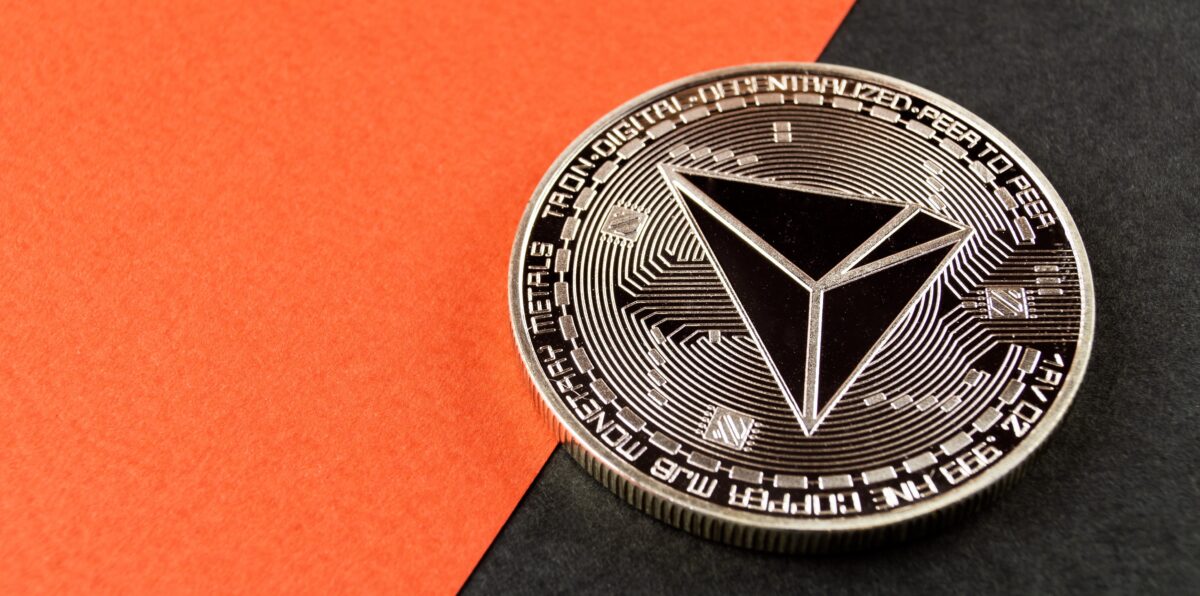
Apart from famous cryptocurrencies like Bitcoin and Ethereum, meme coins are a special type that successfully gains social attention quickly. Meme coins on the Tron blockchain have become quite famous for some time, especially on Crypto Twitter. 

In the previous blog, we helped you to create a meme coin, and, this blog is a guide to help you create your meme on the Tron blockchain network. From features of Tron to meme coin development and its growth potential, we will cover it all!

Why are Meme Coins On Tron Getting Popular? 

Tron is a blockchain-backed platform that is used to develop different decentralized applications. It was launched in 2017 but became a huge success in 2018. Recently, a new meme coin, Sundog, was launched on TRON and gained high popularity. 

A piece of news by Bitcoin Harber threw light on Sundog, launched on SunPump, which quickly hit a $200 million market value in just one week. This boost caused TRON’s price to jump by 12% in the last 24 hours, while Sundog’s value shot up by 237% over the week. As a result, competitors like Solana are falling behind. 

Justin Sun, the founder of TRON, announced that SunPump marks a new chapter for meme coins, which has sparked a lot of activity within the TRON ecosystem. Because of this, the number and value of transactions on TRON have significantly increased. Over the past 30 days, TRON’s (TRX) price has gone up by 19%, even while the prices of major cryptocurrencies like Bitcoin and Ethereum have dropped by 11% and 26%. This makes TRON stand out from other top cryptocurrencies during this period. 

Features Of Tron Supporting Meme Coin Development 

Let us go through the features of Tron that are making it a popular platform for meme coins. 

  • Fast Transaction With Minimal Fees

Tron has a DPoS consensus mechanism that ensures high-speed transactions, which makes it compatible with the fluctuating and fast nature of meme coins. Moreover, the platform has low transaction fees, which makes it cost-effective for developers, investors, and new crypto enthusiasts. 

  • Smart Contract Compatibility 

Smart contracts are important to automate operations and transactions. Smart contracts on TRON are compatible with meme coin mechanics and enable developers to create meme coins with special features like tokenomics, governance models, and decentralized apps (dApps). 

  • Active Community Support and A Dynamic Ecosystem 

TRON has a great community of crypto enthusiasts, developers, investors, and traders who come together to make any meme coin project a big success. Such a dynamic ecosystem creates liquidity for meme coins, contributing to their wide adoption. 

  • Scalable Infrastructure For Growth 

TRON’s architecture can handle large volumes of transactions, which suits the rapidly growing nature of meme coins. Hence, TRON keeps us updated on the ever-evolving market of meme coins. 

  • Social Media Integration With Influencer Partnerships 

Many meme coins communities on TRON are using social media platforms to increase their popularity, enhance community engagement, and promote their adoption. Today, influencer collaborations are common and one of the most effective ways to increase meme coin sales.

  • Dedicated Platform For Meme Coin Launches 

Meme coin launchpads are emerging ways to launch a new meme coin on TRON. They streamline the meme coin launch process and offer marketing support, community-building tools, and safety measures to ensure the success of the meme coin. 

  • NFT and Gamification Integration 

TRON allows the integration of non-fungible tokens (NFTs) with meme coins. NFTs increase the value of meme coins and attract more investors (collectors). Moreover, one can integrate gamification elements, like rewards, challenges, and leaderboards, which makes. This makes TRON meme coins more attractive to users. 

How To Create A Meme Coin On Tron? 

The following are the 7 steps for creating your own meme coin: 

1. Design your token:

Choose a catchy name, unique symbol, and determine the total supply and decimals for your meme coin. Consider creating a simple logo and outlining basic tokenomics. Research to ensure your concept stands out in the crowded meme coin market.

2. Set up a Tron wallet:

Install a Tron-compatible wallet like TronLink. Create a new wallet, securely store your private key or seed phrase, and obtain some TRX for transaction fees. Familiarize yourself with the wallet’s interface and features.

3. Write the smart contract:

Use Solidity to create a TRC20 token contract. Implement standard functions like transfer and balanceOf. Consider adding unique features to differentiate your coin. Use established libraries for security, and thoroughly test your code.

Here’s a basic example of a TRC20 token contract in Solidity:

pragma solidity ^0.5.0;

contract TRC20Token {

    string public name;

    string public symbol;

    uint8 public decimals;

    uint256 public totalSupply;

    mapping(address => uint256) public balanceOf;

 constructor(string memory _name, string memory _symbol, uint8 _decimals, uint256 _totalSupply) public {

        name = _name;

        symbol = _symbol;

        decimals = _decimals;

        totalSupply = _totalSupply;

        balanceOf[msg.sender] = _totalSupply;

    }

    function transfer(address _to, uint256 _value) public returns (bool success) {

        require(balanceOf[msg.sender] >= _value, “Insufficient balance”);

        balanceOf[msg.sender] -= _value;

        balanceOf[_to] += _value;

        return true;

    }

}

4. Deploy the contract:

Use TronIDE or Tron Studio to compile and deploy your contract. Connect your Tron wallet to the IDE and pay the necessary TRX for deployment fees. Double-check all parameters before finalizing the deployment.

5. Verify the contract:

Submit your deployed contract for verification on Tronscan. This step increases transparency and allows users to inspect the code. Provide accurate information about your contract to build trust with potential investors.

6. Create liquidity:

Choose a Tron-based decentralized exchange like JustSwap or SunSwap. Create a liquidity pool pairing your token with TRX or another established token. Provide initial liquidity to enable trading and consider incentives for liquidity providers.

7. Marketing:

Develop a social media presence on platforms like Twitter and Telegram. Engage with the Tron and crypto community. Consider creating a simple website and whitepaper. Run promotions or airdrops to increase awareness and distribute your meme coin.

Why Should You Develop Meme Coin Based On Tron? 

 We have already discussed numerous features of TRON meme coins. Let us summarize the factors depicting why you should invest in meme coin development on TRON. 

Market Growth 

Due to TRON’s favorable conditions for meme coins, the growth of TRON meme coins is dynamically expanding. Also, Sun’s confidence in making a billion-dollar meme coin market on TRON ensures a great return on investment in the future. 

Innovative Trading Features 

SunPump’s features, like one-click token creation and bonding curve pricing, improve the trading experience and have the potential to draw in more investors. These innovations are designed to uphold market integrity and boost community involvement, both of which are vital for the long-term success of meme coins.

Potential For High Returns 

The meme coin market on TRON is relatively new and offers an early advantage to investors. There can be rapid price increases and high returns that can benefit businesses. Moreover, this is a crucial opportunity for businesses that are looking to build a brand in the cryptocurrency world. 

Top Meme Coins On TRON 

Now, we will go through some successful meme coins on TRON. The following are the details: 

Sundog

The Sundog meme coin is based on the natural phenomenon of sundogs. It is known for its active community and frequent giveaways. Sundog has been one of the pioneers in the TRON meme coin space, maintaining a strong following.

Dragon Sun

Dragon Sun is a meme coin with a dragon-themed concept. The coin often hosts community events and giveaways. Dragon Sun has gained a dedicated following due to its unique theme and community engagement.

Sunwokong

Sunwokong is a meme coin inspired by the Chinese mythical figure Sun Wukong. The meme coin has a strong cultural connection and uses Chinese mythology in its marketing and community events. 

Fofar

Forfar is a playful and quirky-themed memecoin. It features humorous content and community-driven initiatives. This lighthearted approach of Forfar has attracted a loyal following.  

Troncat

As the name suggests, Troncat is a meme coin centered around cats. The coin often features cat-related themes and memes. Cat-themed coins have proven popular in the cryptocurrency space, and Troncat is no exception.

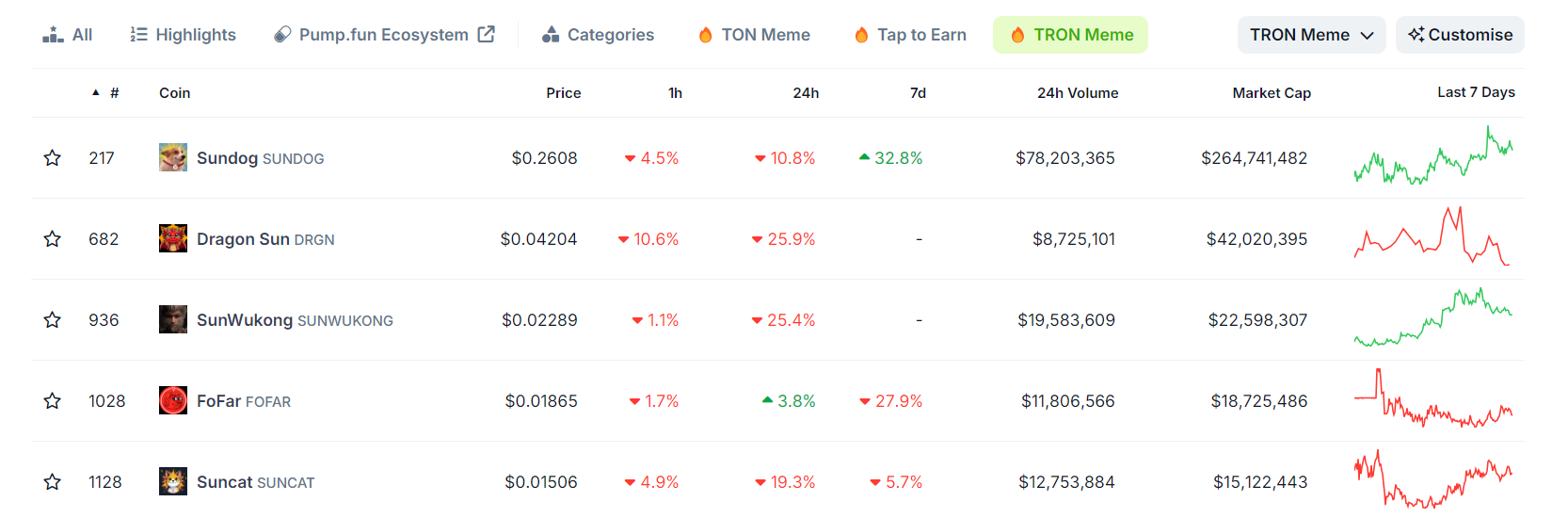
Below are the stats of these TRON meme coins by Coin Market Cap. From the chart, we can see that:

  • Sundog (SUNDOG) is the highest-ranked coin by market capitalization, with a price of $0.2608 and a 24-hour volume of $78,203,365.
  • Dragon Sun (DRGN) has experienced a significant price increase of 25.9% in the past 24 hours.
  • SunWukong (SUNWUKONG) and FoFar (FOFAR) have also increased prices in the past 24 hours.
  • Suncat (SUNCAT) has had a relatively stable price performance over the past 7 days.


Launch Your Own Meme Coin on TRON 

Collaborate with the best Meme Coin development company, Blocktech Brew, and leverage the early benefits of meme coin on TRON! 

At Blocktech Brew, we closely understand the goals of clients and develop strategies that can ensure a high success rate for your coin. From R&D and meme coin development to marketing and continuous support, we hold your hand all the way through! 

Contact Blocktech Brew via email at business@blocktechbrew.com to know more.

Categories
Crypto Coin

Create A Successful Meme Coin In 8 Easy Steps.

The blockchain and crypto world is constantly expanding and bringing many new opportunities to the digital universe. However, meme coins stand unique and are popular among all types of cryptocurrencies. 

Why? Let’s find out. 

This is a digital era where people find peace in sitting on their sofas and scrolling through their social media feeds to watch reels and memes. While all other cryptocurrencies would require special attention, meme coins just spread like memes on their socials, make people laugh, and trend easily. This not only entertains people but generates revenue for crypto enthusiasts and businesses without making any extra effort. 

The scenario above clearly explains why you should build your meme coin. In this blog, we are explaining everything about the meme coin: what it is exactly, the technologies behind it, how you can create your meme coin, the cost, risk factors, marketing strategies, and more.

Do not worry; there are no prerequisites to reading this blog. You just need to spend some time and attention to make the most out of this. 

What Is A Meme Coin?

A meme coin is a type of cryptocurrency based on memes. Memes can be anything funny, visual media like images or videos, and they have their social media existence. Whenever a meme coin is launched, it spreads quickly, which encourages crypto enthusiasts to invest in the social media culture. 

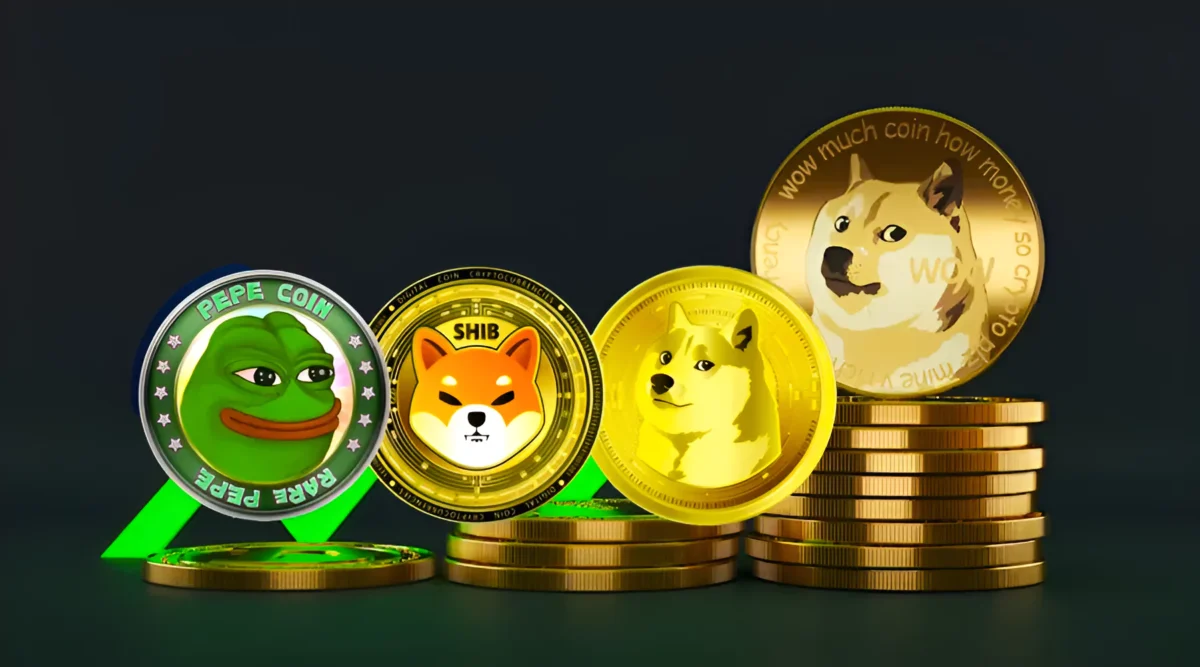
Unlike other cryptocurrencies, meme coins are made to be more entertaining, so they gain social attention and let investors make boosted profits. Meme coins are like coins with a logo, meme design, or cartoon printed on them. Dogecoin, Shiba Inu, and Pepe The Frog are a few successful examples of meme coins.

What Are The Technologies Powering Meme Coins?

Everybody must be aware of cryptocurrencies, but to create your cryptocurrency, you must know about the technologies behind their work. Below are the key technologies that support meme coin creation: 

Blockchain Platforms 

Like all cryptocurrencies, meme coins are also built on blockchain technology. Blockchain sets the foundation of meme coins and allows them to exist in a secure, immutable, and decentralized manner. Blockchain is a network having a series of blocks, each block containing the metadata of transactions and hashes (unique serial numbers). Platforms like Ethereum, Binance Smart Chain (BSC), or Solana provide the necessary infrastructure for creating and managing tokens, leveraging their smart contract capabilities.

Smart Contracts 

The creation, distribution, and management of meme coins rely heavily on smart contracts. Smart contracts are pre-programmed self-executing codes that are used to authenticate the conditions and automate the transactions occurring on the blockchain ledger. These smart contracts govern the rules of the meme coin, such as token distribution, liquidity, and transaction fees.

Decentralized exchanges (DEX) 

Decentralized exchange platforms are peer-to-peer marketplaces based on decentralized finance (DeFi) protocols where people or businesses can trade cryptocurrencies directly without the need for intermediaries. Meme coins are often traded on decentralized exchanges like Uniswap (Ethereum) or PancakeSwap (BSC), which enable users to trade tokens directly from their wallets without a central authority.

Token Standards 

Token standards like ERC-20 (Ethereum) and BEP-20 (Binance Smart Chain) establish the guidelines for creating and managing tokens on blockchain platforms. Meme coins follow these standards to ensure seamless integration with wallets, exchanges, and other components within the blockchain ecosystem.

Community Driven Governance 

Community-driven governance refers to a group of people, like investors or community members, that come together to manage and make decisions related to meme coins collectively.  Many meme coins utilize decentralized autonomous organizations (DAOs) to allow holders to vote on project developments, making community participation a core part of the technology. 

Liquidity Pools 

Meme coins frequently use liquidity pools on DEXs, where users can stake tokens to provide liquidity in exchange for rewards, facilitating smoother trading and reducing price volatility.

These technologies work together to enable the rapid creation, distribution, and trading of meme coins, often driven by community interest and viral trends.

How To Create Your Own Meme Coin? 

The following are the 8 easy steps to create a meme coin:

Step 1: Clarify Your Vision and Goals 

Step 2: Choose the Right Blockchain Platform 

Step 3: Design Your Meme Coin 

Step 4: Write the Smart Contract 

Step 5: Test and Deploy the Smart Contract 

Step 6: Plan Tokenomics and Distribution 

Step 7: Develop a Community and Marketing Strategy 

Step 8: Launch and Manage Your Meme Coin

The following key points will walk you through the details of developing a meme coin, with a step-by-step guide: 

1. Clarify Your Vision and Goals

Meme coins are based on memes and trends; therefore, it is important to define a vision and concept that is widespread, clear, and humorous. Meme coins that align with cultural references and trends will ensure that meme coins create a buzz in the market and gain loads of attention from users.  Meme coin has a competitive market; hence, it is important to be unique and stand out. Here are some points to help you clarify the vision and goals. 

Objective: 

Clearly define the purpose of your meme coin. What do you want to achieve? Are you aiming to create a viral token for community fun, or do you have a specific utility in mind? Understanding the core purpose will guide your decisions throughout the development process.

Target Audience: 

Identify who your meme coin is for. Is it aimed at a specific online community, or are you trying to reach a broader audience? Knowing your audience will help you tailor your messaging and marketing efforts.

Long-Term Vision: 

Consider the future of your meme coin. Will it evolve into something more substantial, or is it meant to be a short-term project? Defining the long-term vision helps in setting realistic expectations and planning for sustainability.

2. Choose the Right Blockchain Platform

When choosing a blockchain platform for your crypto token, it is important to consider different factors depending on which, you can choose the blockchain platform that best aligns with your meme coin concept. Every platform has its own pros and cons; therefore, research well before selecting. Below are key points that explain how to choose the appropriate platform for your meme coin. 

Platform Selection: 

Choose a blockchain platform that suits your needs. Ethereum is a popular choice due to its robust ecosystem and support for ERC-20 tokens, but alternatives like Binance Smart Chain (BSC), Solana, or Polygon may offer lower fees and faster transactions.

Considerations: 

Evaluate factors like transaction fees, network speed, scalability, and the platform’s community support. Each blockchain has its pros and cons, so align your choice with the goals of your meme coin.

Token Standard: 

Understand the token standards (e.g., ERC-20, BEP-20) associated with the platform, as they will define how your coin interacts with wallets, exchanges, and other services.

Currently, TRON meme coins are gaining a lot of popularity due to their favorable ecosystem for meme coins. You can also develop your own meme coin on TRON to leverage the early benefits.

3. Design Your Meme Coin

The next step is to design the meme coin based on the concept you have chosen. It is important to consider that the design should be unique, creative, and easy to recognize. Designing a meme coin starts with extensive research about different themes, cartoons, and icons. It is recommended to choose colorful themes, and bold font sizes to have a dynamic impact on the audience. Below is a breakdown of points:

Token Name and Symbol: 

Choose a catchy name and a unique symbol for your meme coin. The name should resonate with your target audience and reflect the coin’s theme or purpose.

Visual Identity: 

Create a logo and branding materials that represent your meme coin. This includes the color scheme, fonts, and any other visual elements that will make your coin stand out.

Initial Supply and Decimals: 

Decide on the initial supply of coins and how divisible they will be. This affects how the coin will be perceived in terms of scarcity and value.

4. Write the Smart Contract

Smart contracts will be used to carry out all operations and transactions for your meme coin automatically. Hence, writing a smart contract marks a crucial step in meme coin development. 

Smart Contract Development: 

The smart contract is the code that defines the rules of your meme coin, including how it is created, transferred, and managed. You can either write the contract yourself if you have coding skills or hire a developer to do it.

Security Measures: 

Implement security features in the smart contract to prevent exploits like minting additional tokens or unauthorized transactions. Consider using audited smart contract templates to reduce the risk of bugs.

Token Functionality: 

Define the functionalities of your token within the smart contract, such as transferability, burn functions (if applicable), and other custom features.

You can also develop smart contracts with the help of a top-notch blockchain company to avoid any mistakes that can further lead to data breaches or security threats. 

5. Test, Audit, and Deploy the Smart Contract

As the smart contract is written successfully, it is then tested for evaluating the performance, and audited to ensure safety and compliance. Once both the testing and auditing are done, it is then deployed and verified. 

Testing: 

Before deploying your smart contract on the mainnet, test it thoroughly on a testnet (e.g., Ropsten for Ethereum). This allows you to identify and fix any issues without risking real assets

  • Smart Contract Auditing: 

Before deployment, it is important to conduct a professional audit of your smart contract. You can also do this with the help of a reputed smart contract auditing company. This ensures that your contract is free from vulnerabilities and meets industry standards. An audit report can provide transparency and assurance to your users and investors about the safety of your project.

  • Deployment: 

Once testing is complete and you’re confident in the security and functionality of your contract, deploy it to the mainnet. This will make your meme coin live and available for use.

  • Verification: 

After deployment, verify your contract on a blockchain explorer (e.g., Etherscan for Ethereum). Verification enhances transparency and trust with potential users and investors.

6. Plan Tokenomics and Distribution

Create a well-defined tokenomics plan that outlines token distribution, usage, and management, while ensuring regulatory compliance to support long-term success. Let us break it down for you below: 

Tokenomics Design:

Define how your tokens will be distributed, used, and managed. Consider factors like initial distribution (e.g., airdrops, presales), supply caps, and mechanisms like staking or liquidity mining.

Incentives:

Create incentives for holding and using your meme coin. This could include reward systems, burn mechanisms to reduce supply, or partnerships with platforms to increase utility.

Regulatory Compliance: 

Ensure your tokenomics plan complies with local and international regulations to avoid legal issues.

7. Develop a Community and Marketing Strategy

The success of your meme coin will be highly affected by the kind of community you form. Thus, marketing your meme coin to reach the target audience present globally is important. Below given points below explain how can you develop a healthy community for your meme coin: 

Community Building: 

Engage with potential users and investors through social media, forums, and other platforms. Building a strong, active community is crucial for the success of meme coins.

Marketing Campaigns: 

Launch marketing campaigns to generate buzz and attract attention. This could include memes, influencer partnerships, or viral challenges that align with the playful nature of meme coins.

Transparency: 

Keep the community informed with regular updates and transparent communication about the project’s progress and any challenges.

8. Launch and Manage Your Meme Coin

The final stage is to launch your meme coin and manage its operations and community. 

Initial Launch: 

Announce the official launch of your meme coin and make it available for trading on exchanges. Coordinate this with your community to maximize impact.

Ongoing Management: 

Continuously monitor the performance of your meme coin, address any issues that arise, and stay engaged with your community. Regularly update the project to keep it relevant and appealing.

Adaptation: 

Be ready to adapt your strategy based on community feedback and market conditions. The cryptocurrency space is fast-paced, so staying flexible is key to long-term success.

Hence, all the above steps make creating a meme coin quite easy and simple for you! 

Is Programming Necessary For Building A Meme Coin? 

For developing a meme coin, you do not need to have advanced programming skills. However, a certain level of programming knowledge is a must in this case. For example, creating smart contracts for your meme coin would require a programming language, like ethereum smart contracts are made using Solidity. 

Moreover, there are many tools and software like token creation platforms or token generators that allow you to create a meme coin without needing any programming language. They offer a user-friendly interface that simplifies the configuration and deployment of your meme coin. 

What needs to be kept in mind is the fact that anybody can create a meme coin but to create and launch a robust and successful meme coin, you must partner with a top Meme Coin Development Company that can help you in creating, designing, launching, and market the meme coin successfully. 

What Would Be The Cost To Build Your Meme Coin? 

The total cost to build your meme coin can vary from $5000 to $15000 for a basic meme coin and $50000 to $100000+ for an advanced meme coin. 

Let us break it down for you: 

Blockchain Platform Fees

Deployment Costs: Deploying on Ethereum may cost several hundred to a few thousand dollars in gas fees, while alternatives like Binance Smart Chain or Polygon can be under $100.

Smart Contract Development

Basic vs. Complex: A simple token can cost $1,000 to $5,000, while more complex features can push this to $10,000+.

Smart Contract Auditing

Security Audit: Expect to pay between $5,000 and $15,000 for a professional audit to ensure the contract’s security.

Tokenomics and Legal Compliance

Consultation and Legal Fees: Designing tokenomics and ensuring legal compliance could cost between $6,000 and $30,000.

Marketing and Community Building

Initial Campaign: Launching and promoting your meme coin might require $10,000 to $50,000, depending on your strategy.

Additional Costs

Branding and Listing: Professional branding and website development can cost $2,000 to $10,000, while exchange listing fees vary widely.

Total Estimated Costs

  • Basic Meme Coin: $5,000 to $15,000
  • Advanced Meme Coin: $50,000 to $100,000+

These figures can fluctuate based on project complexity, professional services, and the chosen blockchain platform.

What Are The Legal Considerations For Meme Coin Creation?

The following are the legal considerations if you want to develop a meme coin:

Legal Compliance

Even though the laws related to cryptocurrencies differ in different parts of the world, a certain level of security regulations and legal compliance is important to prevent any security and data breaches. 

Consumer Protection

Be it a real-world asset or any normal asset, protecting consumers from any kind of fraud and scams is the responsibility of the provider. Hence, any business launching any kind of crypto token must be transparent and provide clear information to the investors.  

AML & KYC Compliance 

To run this digital business, it is important to know your customer (KYC) and authenticate their whereabouts. KYC and AML (Anti-money laundering) compliance would ensure that no unauthorized person has access to your meme coins and databases.  

Tax Implications 

Tax implications are different in different parts of the world. Hence, it is important to consider the tax regulations in the region you are launching your meme coin from. 

Regulatory Environment 

There are various regulations that are necessary to ensure cryptocurrency safety. Thus, know about the regulatory authorities and environments to prevent any kinds of scams and fraud in your crypto space. 

Ensuring the safety and security of your meme tokens might be a challenge. To make this simple, you can simply collaborate with a reliable meme coin development company like Blocktech Brew which can not only develop a meme coin for you but also ensure its security, and helps you market. 

What Are The Risks To Consider When Launching A Meme Coin?

Apart from security, there are different risk factors for launching your meme coin, which you must consider:

Price Fluctuations 

Meme coin fluctuations vary in influence with different factors. These fluctuations sometimes can lead to loss of money or cryptocurrencies for investors. However, every business has its potential risks, but the crypto market is one of the best markets to invest in and can yield high returns for both investors and businesses. 

Social Media Influence

This is a digital generation that believes in everything that social media says. However, when it comes to making informed decisions about investments, believing social media can have its own consequences. Therefore, any decision you make related to your meme token must be well-researched and not social media influenced. 

Scams And Fraudulent Projects 

The crypto industry is relatively new which is why lots of people do not have the appropriate knowledge about cryptocurrencies and investments. Thus this incomplete knowledge along with the urge to enjoy high profits in the crypto world leads them to invest in scams and fraud projects which results in losses. 

Rushing Up Due To FOMO 

While developing the meme coin, you may experience fear of missing out (FOMO) many times, especially at points where you need to make important decisions. Do not let this FOMO rush you up to make any kind of inappropriate decisions. 

Community Dynamics

Forming an enthusiastic and collaborative is also essential for your meme coin to become successful. However, managing the community dynamics and facilitating the operations to make your meme coin successful is another challenge. 

You can always contact Blocktech Brew to get free consultations for developing a meme coin, managing the meme coin community, or marketing your meme coin. 

Regulatory Uncertainty 

As said above, regulatory measures for meme coins are uncertain in different parts of the world. Thus, you must research, and ensure safety for your meme coin community in all ways possible. 

Effective Strategies To Market Your Meme Coin

Following are some of the ways you can market your meme coin successfully: 

Create Impactful Meme Coin Memes

Creating memes for your meme coin on social media can help it spread like fire in the forest. Thus, think of thousands of meme ideas and leverage their power to let your meme coin have a great impact on the audience. While most people enjoy humor, crypto enthusiasts will see your meme coin as a great opportunity to invest and get high returns in the future. 

Do Influencer Marketing 

Leverage the power of social media, and do healthy partnerships with influencers or celebrities (those who have high audience and fan following) to promote your meme coin. The fandom of influencers has the potential to immensely invest in your meme coin, eventually contributing to its success. 

Host Contests & Giveaways

Organizing some amazing content and giveaways can attract a lot of potential investors,  which will help you form a fruitful meme coin network, and provide you an opportunity to market your meme coin. 

Post Educational Content 

Most people do not have ground knowledge of cryptocurrencies, thus if you post crypto-related educational content on various social media platforms. This move will definitely help you grab the attention of new crypto investors who are seeking to invest in crypto token projects to get high returns later. 

Paid Advertisements 

Like any other business, you can also run paid Ads on different social media platforms to reach wide audiences present on the internet. Social media is a great tool for marketing and can help your meme coin gain global recognition along with great investments. 

Foster Great Collaborations 

You can partner with some successful and already-existing meme coins or crypto token communities. These communities would already have lots of crypto enthusiasts and investors which is your target audience, thereby leading to high conversions for your meme coin. 

Join Hands With The Best Meme Coin Development Company!  

There is no question about the potential returns and growth the meme coin industry holds. Even though this blog will help create their meme coin, there is more in the box. 

Developing a meme coin successfully is not only about meme coin creation but also ensuring its safety, building its community, and marketing it on different digital platforms. 

To ensure your meme coin reaches heights, and brings you high returns, you can collaborate with a top-performing Meme Coin Development Company like Blocktech Brew, which has the right kind of expertise in creating, and marketing the meme coin. 

We have delivered more than 1000+ crypto projects globally, and help our clients with an all-rounded growth. You may reach out to us via email at business@blocktechbrew.com to know more. 


Categories
Blockchain Crypto Coin

Solana Actions and Blinks: Ultimate Guide 2024

Solana is a widely adopted blockchain network in various areas like finance, transactions, gaming, etc. Solana is a scalable blockchain optimized with user preferences; hence, developers can develop their blockchain applications to achieve product-market fit. Unlike blockchains with slow response times and high costs, Solana is a low-fee platform with a 400ms confirmation time and high throughput that helps build user-friendly applications.

In this blog, we will explore Solana Actions and Blinks, the features of Solana that further enhance the user experience of decentralized applications (dApps) and services on the network.

What are Solana’s Actions?  

Solana actions act as APIs (Application Programming Interfaces) that allow developers to define how to create Solana transactions on the blockchain. They provide a way to pass transactions from the application directly to the user. These actions can embed different functionalities within the Solana ecosystem into the applications. Transactions in Solana work in two ways: 

  • GET Request: The client sends a GET request to the Action URL to get information about available actions, like the program name, icon, and actions. This helps in creating a user interface for the actions.
  • POST Request: After the user selects an action, the client sends a POST request to the Action URL to get a transaction or message for signing. The user’s wallet signs it and sends the transaction to the blockchain.

Key points about Solana’s Actions: 

Predefined Operations 

Actions are pre-defined instructions or programs that are executed on the Solana blockchain, such as transferring tokens, interacting with smart contracts, or staking.

Metadata-Rich 

Each Action contains metadata that describes what it does, making it easier for users and applications to understand and interact with it.

Integration with Blinks 

Actions have integrated blinks (blockchain links) that allow Solana actions to be shared across various platforms and be easily accessed.  

Client Support

Actions require supporting client applications, such as browser extension wallets or bots, to facilitate the user’s interaction with the blockchain. These clients help users sign transactions and ensure the secure execution of Actions.

Web and Social Media Interaction

Solana actions can be integrated into social media and web platforms, allowing users to access the platforms directly from these interfaces without navigating to separate dApps. 

How do Solana’s Actions work?

The client initiates the GET request to fetch metadata about available actions on the URL, and the user interface gets displayed to the user so they can choose the desired action. The user selects an action, and the client sends a POST request to obtain the transaction. 

Action URL generates and forwards an encoded transaction as selected by the user. The user’s wallet signs the transaction, and is finally sent to the blockchain network.

Advantages of Solana Actions 

The following are the advantages of Solana Actions: 

Fast Processing 

Solana has a smooth and efficient pathway to execute actions and thus performs faster processing in a large-scale network, ensuring users experience minimal waiting times. 

Minimal Delays

Solana’s architecture minimizes delays, ensuring that transactions are confirmed and finalized swiftly. This low-latency environment enhances the user experience by providing real-time interactions and immediate feedback.

High Flexibility 

Solana offers a versatile framework that can be opted for a wide range of applications and use cases. With such flexibility, developers can create customized solutions tailored to specific needs, making it easier to integrate and deploy various blockchain-based functionalities.

Solana Blinks 

Solana actions get converted into metadata-rich links called Blockchain Links or Blinks. They make the actions shareable, enabling the clients to showcase more functions to users. Website blinks can instantly show transaction previews in wallets without any redirection to decentralized applications (dApps). 

Solana Blinks are integrated with wallets like Phantom, Backpack, and Solflare, allowing websites and social media platforms to start Solana transactions directly. Hence, like HTTP URLs, any website can execute Solana transactions using Blinks. 

Key points about Solana’s Blinks:

Smooth User Experience 

By enabling users to access actions flexibly from social media platforms without navigating to decentralized apps, blinks provide users with a smooth and hassle-free experience to users. 

Functionality Expansion 

In platforms like Discord, bots can expand Blinks into interactive buttons, providing users with more functionality and easier access to blockchain interactions.

Web 2 and Web 3 Integration 

Blinks bridge the gap between Web 2 and Web 3 applications, making it easier to incorporate on-chain interactions into existing web interfaces.


How do blinks detect actions?  

Blinks detect Actions through the Solana Action URL scheme. Here’s how it works:

Actions URL Scheme 

The URL follows a specific format:

solana-action:<link>

Here, <link> is the Action API URL that contains the necessary information about the Action.

Parsing the URL

When a Blink is clicked or accessed, the supporting wallet or client application parses the URL to identify the Solana action scheme.

Decoding the Action 

The client application decodes the URL-encoded Action API link to extract the necessary metadata and details about the Action.

Executing the Action 

Once the Action details are obtained, the client application can display the relevant information to the user and initiate the appropriate blockchain transaction or interaction. This could involve displaying a transaction preview, requesting user approval, and submitting the signed transaction to the Solana blockchain.

Conclusion:

Hence, Solana’s actions and blinks revolutionize the way people interact with the blockchain network, making it easier for users to integrate solana transactions on the blockchain. Moreover, like web links, the action API can be accessed from any third-party platform, further contributing to Solana’s wide adoption and scalability. 

Are you seeking to develop innovative and efficient Blockchain solutions? Stop your hunt here! Blocktech Brew, a leading Blockchain developer has everything you need to turn your vision into reality. 

Reach out to us at business@blocktechbrew.com, and let us introduce you to a new world of blockchain possibilities.

Categories
Crypto Coin

ERC 7007: A Revolutionary AI-Generated Content Token (AIGC)

Introducing tokens and their new standards has never been less than a sensation in the blockchain landscape. For the past few years, we have witnessed the outburst of crypto standards and the mechanisms they utilize. The launch of ERC 7007 has also drawn attention to verified AI-generated content tokens (AIGC). But what are they? How did they come to notice? And why do people feel the need for any such token standards? Continue reading this blog, as you will get the answers to all your queries here. 

What is ERC 7007?

The ERC 7007 extends the ERC 721 token standard for AIGC. It is known as verified AI-generated content (AIGC), a nonfungible token standard to verify, mint, enumerable and updateable extensions. However, it incorporates zero knowledge machine learning (zkML) and optimistic machine learning (opML) capabilities to enable verification and data correctness. 


ERC 7007 ERC 721
Definition ERC 7007 offers verified token standards that allow users to own their AI-generated content, prompts, and designs to avoid the risk of questioning and to ensure authenticity ERC 721 is a unique NFT Token Standard that can be used to differentiate the value from another token using a smart contract. 
Purpose Owning and authenticating AI-generated content and designs Creating unique, non-fungible tokens (NFTs)
Verification Ensures authenticity and ownership of AI-generated prompts Ensures the uniqueness of each token
Token Differentiation Verifies and authenticates specific AI prompts Differentiates tokens with unique metadata
Use Cases AI-generated art, text, music, designs Digital collectibles, art, virtual real estate, unique assets
Uniqueness Ensures each AI-generated content prompt is unique Ensures each token is unique


What’s the purpose of AIGC? 

The AIGC standard generally supports two primary goals: one to set the validity proofs and the other to detect the fraud proofs. This zero-knowledge machine learning enables the model to publish its trained models and claims over the prompt by publishing the inference task.

The Optimistic Machine Learning Scenario on Blockchain lets the owner publish its trained model. It allows users to claim their prompt and publish the inference of the task. Nodes maintaining the model can perform the inferences and submit the inference output, challenging the result within a predefined period. 

This advancement in the AI model allows authors to capitalize on their creations. With this token standard, every prompt can be securely verified on Blockchain. It opens up opportunities to implement revenue-sharing mechanisms and to ensure AI-generated content (AIGC) sales. 

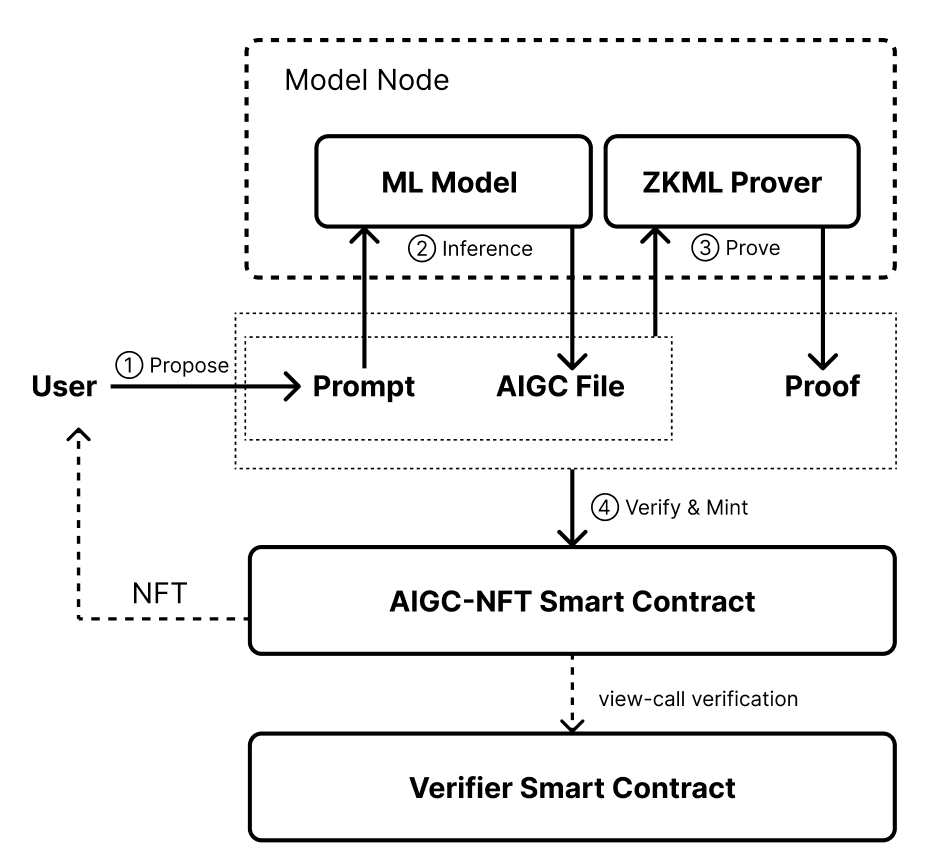
Learn how zero-knowledge machine learning, AIGC NFT standard works:

Why is ERC 7007 a credible form of NFT Standards?

1: Provenance History: 

Using the ERC 7007 standard, AIGC NFT doesn’t just have a digital artwork by your side; the space from where it belongs leads to that result. All those foundations should be preserved to maintain their authenticity. It ensures that whatever prompt you give has a verifiable history, helping people to establish the record they have created. 

2: Creativity Promoter:

 This standard is not just about protecting the old creations but also safeguarding them in a new modular way. It potentially leads to new ways of experimenting 

 With  AI, creative processing is used to lead new and advanced forms of art that haven’t been imagined yet.

3: Interoperability: 

The ERC 7007 allows users to play with the AIGC NFT, which competes with the diverse blockchain ecosystem. It enables artists and developers to create, trade, and innovate on multiple platforms. 

4: Future Proofing:

 As technology evolves continuously, it opens diversified ways to create and interact with digital content. ERC 7007 allows people to avail themselves of flexibility and robust standards that can grow with the technology. 

5: Empowering Creators: 

ERC 7007 shares power with the creators and brings authenticity and originality to the AI-generated content, protecting the artistic rights of the users in the digital landscape, which is quite hard to navigate. 

How does ERC 7007 work?

Step 1: You need to Propose a Prompt

The user must first propose a prompt to get an AI-generated content result.

Step 2: Claim Your Prompt

Using the AIGC NFT smart contract, the user can seamlessly claim its prompt to allocate the specific input for AI-generated content. 

Step 3:  Generate the AIGC File

The machine learning model employs the prompt to develop AI-generated content and produce AI-generated content files.

Step 4: Secure Proofs

Zero-knowledge Machine Learning generates proof confirming the AIGC’s file, which is created using the given prompt. 

Step 5: Verify & Mint the NFT

The user submits a prompt, the AIGC file, proof, and the AIGC NFT smart contract by verifying the evidence, and the contract mints an NFT for the user.

All in All,

The ERC 7007 standard allows the robust framework to verify the authenticity of AI-generated content. By tokenizing, NFTs work under ERC 7007 to protect the creator’s rights and ownership worth. It is a powerful solution that verifies and tokenizes AI-generated content, ensuring authenticity and building trust in digital interactions across various domains. Many industries utilize ERC 7007’s significance in digital art, research, fashion, and digital identity. 

Categories
Crypto Coin

Initial Coin Offering (ICO) vs. Initial Liquidity Offering (ILO)

With the rise of cryptocurrencies, many new projects are being developed to drive success in decentralized finance (DeFi). To boost the funds of these startups, some processes like ICO, ILO, IDO, and IPO are actively being used to raise capital, build a brand and attract more investors. 

In this blog, we will go through two of these processes, i.e., ICOs (Initial Coin Offerings) and ILOs (Initial Liquidity Offerings), and discuss their differences and details. 

Let us first start by discussing ICOs: 

What are ICOs? 

Initial Coin Offering is a popular fundraising mechanism for new ventures looking to establish themselves in the blockchain and crypto environment. In this, the blockchain or crypto startup provides cryptocurrency tokens that refer to some authority or service. For instance, in some cases, the tokens would give investors the authority to make and vote for crucial decisions. The investors who see the growth potential in the startup then buy these tokens to own a stake in the venture. This way, the startup attracts many investors who invest directly into the business without the requirement of any intermediaries. 

How do ICOs work? 

To raise money with ICOs, any crypto project would need to follow the following steps: 

Structuring The Coin:

The coin for the ICO process can be structured in three ways, depending on which one better aligns with the project’s goals. 

Static Supply & Static Price: This refers to a pre-fixed number of tokens with a fixed price for each. For example, the project could raise $1,000,000 by selling 1,000,000 tokens at $1 each. 

Dynamic Supply & Static Price: This refers to fixed prices with a fluctuating number of tokens depending on the investment.  For example, if they sell 1,000,000 tokens and people invest $2,000,000, the price per token would be $2. If only $500,000 is invested, the price per token would be $0.50.

Static Supply & Dynamic Price: This refers to a fixed number of tokens with fluctuating prices depending on the investment. For example, If people invest $1,000,000, they create 1,000,000 tokens. If people invest $500,000, they create 500,000 tokens. The supply of tokens grows with the amount of money invested.

White Paper Release 

To announce the process, the startup releases a white paper on a new website, which is a document containing all the details like the structure of the coin, project goals, strategies, team, tokenomics, duration of the ICO campaign, and more. This gives the public in-depth details about the project and encourages them to invest in the new venture. 

Token Sale

After the white paper release, the token is put on different types of sales like pre-sale, private sale, and main sale. Each sale would have the same or different type of target audience and benefits according to the company’s marketing strategy. 

Token Listing 

Once the sale is over, the token is listed on different cryptocurrency exchanges, where it enters a broad market where more users can buy, sell, trade, and exchange the tokens. 

Advantages of an ICO

Open Access to Tokens

During the ICO drives, anyone can buy the project tokens; thus, buying and selling happen anonymously, attracting many investors. 

Global Token Sales 

In a crypto and blockchain space, ICOs are accessible globally, and investors from different locations can buy and sell the tokens. 

Minimal Entry Barriers 

There are no prerequisites or geographical barriers to buying the coin or token, which allows investors to purchase the tokens hassle-free. 

The Potential of a High ROI 

ICOs allow investors to enter the business at an early stage, which would yield them lucrative returns in the future if the project becomes successful. 

To know more about ICOs and its regulations, check out our blog on ICO Regulations

Disadvantages of an ICO

Below are the disadvantages of ICO: 

Due Diligence Challenges 

There are no strict rules to keep a check on the terms of smart contracts, which may cause many businesses to keep hidden terms and conditions that can prove to be harmful or disadvantageous for investors in the future. 

Regulatory Risks

Lack of regulations or confusion on ICO rules, including the taxes on profits or earnings, complicate the processes and hold investors from making informed decisions.  

Scams & Frauds 

The ability of ICOs to raise capital rapidly makes them highly vulnerable to fraud and scams. Therefore, investors must verify the details of the startup before participating in its ICO process. 

High Volatility 

Market fluctuations disturb the token prices, which can put investor’s money at risk and prone to losses. 

What are ILOs? 

Initial Liquidity Offering (ILO) is another fundraising mechanism for new blockchain startups. It allows startups to launch their tokens by pairing them with pre-existing cryptocurrencies on decentralized exchanges (DEX) without participating in the ICO process. This creates an initial liquidity pool where users trade the new token in exchange for a pre-existing cryptocurrency. ILOs are one of the most popular ways to raise funds for a business, which makes the process trustworthy and smooth for a large pool of customers. 

How do ILOs work? 

The following are how ILOs work:

Token Creation & Setting Up A Liquidity Pool 

To start with the ILO process, the project creates a new token and submits a certain number of tokens into a liquidity pool on a decentralized exchange (DEX). Also, the same number of other already established tokens, such as Ethereum, have been added. Users can now trade between the new and already-established tokens using this liquidity pool. 

Using Automated Market Makers (Amm) 

To facilitate this exchange, Automated Market Makers (AMMs) are smart contracts that automatically proceed with the trade and adjust the prices of tokens according to demand and supply. 

Launching The ILO & Immediate Trading 

After the setup, the ICO is launched, which is the official announcement that the token exchange will be accessible to investors. ILOs do not require any centralized exchange platform. Therefore, investors can buy, sell, and hold the tokens immediately. 

Price Dynamics 

The price of the new token will be determined by how users trade. If more users buy the tokens, the price will increase; if more users sell them, the prices will crash. 

Lower Fees

Due to the inclusion of smart contracts, the gas fees of trading on the decentralized exchange (DEX) are minimal compared to the conventional fundraising approaches. 

Advantages of an ILO

Below are the advantages of an ILO: 

Faster Sale

With the implementation of AMMs, ILO facilitates faster sales, as when the tokens are released into the liquidity pools, the investors can buy them instantly. 

Instant Access and Rapid Liquidity 

As soon as the token is released, developers and investors can buy it without waiting. Moreover, as the project is carried out on DeFi-based DEX exchanges, their liquidity increases rapidly. This makes the liquidity market more compatible and allows traders to trade easily. 

Unbiased Method For Token Trading 

ILO mechanism is unbiased for the investors as it allows them to buy the tokens early and sell them to the public when prices go up. This provides loyalty bonuses and unmatched profits to them. 

Cost-Effective Model 

ILO is considered to be a cost-effective method compared to other techniques. It is also quite fruitful for the users as it allows the early contributors to utilize the initial liquidity to raise profits and lead the project ahead. 

Disadvantages of an ILO 

The following are the disadvantages of ILOs: 

Impermanent Loss

Due to sudden fluctuations in token pricing, the liquidity creators on the DEX platform can lose the value of their deposited assets, leading to impermanent loss. 

Complexity 

Participation in ILOs requires understanding how decentralized exchanges work, which makes it complicated for new investors. 

Market Volatility

Even with the benefits of liquidity pools, the pricing of tokens fluctuates and disturbs supply and demand dynamics created under the liquidity pool. 

ICO vs. ILO 

Now that we know about ICOs and ILOs, let us move forward to discuss the difference between Initial Coin Offerings (ICOs) and Initial Liquidity Offerings (ILOs) through the table: 

Aspect ICO ILO
Fundraising Method Tokens are sold directly to investors in different sales.  Facilitates token trading by providing liquidity to decentralized exchanges. 
Liquidity May face liquidity challenges and delays.  Guarantees immediate and sustained liquidity for the future. 
Regulation ICO regulations vary in different countries and regions.  Regulations are still unclear, and being worked on. 
Trading Tokens may need to be listed for exchange on different platforms as part of the ICO process. Tokens are instantly tradable on DEXs.
Risk of Scams Direct sales of tokens and rapid fundraising attract a large number of scammers.  Liquidity provision is more transparent and less prone to scams. 
Volatility High, presenting significant fluctuations.  Remains high, yet tempered by liquidity pool support. 


Final Words

ICOs and ILOs are both highly trusted and used in fundraising ways in the crypto landscape. However, they both align with the different needs and expectations of the business owners, and they have different risks and benefits associated with them. On the one hand, ICOs are simpler and streamlined for fun raising but are associated with more risks and liquidity concerns in the future. On the other hand, ILOs provide immediate liquidity but are more complex and vulnerable to losses than ICOs. 

Before choosing the right method of fundraising that best suits your business requirements, one must consult a reliable ICO and ILO development company that can guide you better and prevent you from losing money in vain. If you are looking for one such company, worry not! Because Blocktech Brew is the all-in-one company you need! 

To get a free consultation about ICO and ILO development regarding your idea, Do reach out via email at business@blocktechbrew.com and discover unusual ways to grow your business! 

Categories
Crypto Coin

ICO Regulations: A Global Perspective

The ICO (Initial Coin Offerings) market is exploding in the crypto world, allowing businesses to raise funds. However, with growth comes a great responsibility of implementing fair use of ICOs which need a set of clear rules and regulations for the security of the people. In this blog, we will explore ICO markets, what ICOs are, the benefits and risks of ICOs, and delve into the regulatory landscape of ICOs across different countries.

So buckle up and explore the future of fundraising with Blocktech!

What are Initial Coin Offerings?

ICOs are the new and popular fundraising mechanisms used by crypto projects and early-age ventures. Any blockchain company that wants to distribute its shares for the first time creates its specific and unique digital tokens, which are given to the investors in exchange for cryptocurrencies, like Bitcoin, Ether, etc.

These special tokens of the blockchain startup can represent various things, depending on the project, for example:

Access to a platform or service.
Voting rights within the project’s governance.
A stake in the project’s future profits.

Thus, ICOs are great ways to attract investors who are eagerly looking forward to the project’s success and drastically raise funds without surrendering the ownership stakes. These raised funds are used to develop the project and bring the vision to life.

How do ICOs Work?

The usual ICO process includes:

White Paper Release

Whitepapers are a part of the standard process of initial coin offerings. A whitepaper is a detailed document released on the company’s website containing all-rounder information on the company’s project or business plan, its goal, strategies, team, tokenomics, and so on. This will include deep information like their adopted blockchain, information technology (IT) protocols, token supply, pricing, and distribution mechanism.

Token Sale

According to the company’s market strategies, tokens can be put on various types of sales like private, pre-sale, and main sale. For example, private sales can be limited to the investors; pre-sale would offer early access to the benefits to early participants, and the main sale would be for the general public.

Token Listing

Once the initial coin offering is completed, the token is listed on cryptocurrency exchanges. This allows the token to enter the broader marketplace, where it can be freely bought, sold, and traded among investors and users. Getting listed on reputable exchanges is crucial for providing a larger user base for the token.

Benefits of Participating in ICOs

Let’s understand the benefits of participating in ICOs:

Investment Potential

ICOs allow investors to invest in promising projects that will skyrocket the token value if they turn out to be successful. Thus, ICOs offer great investment opportunities to business-minded people.

Accessible Funding

ICOs are accessible to anyone with an internet connection and interest in investing instead of accredited investors in traditional fundraising ways. This global participation allows us to raise capital quickly and efficiently. In addition, the early investors often benefit from lower investment minimums and potentially gain more if the projects succeed.

Transparency & Traceability

ICO operates on the blockchain network, where all the transactions are recorded on a public ledger, providing traceability features to all investors with which they can verify the authenticity of tokens. Also, ICO leverages smart contracts to automate the token distribution process in a fair and immutable manner.

High Liquidity

Shortage of funds and resources is what hinders the growth of most of the investors. ICOs offer easy buying, selling, and exchange options which make them more attractive investments, thus turning the liquidity higher. Also, with higher liquidity, transactions stay active and this stabilizes the token prices.

Lucrative Returns

If the investors choose a potential project to invest in, the project can potentially skyrocket their investments. Startups offering ICOs give a groundbreaking opportunity to investors a chance to explode on their investments. However, this does come with lots of risks, which we will discuss further in this blog.

Potential Risks or Disadvantages in ICOs:

Let us now read about the associated risks with ICOs, which investors and businesses must be aware of:

Due Diligence Challenges

There are no proper auditing procedures to check the terms of the white paper. Sometimes, there can be flaws or hidden terms that mandate the investors to acknowledge the associated risks of investing in ICOs that may remain undiscovered and prove to be harmful or disadvantageous for the investors.

Market Fluctuations

There can be frequent and drastic fluctuations in the token markets, which creates a situation of high risks for investors. Therefore, the investor must consider these fluctuations in the token prices before making any such investments.

Vulnerability To ICO Scams

ICOs are quite vulnerable to scams and fraudulent activities. As ICOs have the potential to raise funds rapidly, this makes them attractive to scammers and, thus, associate a lot of risks in one way or another.

Regulatory Uncertainty

Regulations for ICOs, including the taxes on profits made through them, are quite uncertain and confusing, which keeps the businesses and investors in the dark and complicates processes.

Why is ICO Regulation Necessary?

There are several reasons why ICO regulation is necessary:

Investor Protection

ICOs can be misleading to investors and may lead to financial scams and fraudulent activities. Thus, with proper regulations keeping a check on ICOs, there would be proper disclosure of the ICO terms, the team, and the intended use of funds.

Market Stability

Proper regulations would discourage risky projects that may lead to market crashes and would promote legitimate projects that are safe to invest in. Thus, unregulated projects may lead to market stability.

Money Laundering & Crime

As ICOs can raise funds faster for startups, they attract a number of fraudsters who indulge in illegal financial activities. Thus, regulations help avoid such activities by establishing Know Your Customer (KYC) and Anti-Money Laundering (AML) procedures to promote the safety of investors and businesses.

Investor Confidence

The lack of regulations will disrupt the investor’s confidence to invest in ICOs. Even if the project is legit, and offers a potential growth activity to investors, they would still have trust issues and might not proceed with the ICO of the project.

Innovation with Structure

Regulations don’t have to stifle innovation. Well-designed regulations can provide a framework for responsible ICOs to operate within, allowing innovation to flourish while protecting investors and the market.

Global Consistency

The current ICO landscape is fragmented, with regulations differing greatly between countries. Regulation can help establish a more consistent global framework, making it easier for businesses to launch ICOs and for investors to participate across borders.

ICO Regulation In Various Countries

The United States

ICOs are allowed in the USA, however, they are quite well-regulated. The Security and Exchange Committee (SEC) of the USA once showed concern regarding the lack of protection for investors. Though the USA does not have any proper federal laws for the regulation of ICOs, they still expect the ICOs to be registered with the SEC. Moreover, the SEC even monitors the endorsements of ICOs by celebrities without the disclosure of the source, nature, and payment. At last, the US Department of Justice keeps an eye on ICOs, and any unlawful practices would hold the accused accountable in court.

China

In 2017, China banned ICOs and saw them as a hindrance to the financial order of the country, and China’s central bank considers ICOs as a suspect of criminal or fraudulent acitivity. However, with the rise of cryptocurrency, we may expect some changes in this decision in the future.

Russia

Russia has no banning on ICOs, but it has strict regulations imposed on them which make it difficult to raise funds during initial coin offering. It has imposed limits of 50,000 roubles on unqualified investors, while licensed investors have no limits. In addition to these rules, ICO organizers are supposed to submit some of the details, like legal and operational details, to the government.

Australia

The Australian Securities and Investment Commission (ASIC) has a set of rules for startups that want to launch their ICOs to make sure that the ICOs are trustworthy for investors and comply with the relevant laws. Disclosure, registration, and licensing are a must thing for ICOs in Australia. Thus, the Australian government recognizes the huge potential of the ICOs but has strict laws for the security and safety of the investors and the public.

South Korea

South Korea is one of the countries with a high crypto trading market. Though the country banned all ICOs due to the related risk of scams, now the country encourages everybody to use cryptocurrencies, even the banks, for crypto exchanges. However, South Korea only supports real-name transactions to reduce the risk of scams and fraudulent activities.

India

India does not regonize cryptocurrencies as legal, and thus, it does not have any regulations made to monitor the crypto transactions. However, India is developing at a speedy rate. Thus, we can expect some new laws and regulations to come up to promote the responsible use of crypto exchanges and ICOs in the country.

Thus, the crypto world is paving the way to success, and even if it is associated with risks, countries have recognized its potential to drive businesses and the digital finance world. Therefore, with proper regulation and compliance with laws, governments can ensure the reliability of ICOs and crypto tokens and promote their responsible use to leverage their skyrocketing power.

Best ICO Development Services- Blocktech Brew

Looking to launch an ICO for your blockchain project? Don’t go it alone; Blocktech Brew provides tailored solutions for blockchain, smart contracts, and ICO development. We understand your unique needs and can help you navigate the process.

You can also reach out to us via email at business@blocktechbrew.com to discuss your project and pave your way to success!

Categories
Crypto Coin

WorldCoin Explained: Introduction, Application, Predictions & Everything You Need to Know

We are all witnessing the growth and evolution of digital finance. The innovation first started with blockchain and was followed by digital coins. In this continuously changing landscape, the emergence of the world coin has been found.

This development is now changing the traditional means of identity verification, understanding, and accessibility. Now the whole game revolves around the  World Coin and the World Coin Orbs.

Introduction to Worldcoin Development
worldcoin development

Irrespective of the financial status, nationality, or origin of a person, world coins are based on an open-source protocol. They are drafted for easy accessibility, opening the door to global attainability. This evolution brings digital ease, where individuals are not just participants but direct and active holders of their digital identities.

After three years of development, the digital ID platform Worldcoin officially announced its launch on July 2, 2023. It was co-founded by CEO Sam Altman, who founded OpenAI. This launch aims to provide verified World IDs, cryptocurrency tokens (Worldcoin), and a crypto wallet application.

According to WorldCoin, artificial intelligence has made it difficult to track the activity, content, artwork, and others that are made using humans or come from AI sources. To resolve this confusion, Worldcoin launched the concept of digital identities as ‘proof of personhood’. 

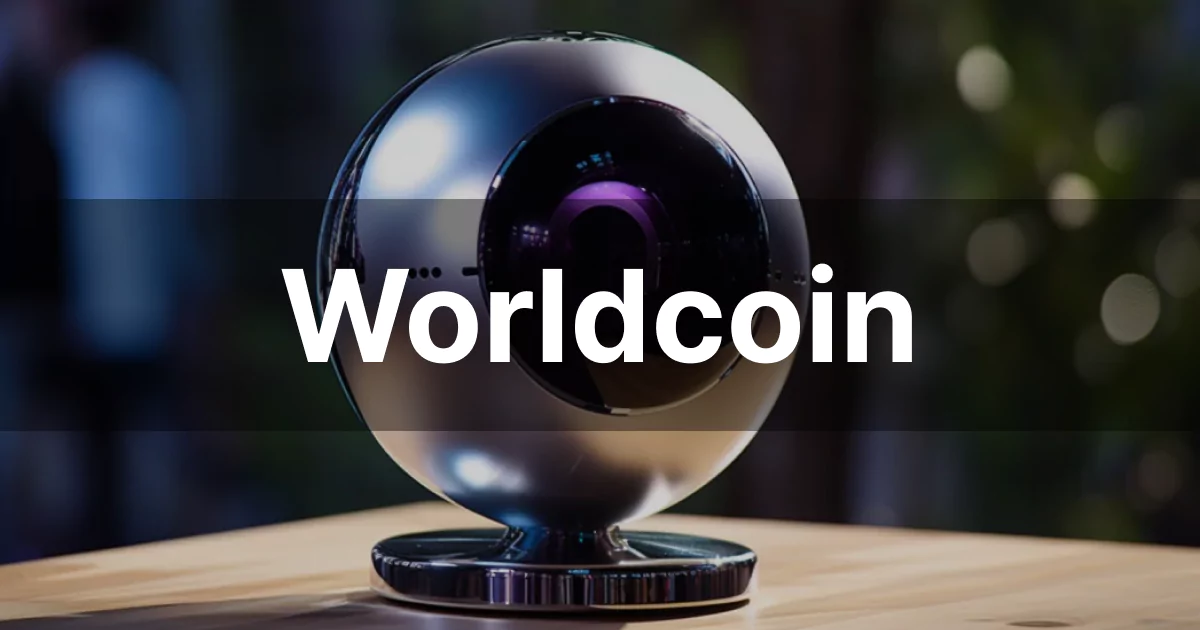
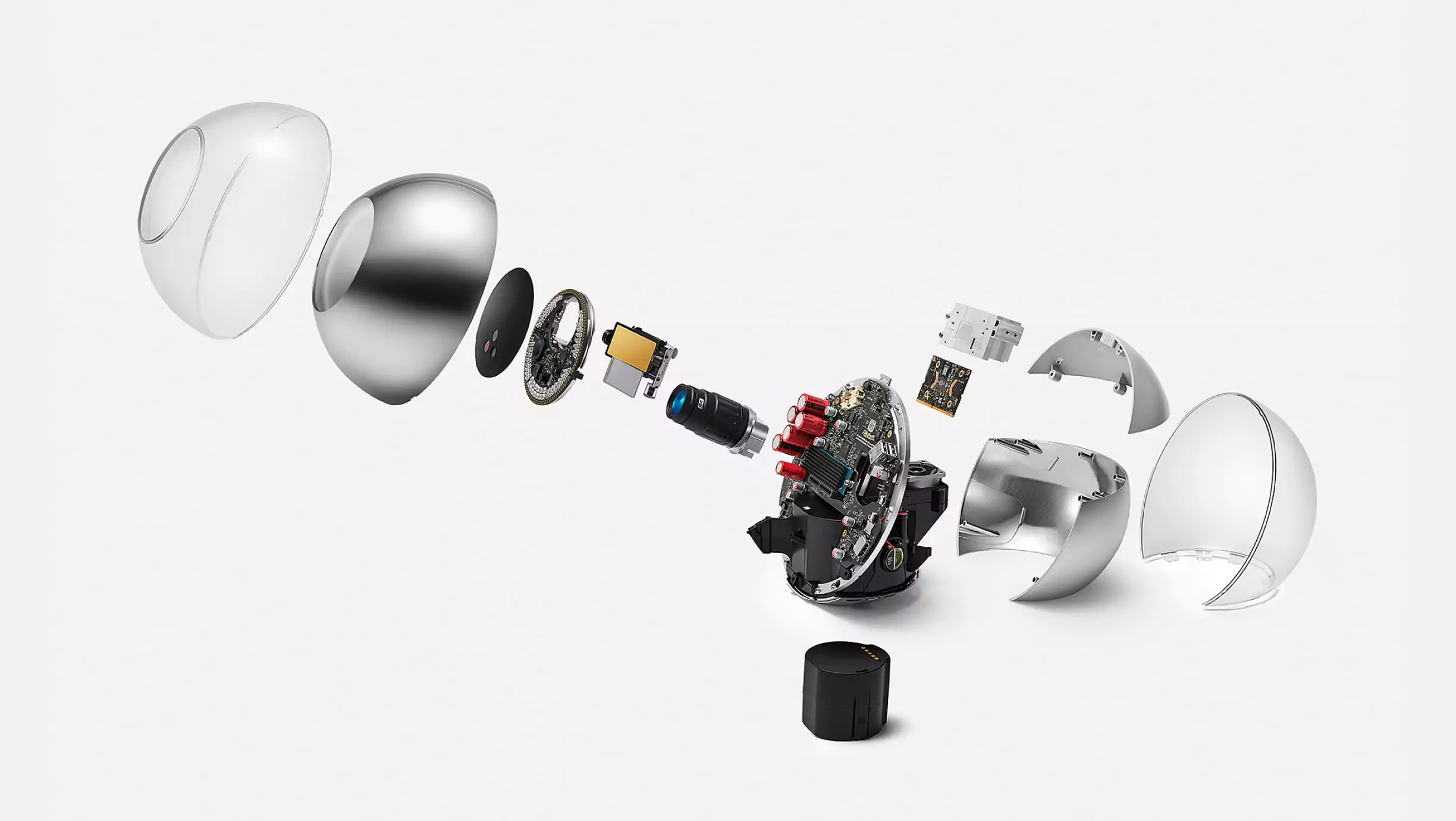
Worldcoin utilizes the Worldcoin Orb, a biometric imaging device that is used to establish the unique identification of each individual using iris scanning. It creates personal and secured identification codes for a unique identity. Here, codes are saved on decentralized blockchain technology, which nullifies the chance of the occurrence of any malicious activity, fraud, or identity theft. 

What is WorldCoin?

Worldcoin is a digital identification platform designed to ensure unique digital identities (digital passports) by verifying that the user is human, not a bot or an AI. This project was the most controversial topic in the cryptocurrency world. Worldcoin set its aim to build the world’s largest identity and financial network that can serve worldwide without any limitations.

How does the World Coin work?

Worldcoin has three prominent stages. The user needs to follow all these in sequence to enforce its components: 

1 World IDs

World IDs are the soul of this platform, on which the company enables human verification while maintaining privacy. It is known as the ‘proof of personhood’ and uses an iris-scanning device for verification called an orb.

Like fingerprints, every person has a unique iris pattern. The world orb captures that unique structure to create an identification code named IrisCode. This code aims to prevent the occupancy of multiple WorldIDs.

Each world ID is associated with the Worldcoin blockchain and needs to be deployed in a cryptographically secured world app for self-identification. 

2 World App

The World App is the first Worldcoin wallet that is designed to make digital identities accessible on a global scale. It requires authentication using World IDs to identify the real person. After successful steps, users can easily get Worldcoin tokens and send and receive them anywhere in the world. 

3 Worldcoin Token (WLD)

After the successful creation of World IDs and the downloading of the World App, users can easily access WLD crypto tokens. As per the information shared by Worldcoin, approximately 10 billion WLDs will be issued in 15 years.

What are the applications of Worldcoin?

The Worldcoin project was created to establish global equality and equal financial opportunity. Proceeding with the idea, Worldcoin is building the world’s largest financial network that will share easy access and ownership with all.

Designed for everyone

This platform is designed for all humans. It doesn’t discriminate based on the identity, nationality, or financial status of the individual. With the help of this mechanism, it would be easy to differentiate between humans and bots. It will come up as a privacy-preserving solution for people.

It’s easy to prove your personhood

Worldcoin IDs utilize WordOrb to detect the uniqueness of the iris for successful and authentic verification of human beings. This network allows users to own and control their digital identities without the intervention of any third party.

Governance

WorldCoin has unique possibilities in terms of governance. World IDs are immutable and secure for establishing digital proof of personhood. This vector of Worldcoin can be combined with others, like token-based or reputation-based vectors.

Assured Incentives

Conventional reward programs are prone to fraud and mischief. But with World IDs, these issues can permanently escape financial networking. World IDs securely arrange incentives and benefits for both companies and consumers simultaneously.

Equity in resource distribution

As World Coin follows an open-source, decentralized proof of personhood protocol, it extends the same benefits to each user globally. World IDs are used to distribute access to created value using universal standardized income.

Worldcoin Price Prediction 2023|2024|2025

Based on the analysis of Crunchbase, Worldcoin has raised $125 million in its two presale rounds. It was founded in 2019.

2023

In 2023, the World Coin was launched, and it’s expected to have short-term volatility in its trading value. As per reports, Worldcoin has already achieved 2 million signups on the platform with an average of 40K weekly signups. It’s predicted that the minimum price of WLD will be $3.5 and could rise to $4.8 by the end of 2023.

2024

In 2024, it’s predicted that Bitcoin will also join the race. And that presence might impact the Worldcoin’s price scale. According to Worldcoin’s latest update, 3.5 billion tokens will be unlocked by its launch and by the end of the year (3 post-launch). Worldcoin’s price is estimated to be low at $3.8 and rise to 5.2 by the end of 2025. 

2025

As per the study made by Vitalik Buterin, there are some concerns raised about Worldcoin. If the company can easily eliminate those factors, it would be better to attract speculative investment. The estimation of Worldcoin price in 2025 is possibly low up to $4, and highs up to $6.5. 

Lastly, WorldCoin is going to be a massive 2023 project that utilizes Ethereum-based blockchain protocols, helping users authenticate their proof of personhood. It is designed for easy accessibility, simplicity, and inclusivity. Make a World ID, install WorldApp, and get ready to access WLD tokens.

FAQs 

1: What is WorldCoin?

Worldcoin is a digital identification platform that was formed by Samuel Harris Altman, widely known as the CEO of OpenAI. It aims at the digital identification of every human, eliminating the chaos between real beings or bots (AI).  Worldcoin builds its own digital passports that are accessible globally, surpassing the nationality, financial status, or background. 

2: What is the use of WorldIDs?

World IDs are denoted as the soul of world coins. The World Coin issues World IDs to each user, verifying their identity, and keeping privacy and security in charge. This process is described as the ‘proof of personhood’ and uses the World Orb to establish a unique identity. 

3: What is the purpose of World Orb in the WorldCoin project?

WorldOrb is the essential part of WorldCoin that is used to underpin the system. The orb is used to authenticate the user is real, unique, and didn’t have any WorldIDs before. Alike fingerprints, this World Orb detects the iris of a human being to generate a unique verification code. This code is also known as the Iris Code. 

4: What are the benefits of WorldCoin?

Worldcoin helps people to integrate over open source decentralized protocol. It brings equity in financial networking, secured and easy WLD tokens exchange, and an assured incentive platform for both companies and consumers.

Categories
Crypto Coin

Token Standards: ERC20 vs ERC721 vs ERC1155

If you are into blockchain, you are not new to token standards. 

The most popular token standard is ERC-20. You might have heard of ERC-20 for smart contract development, dApp development, and token creation. Besides, developers highly prefer ERC-20 to build blockchain apps. Thanks to its flexibility and features.

Do you know that ERC-20 was integrated into Ethereum in 2017? 

Then, in the NFT era, we saw the emergence of ERC-721 and ERC-1155. 

These token standards are different from ERC-20 in fungibility and use. 

Thinking how?

This blog is a guide on the difference between ERC-20, ERC-721, and ERC-1155 token standards.

Keep reading to find out.


What are Token Standards?

Ethereum blockchain came up as an efficient solution for the first generation of blockchain, Bitcoin. 

The goal was to create an open-source blockchain network that will support smart contract development.

By supporting smart contract standards, Ethereum enables to create of tokens with better interfaces and composability. This allows businesses to create or use tokens for their specific needs.

Today, Ethereum is the hub of dapp development, fungible and non-fungible token development and web3 solutions.

Besides, developers use Ethereum token standards and network protocols to build blockchain solutions. They use it to build blockchain apps, wallets, and platforms.

This was all about the Ethereum blockchain. Now, coming back to token standards.

In the early days of the launch, Ethereum allowed users to create tokens without any ERC standards. 

So, if you can build tokens without ERC standards, why come up with one?

If things were fine, there was no need for several token standards.

What was the problem, then?

The problem was that these tokens lacked composability. You cannot use these tokens for Defi services or wallets.

That is why, Ethereum launched the ERC token standard. They offer basic guidelines to build smart contracts on the network. 

What are these guidelines?

To understand the ERC-token standards, you need to first learn about smart contract standards.

  • Smart contracts lay down rules that the developer must comply with. 
  • He needs to follow these guidelines to build smart contracts or any dApp on the blockchain platform.
  • These standards apply to all blockchains that support the development of smart contracts and dApps.
  • Smart contract standards include token standards, library themes, formats, name registries, and more.

These smart contract standards are another name for token standards. To sum up, smart contracts on the Ethereum network need to abide by the standards for token creation, transactions, and more.

Besides, Ethereum continues to release unique token standards that cater to specific purposes. For example, ERC-721 token standards are for minting NFTs.


What is ERC-20 Token Standard?

The rise of smart contracts brought some worthy developments in blockchain and crypto. 

Now, with smart contracts, developers can create contracts that can act like digital currencies. While it sounds amazing, the problem was keeping track of all the standards of writing virtual currencies.

Ethereum network was also in need of a structured system to operate on its network. Besides, it also needed to support token development and be able to regulate them on its network.

That is how the ERC-20 proposal came in. The ERC-20 proposal was introduced in 2015, while the token standard was launched 2 years later.

ERC-20 allows you to create fungible tokens on the Ethereum blockchain. Fungibility is the core feature of the ERC-20 token standard. 

But what do you understand by fungible tokens?

Fungible tokens also mean identical tokens. These tokens are exchangeable, as all the tokens have the same value. 

For example, the value of 1 fungible token will always be the same as the value of another fungible token. If the value of 1 ETH is $1800. Then the value of all ETH tokens will be $1800. 

ERC-20 is also the token standard for the native currency, ETH, of the Ethereum blockchain.

The blockchain development company also uses these token standards to build token applications. 

Besides, crypto coin development company also uses different token standards to build crypto coins as per the business needs.


What is ERC-721 Token Standard?

Unlike ERC-20 token standards which support fungible token development, ERC-721 is for non-fungible token development. 

Before we move forward with ERC-721, let’s discuss non-fungible tokens.

Non-fungible tokens are digital tokens on the blockchain network. These tokens represent unique physical or digital assets. 

The assets can be anything from artwork, memes, music, videos, real estate, and more. 

Besides, each of these non-fungible tokens has a different value. Why is it so?

As each token represents unique assets that have different values. Therefore, each token will also have a different value. So, you cannot exchange 1 non-fungible token with another, as both are different.

How did the ERC-721 token come into existence?

Cryptokitties was one of the first and most popular NFT collections. The CTO of Cryptokitties, Dieter Shirley, proposed a new token type in 2017. He brought up the proposal as an Ethereum Improvement Proposal, or EIP. His proposal was approved in 2018. 

ERc-721 token standard enables you to mint non-fungible tokens on the Ethereum blockchain.

If ERC-20 was a milestone in fungible token development. Then ERC-721 is the pillar of NFT development.


ERC-1155: A Multistandard Token

You saw the ERC token standard for fungible tokens and non-fungible tokens. 

Witek Radomski came up with an all-inclusive ERC-1155 token standard. This smart contract standard enables you to create fungible tokens, non-fungible tokens, and semi fungible tokens. 

Let’s understand the ERC-1155 token standard with an example.

Suppose you are playing games. You will earn points for completing missions. Besides, you can use these points to buy game items. Moreover, you can exchange these items as well.

Now developers can use the ERC-1155 token standard to create game tokens. Also, they can use the same standard to build NFTs representing game items.

Let’s take another example. We all know there is only one Mona Lisa painting in the world. Now suppose the museum wants to create a digital twin of the Mona Lisa painting and sell it. 

Now they create 50 digital copies of the Mona Lisa painting. All 50 copies have the same value. But all 50 Mona Lisa painting NFTs are unique to other NFTs and have different values as well.

So here developers can use ERC-1155 token standard to create non-fungible tokens representing Mona Lisa artwork. While all 50 copies will also exhibit fungibility with another. 

Thus, you saw how ERC-1155 tokens give flexibility and accessibility to developers and users.

But why was there an urgent need for the ERC-1155 token standard?

  • The limitations of ERC-20 and ERC-721 tokens led to the development of ERC-1155, which addresses these issues. 
  • In the case of ERC-20 tokens, if users accidentally send tokens to the wrong address, the transferred tokens are lost permanently due to the lack of a solution for such transfer events. 
  • Additionally, both ERC-20 and ERC-721 standards require deploying separate smart contracts for each token type or collection. 
  • Furthermore, obtaining a token identifier directly is not possible. This makes transactions with these tokens more challenging. 
  • For instance, when a buyer wants to purchase a set of 5 NFTs from you. Transferring them individually requires multiple transactions. It will cost you additional fees and cause network congestion. 
  • Moreover, these redundant bytecodes strain the Ethereum blockchain, resulting in high gas fees and longer transaction times.
  • Many decentralized applications (DApps) utilize both types of tokens. So, managing their contracts becomes complex due to the significant differences in their creation.

These challenges prompted the introduction of ERC-1155.

How did ERC-1155 resolve the issues?

  • This standard allows each token ID to represent a configurable new token type. 
  • It reduces the amount of data needed to differentiate tokens. 
  • Additionally, ERC-1155 enables the inclusion of different types of NFTs in a single transaction.
  • Therefore eliminating the need for separate transactions for each token. 
  • These functionalities alleviate network congestion and significantly reduce gas fees.
  • Furthermore, DApp developers utilizing ERC-1155 can allow users to register both fungible and non-fungible tokens using the same contract and address. 
  • Fungible tokens serve as payment currencies or in-game coins.
  • Non-fungible tokens are used for collectables or exchangeable items in games or DApps. 
  • This approach maximizes resource efficiency.


Conclusion

Token standards define a specific set of rules which developers must follow for smart contract development on the blockchain network.

Be it ERC-20, ERC-721 or ERC-1155 token standards, all play a significant role in encouraging a decentralized ecosystem.

Looking to create your own token? Or build a dApp for your business?

Blocktech Brew – a leading blockchain development company will help you with custom blockchain solutions aligned to your business goals.

Get on a call with our experts to explore how we can kickstart your business.

Categories
Crypto Coin

Altcoins Explained – What are Altcoins & How to Build One?

Altcoins are simply alternatives to the world’s largest and most popular cryptocurrency Bitcoin and traditional fiat money.

The first altcoins launched in 2011 and as of January 2023, there are tens of thousands of altcoins available. And presently, Altcoins make up more than 40% of the total cryptocurrency market.

While the early altcoins aimed at improving aspects of Bitcoin such as transaction speeds or energy efficiency, the recent ones serve various purposes depending on the goals of the developers.

As Altcoins hold such an important place in the crypto world, it’s really important that you must know about Altcoins in detail.

Being an established crypto coin development company, we’ll tell you about Altcoins and the different types of Altcoins.

What are Altcoins?

Altcoins are defined as crypto coins other than bitcoin. The term “Altcoin” comprises the words “alt” and “coin,” where alt stands for “alternative,” and coin for “cryptocurrency.”

Altcoins were initially proposed to change the regulations governing Bitcoin and make it more user-friendly.

Generally, Altcoins belong to the blockchains they are specifically designed for. Many are forks (splitting of a blockchain incompatible with the original chain—from Bitcoin and Ethereum ). These forks generally have more than one reason for occurring. Mostly, a group of developers disagree with others and leave to make their own coin.

Different Types of Altcoins

In addition to acting as virtual money, altcoins can be used for other things. Unlike Bitcoin, which aims to be a decentralized form of money, Ethereum is a network of computers that enables users to host smart contracts and run decentralized applications on the blockchain.

However, Altcoins have some special features and advantages over Bitcoin.

Here’s the list of different types of altcoins along with their special features:

Stablecoin

A stable coin is a cryptocurrency whose value is rooted in either another currency, the US dollar, or assets. It is a form of e-money to have designs on real-world time currencies. Stablecoin does not change unforeseeably or briskly. Some of the stablecoins serve the behavior of a 1:1 ratio which means they are equal to any US dollar, gold, or precious metal.

To know more about Stablecoins, check out this video:

https://www.youtube.com/watch?v=wxWaJxRWLmM

Meme Coin

A meme coin is a term used in the cryptocurrency world to refer to well-known currencies that ardent online traders and supporters back. Memes are sometimes used to represent these currencies in these memes.

Even though meme coins may be entertaining, they are also extremely risky investments and may have little to no intrinsic value.

Utility Token

Utility tokens are tokens made for a special purpose. A utility token is a type of digital asset that is used to finance a network by guaranteeing its buyers access to some of the network’s products.

These tokens can be purchased on the crypto exchanges and held, but in actual are meant to be used in the blockchain network to keep it functioning.

Security Token

Security tokens are digital assets created on a blockchain that look similar to securities traded on stock exchanges. Some companies provide equity through ownership, dividend payments to investors, or even bonds. Security tokens are typically introduced through Initial Exchange Offerings (IEOs) or Security Token Offerings (STOs).

Mining-based

As their names suggest, mining-based altcoins are created through the process of mining and employ a Proof-of-Work (PoW) algorithm, which allows for the creation of new coins by completing “blocks” of verified transactions that are added to the blockchain. Altcoins like Litecoin, Monero, and Zcash are examples of those that are mine-based.

2023’s Top 10 Altcoins by Market Cap Value

Here are the top 10 Alternative Currencies ranked by market capitalization value (as of January 3, 2023):

  1. Ethereum (ETH) – $148 billion market cap
  2. Binance Coin (BNB) – $39 billion market cap
  3. XRP – $17.3 billion market cap
  4. Dogecoin (DOGE) – $9.3 billion market cap
  5. Cardano (ADA) – $8.7 billion market cap
  6. Polygon (MATIC) – $6.8 billion market cap
  7. Litecoin (LTC) – $5.4 billion market cap
  8. Polkadot (DOT) – $5.2 billion market cap
  9. Tron (TRX) – $5.1 billion market cap
  10. Solana (SOL) – $4.7 billion market cap

Note – We have not included any stablecoin in the above list of Altcoins.

How to Develop Your Altcoin

Let’s go through the step-by-step process to create your own Altcoin:

Step 1: Identify the Problem That Your Altcoin Will Solve

Before you start developing an altcoin, it is important to have a clear understanding of the problem or opportunity that your altcoin aims to solve. This will help you to focus your efforts and ensure that your altcoin has a clear value proposition.

Some examples of problems that altcoins may aim to solve include:

  • High transaction fees – Some altcoins aim to offer a more cost-effective alternative to bitcoin by reducing transaction fees or improving scalability.
  • Privacy Concerns – Some altcoins focus on privacy and offer features such as stealth addresses or zero-knowledge proofs to protect users’ anonymity.
  • Limited functionality – Some altcoins offer additional features or functionality that are not available in bitcoin, such as smart contracts or decentralized governance.

Step 2: Finalize a Blockchain Platform

Once you have identified the problem or opportunity that your altcoin aims to solve, the next step is to choose a blockchain platform on which to build it. There are several blockchain platforms to choose from, each with its unique features and capabilities.

Some popular blockchain platforms for altcoin development include:

  • Ethereum – Ethereum is a decentralized, open-source blockchain platform that supports smart contracts. It is one of the most popular platforms for altcoin development due to its flexibility and wide range of developer tools.
  • EOS – EOS is a decentralized, open-source blockchain platform that is designed for high scalability and fast transaction speeds. It is often used for the development of decentralized applications (dApps).
  • TRON – TRON is a decentralized, open-source blockchain platform that is focused on entertainment and content creation. It is popular for the development of decentralized applications related to these areas.

Step 3: Design and Implement Your Altcoin

Once you have chosen a blockchain platform, the next step is to design and implement your altcoin. This involves creating the code for your altcoin and building the necessary infrastructure to support it, such as a network of nodes and a system for mining and validating transactions. Some key considerations for this phase of altcoin development include:

  • Consensus Algorithm – Your altcoin will need a consensus algorithm to ensure that the network reaches an agreement on the state of the blockchain. Some popular consensus algorithms include proof-of-work (PoW), proof-of-stake (PoS), and delegated proof-of-stake (DPoS).
  • Token economics – You will need to design the economic model for your altcoin, including the total supply of tokens, the rate at which they will be released, and any incentives for holding or using the tokens.
  • Network security – Ensuring the security of your altcoin’s network is crucial to its success. This may involve implementing measures such as multi-sig transactions or security audits.

Step 4: Launch and Promote Your Altcoin

Once your altcoin is developed and ready for launch, the final step is to promote it to potential users and exchanges. This may involve building a community around your altcoin, reaching out to exchanges to list it, and engaging with potential users through social media and other channels.

Final Thoughts

Altcoin development is usually a complex process, but it can also be extremely rewarding for those who can successfully create and launch a new cryptocurrency. The development process involves conceptualization, coding, testing, and launch, and can be really time-consuming. 

By addressing real problems and offering unique solutions, altcoins have the potential to revolutionize the world of cryptocurrency and make a lasting impact on the global financial landscape.

So, if you want to create your own Altcoin, get in touch with a reliable Altcoin Development Company today!!

Categories
Crypto Coin

How to Launch an ICO Successfully in 2024

Initial Coin Offering (ICOs) and token sales started gaining global attention back in 2017. And since then, they haven’t looked back!

But what is an ICO? 

An initial coin offering (ICO) is a kind of capital-raising activity for any cryptocurrency or blockchain-based environment. ICOs are a popular way to raise funds for products and services usually related to cryptocurrency. One might also view ICOs as an initial public offering (IPO) that makes use of cryptocurrencies.

Now you must be wondering How to start or launch your own ICO successfully. Right? 

Being a leading ICO development company, we’ll take you through all that you must know to build your own ICO in 2024…

How To Start a Successful ICO?

Building a successful ICO is never easy. While it’s true that some businesses have launched an ICO in the past with little to no work, the ICO market has progressed significantly in a very short time span.

Numerous countries around the world have started taking action against ICO fraud as a result of the recent wave of incidents. Some nations have even gone so far as to outright outlaw ICOs. Additionally, investors have grown tired of ill-conceived ICOs and now generally steer clear of them.

Hence, there are certain things you need to keep in mind before start building an ICO. Let’s go through everything in detail.

Is Launching an ICO the Right Thing For You?

The first thing to figure out is that do you actually need to start an ICO.

To come to a final decision, you must take into account the following factors:

  • Should you even use blockchain? Despite being a promising technology, blockchain is not a panacea for all business issues. Are there other technologies that you could use to deliver the specified business functionalities? If you require a decentralized P2P network with a distributed ledger, blockchain is the solution for you. 
  • Do you have to provide a cryptocurrency token? Can you design an effective economic framework for these tokens? A cryptographic token makes sense for you if you can.
  • Is the use of cryptocurrencies legal where you live? If it isn’t, you must first make the necessary legal procedures before organizing your ICO campaign. Do not forget that cryptocurrency regulations are dynamic and changing.

Understanding The Cryptocurrency Market

The majority of the essential elements of how the cryptocurrency market functions should already be understood by businesses that have created their own cryptocurrency or invested in cryptocurrencies like bitcoin.

Generally speaking, investors are probably already a part of the bitcoin community and are therefore already aware of the process of purchasing digital assets.

Therefore, you must have a solid understanding of the workings of cryptocurrencies as well as the kinds of selling features that appeal to users as investors. Knowing your ICO’s unique selling propositions (USPs) will make sure that it is a success.

Create a Flawless White Paper

Investors of today expect comprehensive, well-written ICO white papers. Even while a small percentage of investors continue to invest in cryptocurrency on the basis of nothing more than buzz in the market, few people are ready to take that chance in light of recent high-profile frauds.

A decent white paper should promote your ICO without coming off as promotional material. A white paper should really be more like a scientific study in that it should first clearly state the issue at hand and then offer a solid, step-by-step solution.

Investors are likely to assume your paper is a fraud if it appears to be entirely marketing-focused and lacks any substantive information.

Things to Consider During White Paper Creation

  • The white paper must only contain entirely original content.
  • Your technology solution must be explained in the white paper without utilizing technical lingo.
  • To let potential investors know your project’s launch date, you must display a roadmap for your blockchain product.
  • You must demonstrate how you are reducing risks associated with the new technology if you are employing a relatively new flavor of blockchain technology.
  • Your white paper should outline your current efforts if you are already working on developing your product. Additionally, you want to make the source repository available so that possible investors can assess your development.


Remember, the goal is to address all the issues your ICO will solve, your business model, marketing plan, your goals and pricing clearly.

Get the Right Legal Advice

It is important to acquire qualified legal advice prior to creating your own ICO to ensure that you are in complete compliance with the laws of the nation in which your business is headquartered.

If your ICO is found to be used by any illegal organization, the penalties for breaking these rules vary from country-to-country and may even include being placed on a terrorist watch list.

Before moving further, get sound legal counsel to ensure that you can successfully launch an initial coin offering. To assist you in drafting the terms and conditions for your ICO, you can also employ the counsel and services of your legal counsel.

Partner with a Reliable ICO Development Team

In addition to having the knowledge and experience necessary to effectively launch an ICO, your ICO development team must also be able to convey confidence to investors.

The most challenging aspect of any ICO launch is certainly assembling the greatest development team. You need people committed to the success of your project and are willing to invest their time and reputations in it.

To make your ICO seem open and genuine, you must include images of every member of the team. A wonderful suggestion is to include a photo of your staff as a whole in your office setting, as this serves to reassure potential investors that your team is real.

Choose the Best Platform For Your ICO Launch

Next to think about is the token technology you’ll employ for your ICO. Due to Ethereum’s applicability for this use case, the vast majority of businesses decide to launch an ICO on this platform.

The Ethereum platform contributes in making ICO launches simple and easy because it uses blockchain technology to build digital contracts. Making Ethereum ERC-20 Tokens that can be utilized for your ICO just takes a few minutes.

There are multiple resources available to assist you in organizing a token sale. You will therefore need to conduct a study to identify the one most appropriate for you.

Another choice is to get enlisted with the aid of a quality ICO tool.

For example, BlockStarter lets you share your ICO concept with a worldwide blockchain community. These companies and individuals can then decide if they wish to jump on board and invest in your ICO.

Plan for Core Audit

The durability of your goods will interest many of your investors. Blockchain protects against hacking, although it differs from smart contracts in some ways. Smart contracts that function on a blockchain are susceptible to hacking attacks.

Thus, create a strong plan to audit your smart contracts.

Safeguard Your ICO Against Cyberattacks

There is nothing more important than safeguarding your ICO against cyberattacks. Your entire project will almost probably be doomed by this, and investors will flee for the hills. The security breach of an ICO can even cost in millions.

Thus, it’s worthwhile to spend more on a cybersecurity service if your team is lacking a security expert. These companies are actually a highly cost-effective approach to build a successful ICO, given the amount of money involved and your reputation.

If you decide to work with a third-party company, you can mention them in your ICO literature to strengthen your credentials.
Price Your Token’s Value Sensibly

Consider both the total number of tokens you want to issue and the amount you hope to raise when determining the token’s worth. Generally, it is recommended to issue a greater number of total tokens while keeping the cost of each token lower.

Investors will be less likely to purchase more expensive tokens since they want to maximize their return on each token.

As an alternative, you can give up the fixed pricing model and sell your tokens at a variable price based on how many investors acquire them. Make a wise choice because each of these models has advantages and disadvantages.

Plan a Strong Marketing Strategy

You must already have a clear marketing plan designed to reach all the appropriate audiences with your ICO. Remember that there are hundreds of ICOs being launched every week, so you needs to stand out.

You should design an original and creative PR campaign that contains the following elements:

  • An attractive, intuitive, and easy-to-use website
  • An outstanding pitch deck that demonstrates why investors should purchase your tokens in detail.
  • Supporting content to explain your ICO and its working more clearly, like a video for example.
  • Well-executed Social Media Campaigns
  • Ads and banners particularly targeted at potential investors’ websites

Again, if your team lacks knowledgeable professional marketing strategist experienced with ICOs, you should either employ one or hire a reputable marketing agency.

Final Thoughts

The Blockchain Market is forecasted to reach $28 Billion by 2025 and ICOs will play a major role in this.

And Investor confidence is the most important aspect for any ICO.

However, it can be challenging to get your target audience notice you. Your ICO has no chance if you don’t make sure that it solves each of the issues brought up in this post in a way that appeals to potential investors.

Any ICO’s planning and execution takes a lot of time. But when done correctly, the benefits can be enormous, ensuring that you raise enough money for your business to carry out whatever project it needs the ICO for.

If you any queries or doubts related to building an ICO, you can collaborate with our ICO development company now!

Our Trusted Partners

Meet Our Allies In Building Innovative Solutions Fuelling Growth & Unbeatable Results

Collaboration is key to building innovative solutions that deliver unbeatable results. Our trusted partners and allies share our vision and values, allowing us to work towards common goals. By leveraging each other's strengths and expertise, we can create a powerful force for growth and success.

haken
haken
haken
haken
haken
haken
haken
haken
haken
haken
haken
haken
haken
haken
haken
haken
haken
haken
haken
haken
haken
polygon
haken
haken
haken
haken
haken
bians
Lg-3
Lg-3
Lg-3
bians
Lg-3
Lg-3
bians
Lg-3
Lg-3

Have A Vision?

Share Your Idea Now & Step-Ahead With Innovative Blockchain Solutions.

Let’s Fire Up Your Business!

Team Up With Us Today For An Unforgettable Service Experience

Dubai

Level- 26, Dubai World Trade Centre Tower,
Sheikh Rashid Tower, Sheikh Zayed Rd, Dubai, UAE

business@blocktechbrew.com

+971 55 473 8790

India

Plot no I - 36, Sector 83 Alpha,
Mohali SAS Nagar 140308

business@blocktechbrew.com

+91 771-966-6171

Mexico

Av. Miguel Hidalgo y Costilla 1995, Arcos

Vallarta, 44600 Guadalajara, Mexico

business@blocktechbrew.com

+1 (332) 233-6033

USA

401 Park Avenue South, 10th Floor
New York, NY 10016

business@blocktechbrew.com

+1 (332) 233-6033

UK

2nd floor, College House, 17 King Edwards Rd,
London HA4 7AE, UK

business@blocktechbrew.com

+44 (20) 82644493