








































Categories
Wallet

Create Sui Wallet: A Comprehensive Guide

The blockchain landscape is constantly evolving, and Sui has emerged as a promising player in this dynamic field. It offers a unique combination of simplicity, scalability, and speed. Whether you’re a crypto enthusiast, a developer, or simply curious about this cutting-edge technology, your journey into the Sui ecosystem begins with a crucial first step: creating an SUI wallet.

In this comprehensive guide, we’ll explore what a Sui wallet is, its key features, and the process of setting up your SUI wallet. 

About Sui Blockchain

Sui is a layer-1 new-generation blockchain built on the MOVE programming language created by Facebook for Diem. It has a monolithic structure, which means that it handles all the operations on a single network. Sui offers optimized simple transactions with high scalability and speed. To do any kind of transactions on the Sui network, Sui-specific wallets are used. 

Popular Sui Wallets:

  • Sui Wallet: The official wallet developed by Mysten Labs, the company behind the Sui network.
  • Suiet: A user-friendly wallet with a focus on simplicity.

This blog will walk you through creating one of these wallets, Sui Wallets, the official wallet used for the Sui blockchain ecosystem. 

What is a Sui Wallet? 

Sui wallet is a cryptocurrency wallet designed specifically for interacting with the Sui blockchain. It is used to store, manage, and trade Sui tokens and NFTs. Sui wallet can be integrated into various decentralized applications (dApps) to allow users access to the services and applications of the Sui network. 

What does Sui Wallet include? 

Sui wallet has three important types of information:

Public Key or Wallet Address 

A wallet address is an alphanumeric sequence used by others to send cryptocurrencies to your Sui wallet. Just like human beings use addresses to send parcels, wallet addresses are used by people to send coins to each other.   

Passphrase 

The passphrase is a password or security key made of 12 English characters. Passphrase login is a must-step to recover your wallet operations. 

Private Key

A private key is also an alphanumeric sequence used to connect to the account. It can be considered similar to a bank account’s PIN.

Features of Sui Wallet 

The following are the features of the Sui wallet: 

Supports Sui Ecosystem 

Sui Wallet not only stores Sui tokens but also gets integrated into many dApps, allowing users to access their Sui assets services and do transactions from third-party applications easily and quickly. 

Friendly User Interface 

Sui Wallet’s user interface is made simple and easy to provide a smooth experience to users, especially the new ones.  

Multiple Language Options  

Sui Wallet provides multilingual options like English, Vietnamese, Chinese, Japanese, Korean, etc., to allow diverse audiences to leverage the wallet benefits easily and promote its wider adoption. 

Key Code System 

Sui wallet has private and public key options to control who accesses the wallet. This prevents the access of the wallet from any unauthorized user.  

Multi-Currency Support 

Just like languages, the Sui wallet also supports multiple cryptocurrencies, including Bitcoin, Ethereum, etc, to offer diversity to users. Moreover, it sends frequent updates to its user base about new and emerging crypto technologies. 

Performance 

Sui wallet allows fast transactions and is optimized for quick processing with low transaction fees. It can even handle large transactions without any performance degradations. 

Customization 

Various types of customizations are provided in the Sui wallet to let users personalize the interface in a way that suits them. Users can also configure alerts for transactions and account activities. 

Backup and Recovery 

Sui wallets are reliable as they offer multiple backup options to ensure the recovery of digital assets. 

Customer Support 

Sui offers 24/7 customer support through its wallet services. Also, they provide comprehensive guides and resources to assist users. 

Advance Features 

Sui wallet supports smart contracts and enables smart contract interaction directly from the wallets. Moreover, they offer options for staking supported cryptocurrencies to earn rewards.

How To Create a Sui Wallet?

1. Install the Sui Wallet Extension

1. Install the Sui Wallet Extension

  • Access the Chrome Web Store: Open your Chrome browser and go to the Chrome Web Store.
  • Search for Sui Wallet: Search for “Sui Wallet” in the search bar.
  • Install the Extension: Click the “Add to Chrome” button to install the Sui Wallet extension.

2. Create a New SUI Wallet
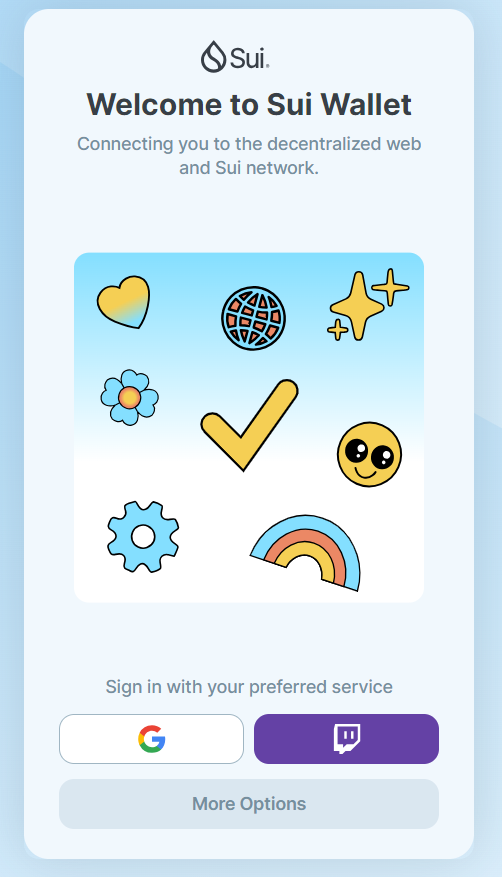
Create a New Wallet
Create a New SUI Wallet
  • Open the Extension: Click the Sui Wallet extension icon in your browser’s toolbar.
  • Create a New Wallet: Select the option to create a new wallet.
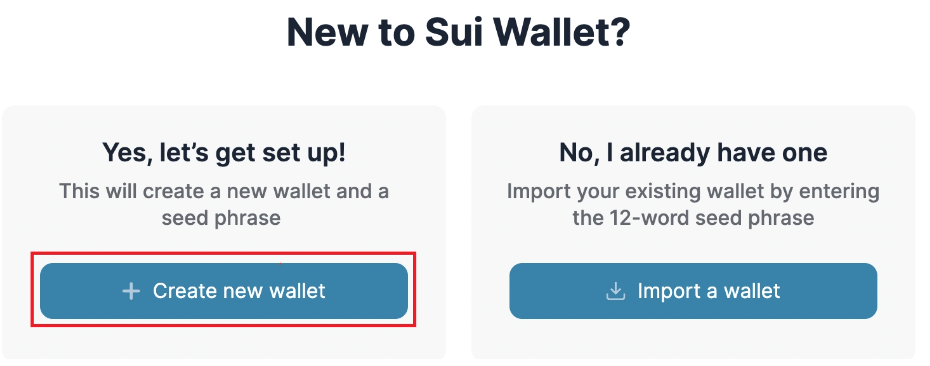
  • Set a Passphrase: Create a strong passphrase for your wallet. This is different from your recovery phrase.
  • Backup Recovery Phrase: You will be presented with a 12-word recovery phrase.
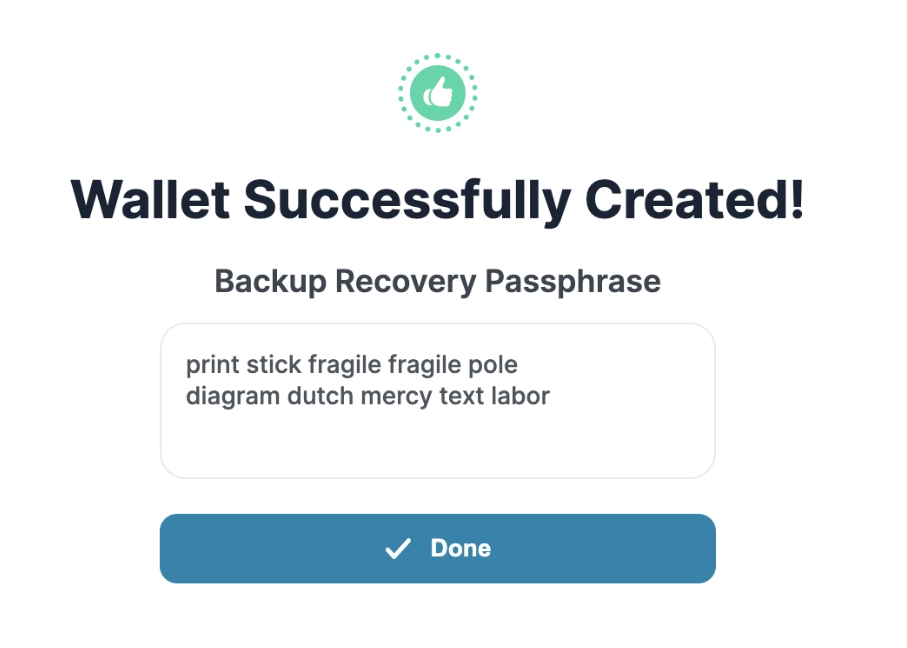
SUI wallet created successfully
  • Write it down and store it securely. This phrase is crucial for recovering your wallet if you lose access.
  • Confirm Passphrase: Re-enter your passphrase to confirm.
  • Agree to Terms: Accept the terms of service.

3. Secure Your Wallet

  • Store Recovery Phrase Safely: Keep your recovery phrase in a secure location, away from digital devices.
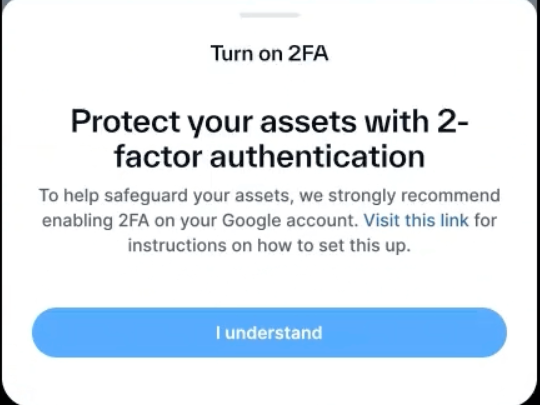
  • Enable Two-Factor Authentication (2FA): If available, enable 2FA for added security.
Important Considerations

  • Security: Always prioritize the security of your wallet by using strong passwords, enabling two-factor authentication, and avoiding phishing scams.
  • Backup: Regularly back up your wallet’s recovery phase to prevent loss of assets.
  • Education: Understand the risks associated with cryptocurrency before investing.

Once your wallet is created, you can start exploring the Sui ecosystem, sending and receiving SUI tokens, and interacting with various dApps.

Best Practices For Wallet Security 

Below given are some best practices to ensure your Sui wallet’s security: 

  • Never share your recovery phrase with anyone. This phrase is the key to your wallet. Anyone with access to it can control your funds.
  • Use a strong and unique password. Easy passwords can easily be hacked by hit-and-trial methods, so please ensure that you keep unique passwords only that you don’t use anywhere else.  
  • Enable additional security features. Selecting two-factor or multi-factor authentication adds a layer of security to your wallet. 
  • Keep your wallet updated. This ensures you always have the latest security patches to protect your wallet. 
  • Be cautious of phishing: Only download wallet apps from official sources and be wary of links asking for your wallet information.
  • Consider hardware wallets. For large holdings, hardware wallets can be safer as they would keep all the private keys offline. 

Integrate Sui Wallets in Your dApps

Blockchain technology is already developing at a fast rate, and staying ahead of the curve here is not just an advantage but a necessity. As Sui Wallet’s impeccable performance, speed, and scalability continue to gain popularity, it is the right time to integrate Sui Wallet into your decentralized applications for forward-thinking businesses. At Blocktech Brew, we’re here to guide you through this process, ensuring your project reaches the full potential of Sui’s innovative ecosystem.

Why Hire Sui Developers At BlockTech Brew? 

  • Customized Integration Solutions 
  • End-To-End Development 
  • Security Audits 
  • Performance Optimization
  • Ongoing Support  

Reach out to us via email: business@blocktechbrew.com and take the next step forward to blockchain technology! 

Categories
Web3

How to Set Up a Crypto Wallet?: A Complete Guide

With advancements in technology and elevation in the crypto game, the digital world is speedily paving its way to adopt cashless transactions and virtual currencies. However, be it trading cryptocurrencies or building digital assets, every operation needs a crypto wallet. 

This blog is a complete guide for crypto enthusiasts who want to explore crypto wallets. In this blog, we will learn what crypto wallets are, how they work, their types, and the methods to set up each type of crypto wallet.  

What is a Crypto Wallet? 

A crypto wallet is a digital space where people can store and manage their cryptocurrencies. A crypto wallet works similarly to the real-world physical wallet, where people pull out money from their wallets to pay for something and then keep the remaining money back in the wallet. However, a crypto wallet holds digital keys to access and manage cryptocurrencies instead of holding physical currency.

To make any transaction related to cryptocurrencies, digital assets like virtual real estate, and NFTs, having a crypto wallet is a must. Crypto wallets are fast to create, and any commoner with no knowledge of the crypto world can set up a crypto wallet easily. 

How do Crypto Wallets Work? 

Unlike regular wallets, crypto wallets do not simply hold the cryptocurrencies. Instead, they are stored on the blockchain network or public ledger. 

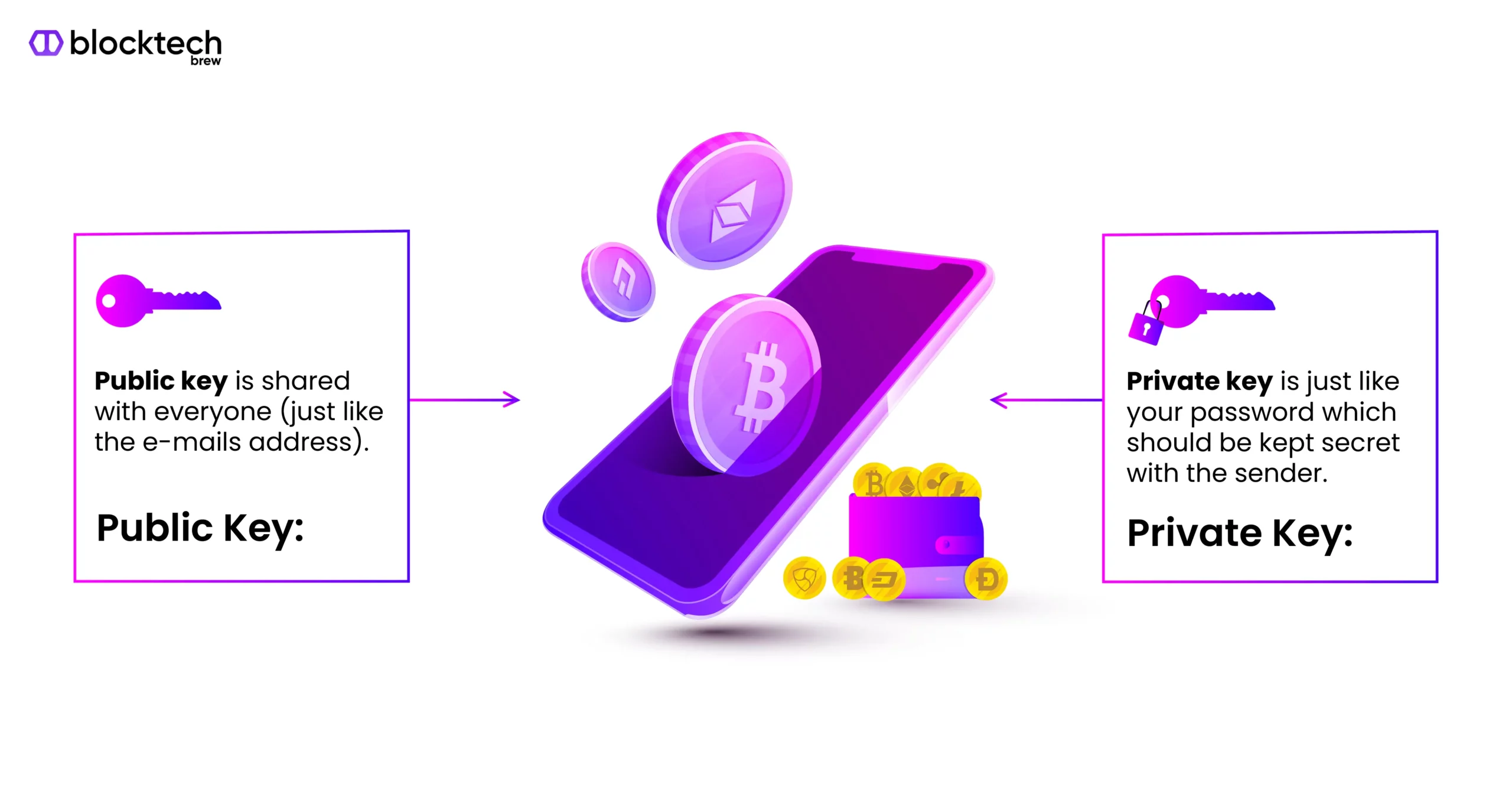
Crypto wallets have private and public keys to facilitate the decentralized finance DeFi processes. Private keys are used to secure transactions with cryptocurrency. These are created when the crypto wallet account is created. Private keys are not stored on a central server. Therefore, they can’t be restored once lost. 

Public keys are like unique numbers that record transaction data on the blockchain ledger. They show the transaction number but not any other details like the amount, owner name, place of transaction, etc., making the transaction much more secure. 

Hence, private keys help people to make transactions on the blockchain, while public keys store the transaction record with a unique alphanumeric number on the blockchain ledger. 

Types of Crypto Wallet

Before knowing how one can set up a crypto wallet, it is important to know about the types of crypto wallets, which are discussed below. 

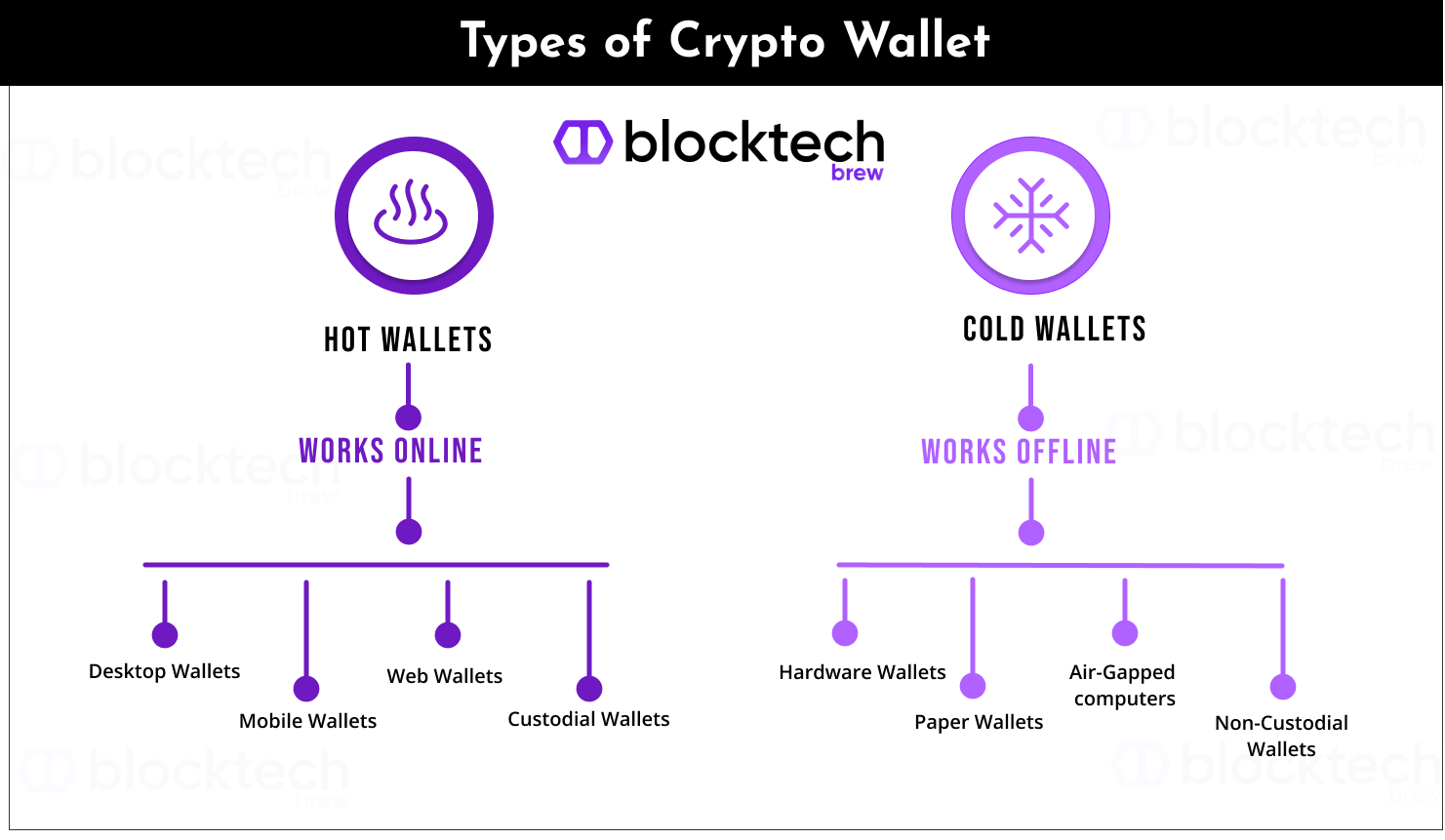
Types of Crypto Wallet

Crypto wallets are broadly categorized into Hot Wallets and Cold Wallets. 

Hot wallets are crypto wallets that function digitally while connected to the internet. On the other hand, cold wallets are the ones that can function even offline. 

Next, let us go into the details of each type of wallet. 

Hot Wallets

Most crypto wallets are hot wallets. They are easy and convenient to use but are also prone to hacking. Following are the four types of hot wallets: 

Desktop Wallets

Desktop wallets are software installed into the desktop, and your computer’s hard drive is used to store the private keys. This makes the wallet more secure as you do not need to use any external or third-party space to store your crucial keys. This type of wallet consumes more disk space and needs to be connected to a fast internet connection to do any kind of operation. 

Examples of Desktop Wallets include Exodus, Electrum, and Bitcoin Core. 

How to set up a Desktop Wallet? 

  • Download the Wallet: Choose a reputable desktop wallet like Electrum (for Bitcoin) or Exodus (for multiple cryptocurrencies) from the official website.
  • Install the Wallet: Follow the installation instructions for your operating system (Windows, macOS, Linux).
  • Set Up: Open the wallet application and follow the on-screen instructions to create a new wallet. This will generate a private key and a backup phrase.
  • Backup: Write down the backup phrase and store it securely. This is crucial for recovering your wallet if needed.
  • Secure: Set a strong password for additional security.

Mobile Wallets

Mobile wallets get installed like apps on smartphones and use the device’s storage to store private keys. They are convenient and can easily carry out any crypto transaction via QR codes anywhere and anytime. Though they can be used daily, mobile wallets are quite prone to fraud, hacks, and viruses. 

Examples of Mobile Wallets include Trust Wallet, Coinomi, and Mycelium. 

How to set up a Mobile Wallet? 

  • Download the App: Go to the App Store (iOS) or Google Play Store (Android).
  • Install the App: Search for a reputable mobile wallet app like Trust Wallet or Mycelium, then install it.
  • Create Wallet: Open the app and follow the prompts to create a new wallet. Write down the recovery phrase securely.
  • Backup: Store the recovery phrase in a safe place.
  • Secure: Set a strong PIN or password for the app to enhance security.

Desktop wallets and mobile wallets are also the types of software wallets. Software wallets are wallets in the software application forms. They are used via devices like desktops, laptops, or mobile phones to manage cryptocurrencies.  

Web Wallets

Like normal websites, web wallets are accessed via internet browsers. They store the private keys on a server controlled by a third party. They are good for making small and quick transactions and can be accessed from any device if you have a browser and an internet connection. Web wallets are the least secure and prone to hacking and breaching activities. 

Examples of Web Wallets include MetaMask, Coinbase, and Blockchain.info. 

How to set up a Web Wallet? 

  • Visit the Website: Go to a trusted web wallet service like MetaMask or MyEtherWallet.
  • Create Wallet: Follow the steps on the website to create a new wallet. Generate and record your private key and backup phrase.
  • Backup: Store the backup phrase securely offline.
  • Secure: Set a strong password for your account.

Custodial Wallets 

Also known as Hosted Wallets. Custodial wallets are third-party solutions that are used by crypto users to manage their private keys. Usually, managing crypto funds is not easy, and choosing a reliable third-party service can help better manage these funds. It is preferable to choose the service provider offering insurance coverage for any theft or fraudulent activities. 

Examples of Custodial Wallets include Binance and Kraken. 

How to set up a Custodial Wallet? 

Sign Up: Register on a reputable cryptocurrency exchange or custodial wallet service like Coinbase or Binance.

Complete Verification: Verify your identity as required by the platform.

Access Wallet: Once verified, log in to your account and access your wallet through the platform’s interface.

Security Measures: Follow the platform’s recommended security measures, such as enabling two-factor authentication (2FA) for enhanced security.

Cold Wallets 

Hardware Wallets 

Hardware wallets are said to be the most secure way to store cryptocurrencies. They are physical devices like USB keys, which might also have advanced safety measures like biometrics. Hardware wallets need to be connected to the computer to run the software for accessing the cryptocurrencies, so it is important for users not to lose their hardware wallets. Having their storage makes them less vulnerable to any hacking activities. Moreover, when the hardware wallet is disconnected, it is safe from any malware.  

Examples of Hardware Wallets include Ledger Nano S and Trezor.

How to set up a Hardware Wallet? 

Purchase: Buy a hardware wallet such as Ledger Nano S or Trezor from the official website or authorized resellers.

Setup: Follow the setup instructions for the hardware wallet. This usually involves connecting the device to your computer and initializing it.

Generate Wallet: Create a new wallet on the device and set up a PIN code for added security.

Backup: Write down the recovery seed provided by the device and store it offline in a secure location.

Paper Wallets 

Paper wallets are physically QR-coded wallets. They are physical printouts or written records of public and private keys. They are immune to online attacks but have several flaws that have made them dangerous. Paper wallets offer a simple and cost-effective way to store digital assets offline, but they require careful handling to avoid physical damage or loss.

How to set up a Paper Wallet? 

  • Generate: Use a trusted paper wallet generator like bitaddress.org to create a new paper wallet offline.
  • Print: Print out the wallet details, including the public and private keys.
  • Secure: Store the printed paper wallet in a safe, dry place, away from potential damage or unauthorized access.

Air-Gapped Computer Wallets 

An air-gapped computer wallet is a cryptocurrency storage solution that uses an isolated computer to enhance security. This computer, known as an air-gapped computer, is completely disconnected from all networks, including the internet, local networks, and wireless connections like Wi-Fi or Bluetooth. This isolation makes it highly resistant to hacking attempts and malware infections.

How to set up an Air-Gapped Computer Wallet? 

Setup: Use a dedicated computer not connected to the internet for added security.

Install Wallet Software: Install wallet software like Electrum or Bitcoin Core on the air-gapped computer.

Generate Wallet: Create and manage wallets offline to minimize exposure to online threats.

Non- Custodial Wallets 

Also known as Self-Custodial Wallets. Non-custodial wallets are a type of cryptocurrency wallet where the user has full control and ownership of their private keys. Users can only access and manage their funds without relying on a third party. These wallets come in various forms, including software wallets like MetaMask and Trust Wallet, as well as hardware wallets like Ledger and Trezor. The primary advantage of non-custodial wallets is enhanced security and privacy, as users are not dependent on external entities to safeguard their funds. 

How to set up a Non- Custodial Wallet? 

  • Software Wallets: Download and install non-custodial software wallets like Electrum or MetaMask.
  • Setup: Create a new wallet within the software and generate your private key.
  • Backup: Always back up your recovery phase offline to ensure access to your funds in case of device loss or failure.
  • Security: Set a strong password and consider additional security measures like two-factor authentication (2FA).

Hence, we have briefly compiled all types of wallets and the methods to set them up. 

If you are a business looking to launch a crypto wallet, contact Blocktech Brew and experience the best crypto wallet development service ever! 

Categories
Web3

Web3 SocialFi: Incentivizing Social Networking


As the blockchain and crypto industries are rising, the tables are turning for conventional ways of storing data, finance, and much more. SocialFi is a concept that combines these technologies to incentivize social networking using cryptocurrencies. In this blog, we will dive deep into this emerging facet of social networking and explore its inner workings, key features, and real-life examples.

What is SocialFi? 

SocialFi is a cutting-edge ecosystem built from the intersection of social networking, web3, and decentralized finance. In simple words, it is an ecosystem built on web3 where people would be paid in cryptocurrencies to network with each other or post, comment, and like on each other’s social updates. 

Let us decode how these 3 technologies contribute to the Web3 SocialFi’s functioning:

Social Networking

It allows people to be in touch, chat, and react with each other, just like the conventional social media platforms. 

Web3

It sets the underlying base for SocialFi to work efficiently with Web3 principles like decentralization and user ownership, thus allowing SocialFi to be different from conventional social media platforms.  

Decentralized Finance (DeFi)

Decentralized Finance or DeFi takes care of the financial aspect, allowing users to earn crypto rewards and participate in the financial opportunities of the platform.

How Does It Work? 

Like in traditional social media, where users create and post different types of content and get paid, SocialFi also pays crypto tokens to the users for content creation and networking access to the web3 platforms. However, in both cases things work differently at the back-end. 

Earlier, the social media platforms were owned, controlled, and managed by just one organization that had access to all the user data, whereas in Web3 SocialFi, all the user data is distributed among various blockchain nodes, and no single party would be the “owner’ of it, giving the user all the control of their data. 

Also, to increase the participation of people, crypto rewards are given for networking activities like likes, comments, reposts, or simply for being present across the SocialFi network. These tokens can be used by them to have a say in different decision-making activities like voting etc. Thus, by incentivizing social media for the users, Web3 SocialFi has taken the way people interact with each other to a whole another level while considering user privacy and security. Apart from this, DAOs, decentralized autonomous organizations, or decentralized autonomous cooperations are like the board of members of SocialFi, which handles its work in a distributed manner. 

They are used to coordinate with stakeholders, and this works by providing authorization to members like active participants or developers to make decisions and guide the organization, unlike the board of directors controlling the traditional social media platforms. 

Key Components of SocialFi 

Based on the working of Web3 SocialFi, let’s break down the key components of SocialFi: 

Blockchain Technology 

Blockchain is a decentralized network chain that stores and transmits information in the form of blocks. Each block has its unique hashes (like unique IDs) and transactional data. Blockchain stores data immutably across different nodes.

Non-Fungible Tokens (NFTs)  

Non-fungible tokens or NFTs are the digital certificates of unique and one-of-a-kind things like art, music, video, or any such thing. Just like copyrights or patents, NFTs are the digital mark that gives you the authority and ownership of a particular non-fungible asset. NFTs can be created, bought, and traded using cryptocurrencies. 

DAOs (Decentralized Autonomous Organizations)

DAOs act as the board of directors and management organizations in Web3 SocialFi. They consist of active members (token/crypto reward holders) of the social platform who participate in making important decisions for the platform. 

Decentralized Applications (dApps) 

SocialFi platforms run on decentralized apps, apps that are built on decentralized platforms like Ethereum. They power Web3 social experiences, enabling users to connect, create, and earn crypto through DeFi features.

Decentralized Storage

Based on the decentralized web server, SocialFi platforms store their data on decentralized storage solutions like IPFS storage to ensure the security, immutability, and freedom of speech of the user data. 

Incentive Mechanism & Tokenization 

There are different innovative payment gateways present on different types of SocialFi platforms to attract more content creators and reward their creations seamlessly. 

Decentralized Governance

With DAO-backed management practices, SocialFi platforms ensure decentralized governance, unlike traditional social media platforms where just one company holds all the authority and decision-making. 

Features & Benefits of Web3 SocialFi 

Below given key points are the core principles of SocialFi separate it from the working of Web2 social media platforms. 

Freedom from Censorship

Web2 social media platforms have a number of regulations that restrict users from posting freely or censoring their content. Conversely, Web3 SocialFi platforms are handled by DAOs, allowing users to take part in important platform decisions and bring up their thoughts freely. 

Immutable Digital Ownership 

Web3 SocialFi gives content creators the utmost authority and control of their data. Moreover, the uniqueness of their data is preserved by NFTs, thereby giving immutable digital ownership to creators and ensuring their data security and privacy. 

Earning Potential  

The crypto token rewards that are given to the users and audience are the center of attraction for content creators, investors, and various brands. Moreover, as advancements are coming into the fields of blockchain, Web3, and cryptocurrencies, the field of Web3 SocialFi has immense potential. 

Real-Life Examples 

Following are some real-life examples of Web3 SocialFi platforms 

DeSo 

Decentralized Social is a specially designed blockchain network for decentralized social media applications and allows users to incentivize their content creation. By encouraging creators to mint the NFTs for their creation, DeSo promotes digital ownership and lets creators and collectors earn rewards for engagement, and for participating in the decentralized governance. 

Sapien 

Sapien is the decentralized social media platform built on one of the leading blockchain networks, Ethereum. Users can create NFT for their content and thus incentivize their creations. Moreover, participants also get to earn rewards for networking and participating. Also, Sapien has its decentralized authorization organization (DAO) for decentralized governance. 

Audius 

As the name says, Audius is another music streaming platform that leverages the power of blockchain to promote direct artist and fan connections. The payments are done via cryptocurrencies, and thus facilitate transparent royalty payments while governing the community. 

Friend.tech 

Friend.tech is another SocialFi platform built on one of the top blockchain networks, Base, that uses “Keys” as their social tokens to allow users to interact with each other and earn rewards for their participation, which in turn motivates them to stay more active on the platform. 

Open Campus

Open Campus is a blockchain-based education platform where users can access educational content through EDU social tokens. The system validates the standard content quality before publishing and encrypts the educational content as NFTs. Thus, educators can earn revenue and be motivated to create more content for the betterment of learners. 

Hence, the above real-life SocialFi platforms in different domains like education, music, and social networking clearly exemplify the role of Web3 SocialFi in drastically transforming the working of conventional social media platforms. Moreover, networking has the power to boost any industry, and in this case, as SocialFi rises, it will elevate the markets of blockchain and cryptocurrencies as well. 

Do you want to participate in the revolution of Web3 SocialFi? Then, launch your own SocialFi platform with Blocktech Brew and earn loads of money! 

Contact business@blocktechbrew.com  to know more. 

Categories
Blockchain Web3

IPFS Storage: Resilience, Speed & Freedom

In today’s digital age, where data is the key component of all industries, how we store it matters more than ever. In this blog, we will discuss the traditional storage system and the problems that triggered the rise of IPFS storage. We would explore the power of IPFS and unlock a new era of secure, permanent, and censorship-resistant storage.

What is IPFS? 

The InterPlanetary File System (IPFS) is a decentralized file system that is used to store and share files across different nodes and allow individuals to track and see their different versions over time. Unlike the client-server architecture that stores files on a centralized server, IPFS provides a distributed network shared among different bodies. Thus, it facilitates quicker and more reliable access to files. 

Problems of Centralized Storage System 

Before diving into the details, let us first read about the problems that came up with the centralized storage systems, which caused better ways of storing files, i.e., IPFS and decentralized networks, to be introduced. 

  • Censorship Risks

In centralized networks, the central body has the authority to censor the information that it thinks is harmful or incorrect. Hence, this limits free speech and access to information. 

  • Vulnerability to Single Points of Failure

In centralized storage systems, if the central system fails or undergoes a security breach, the entire network will fail, and this is called a single point of failure. 

  • Innovation Constraints

Entities with centralized control often possess exclusive control over information and resources, hindering competitive dynamics and curtailing the scope for innovation.

  • Privacy Concerns

As all the data is stored in a single location, it becomes vulnerable to breaches and hacking, and hence, raises questions on the privacy and security of the sensitive information of users. 

  • Wealth Distribution Disparities

Wealth among the centralized systems is distributed very unevenly; for example, most of the wealth would be given to the centralized systems and barely distributed among the users. 

On the other side, decentralized storage networks like IPFS majorly solve all these issues and allow users to have evenly distributed power, wealth, and security. 

IPFS and Blockchain 

Blockchain is a distributed, decentralized data management network that offers top-notch features like transparency, and traceability. As both IPFS and blockchain have similar features, blockchain comes at the forefront of recording the file metadata to support IPFS. Moreover, both blockchain and IPFS serve different purposes in the real world. To have a more comprehensive understanding, let us first know about both of them separately. 

IPFS v/s Blockchain- What’s the difference?

Blockchain, the decentralized ledger is widely used in today’s age to store data on different transactions in a distributed and transparent manner. It has consensus methods, and cryptographic algorithms to ensure the safety and integrity of the data stored on blockchain. Blockchain has various applications across different industries like decentralized applications (DApps), decentralized finance (DeFi), crypto industry, blockchain gaming, decentralized identifiers (DIDs),  and so on. 

On the other hand, IPFS aims to provide a global decentralized file system network that can tackle the problems associated with traditional web protocols. It is resistant to censorship, and mutability, and allows the files to be stored in an efficient manner. IPFS ensures that the data stored in it, is unique, by allotting it a unique identifier, and is protected against modifications. If the data gets changed by following the protocol, a new “hash” identifier is generated which would be different from the hash stored on the blockchain for the recorded data. 

Hence, the incorporation of Blockchain supports the working of IPFS, where IPFS stores the files in a decentralized and distributed system, blockchain keeps the track record in a decentralized, and transparent manner, and verifies all the transactions. 

How IPFS Works?

Let us break down the key areas referring to how IPFS stores data: 

Distributed Data Storage 

Inter Planetary File System is a peer-to-peer network that is used to store and share files across multiple nodes. To store files resiliently, IPFS works by breaking down the files into smaller pieces called “blocks’, and storing them in various nodes all over the network. This means that files are stored at multiple locations instead of a single location, thus protecting them from the associated risks with the single point of failure. 

Content-Addressed System 

A content-addressed system is used to name files in the IPFS system. This means that IPFS provides a unique hash of the content instead of location, and names to identify the files. This content-addressing system allows users to download or access files from different nodes even if they were initially uploaded or stored at different locations. Moreover, this system can create permanent and immutable links likewise URLs, which can be used as references to access files when they are moved to different locations. 

Data Retrieval By Nodes 

As noted previously, the storage of content involves a variety of nodes. These can vary from individual personal computers to substantial data centers. Each node plays a role in maintaining a Direct Acyclic Graph (DAG), which effectively maps all the blocks, and simplifies the process of data retrieval. To request a file, a node sends out requests for the blocks that make up the file, and then receives the output that stores them. As the node is done with receiving all the blocks, it reconstructs the file. 

Hence, data is stored and retrieved in a much better and more efficient way by decentralized IPFS storage. 

Applications of IPFS 

The following are the use cases of IPFS storage: 

Scattered Storage for Resilience

IPFS stores files scattered among various nodes at different locations in the form of blocks and ensures that the data can be easily retrieved even if some of the nodes go offline or leave the network, as the files can be reconstructed from the remaining blocks that have crucial information. This redundancy makes the network highly resilient to node failures and network disruptions. 

Global Delivery with Decentralization

When a user requests a file, IPFS from its decentralized storage retrieves the necessary blocks that are present closest to the user, rather than relying on centralized storage systems that may be present far from the user’s location. This reduces the latency, and bandwidth costs, and increases the global accessibility of the data stored. 

Foundation for dApps

Decentralized apps are regular apps but without a central storage point, and that is why IPFS can set the groundwork for dApps to store the data in a secure, transparent, and independent manner. Moreover, the content-addressed and immutable feature ensured data integrity which is quite beneficial for the dApps to provide trustworthy and tamper-proof services. 

Preserving Web History

In the centralized and ever-changing web system, websites rely on centralized servers which may go offline, or remove content. On the other hand, IPFS allows the web to create permanent storage links that can even be used when it goes offline. Also, the websites are replicated making it much harder to replicate. 

Uncensorable File Sharing

As IPFS does not have any centralized server, there is total transparency with no censorship. Also, as the data is stored at multiple nodes it is very hard to erase or remove anything from the network. Thus, IPFS allows free speech without the fear of being restricted. 

Benefits of IPFS 

  • Quicker Content Delivery 

IPFS enables efficient content retrieval by leveraging its decentralized network of nodes, leading to lower latency and faster content delivery compared to traditional web systems. The peer-to-peer architecture allows nodes to retrieve content from multiple sources simultaneously, ensuring high availability and minimizing bottlenecks.

  • Enhanced Data Availability 

With the presence of data at different locations, data availability is increased, with a reduced risk of downtime. Thus, the method of content addressing ensures that the information can be accessed anytime, and anywhere. 

  • Robust Security & Privacy 

IPFS offers cryptographic security which ensures the authorized use of the content stored on the network. Moreover, decentralization provides the benefits of transparency with no vulnerability to censorship and surveillance. 

  • Cost-Effective Storage Solutions 

By leveraging the power of distributed storage, IPFS can help reduce the cost of hosting and serving content, without compromising on speed or security. Its decentralized architecture enables efficient content distribution, ensuring high availability and fast retrieval times. IPFS provides enhanced security and data integrity through content addressing and decentralization.

Conclusion 

The IPFS community is actively working on improving scalability and performance, as well as developing more user-friendly interfaces and tools to make IPFS more accessible to non-technical users. Additionally, there are initiatives underway to encourage more developer adoption and support, including hackathons, developer communities, and educational resources.

Overall, IPFS represents a promising new approach to storing and sharing files in a decentralized, peer-to-peer network. As the internet continues to evolve and face new challenges, IPFS may play an increasingly important role in ensuring a more resilient, censorship-resistant, and decentralized web. By leveraging the power of distributed storage, IPFS offers a cost-effective, efficient, and secure solution for hosting and serving content, without compromising on speed or performance. The future of IPFS looks promising, paving the way for a more open, transparent, and decentralized internet.

IPFS Storage is gaining heights in Web 3 solutions, and Blocktech Brew  is leading the way in Web 3 Development. So, to get your cutting-edge Web 3 and blockchain solutions developed, do reach out to us via business@blocktechbrew.com 

Categories
Blockchain Web3

Base Ecosystem: Redefining Decentralized Finance

What is a Base Ecosystem? 

Cryptocurrency and blockchain are ever-evolving technologies, and base is coming up as a new fascinating innovation. Developed by Coinbase in early 2023, the base ecosystem is a cutting-edge layer two (L2) network that is strategically built on top of Ethereum, and it is aimed to revolutionize the way humans interact with the blockchain and support the development and deployment of decentralized apps (dApps). 

While Ethereum brought new opportunities for decentralized applications in various industries, congestion, high fees, and scalability issues still stood as a challenge, and to overcome these, the L2 network came up with solutions. Layer 2 networks retain the security of layer 1 networks, increase speed, and minimize costs to enhance customer experience. 

Base Ecosystem Architecture

Base architecture
Base architecture

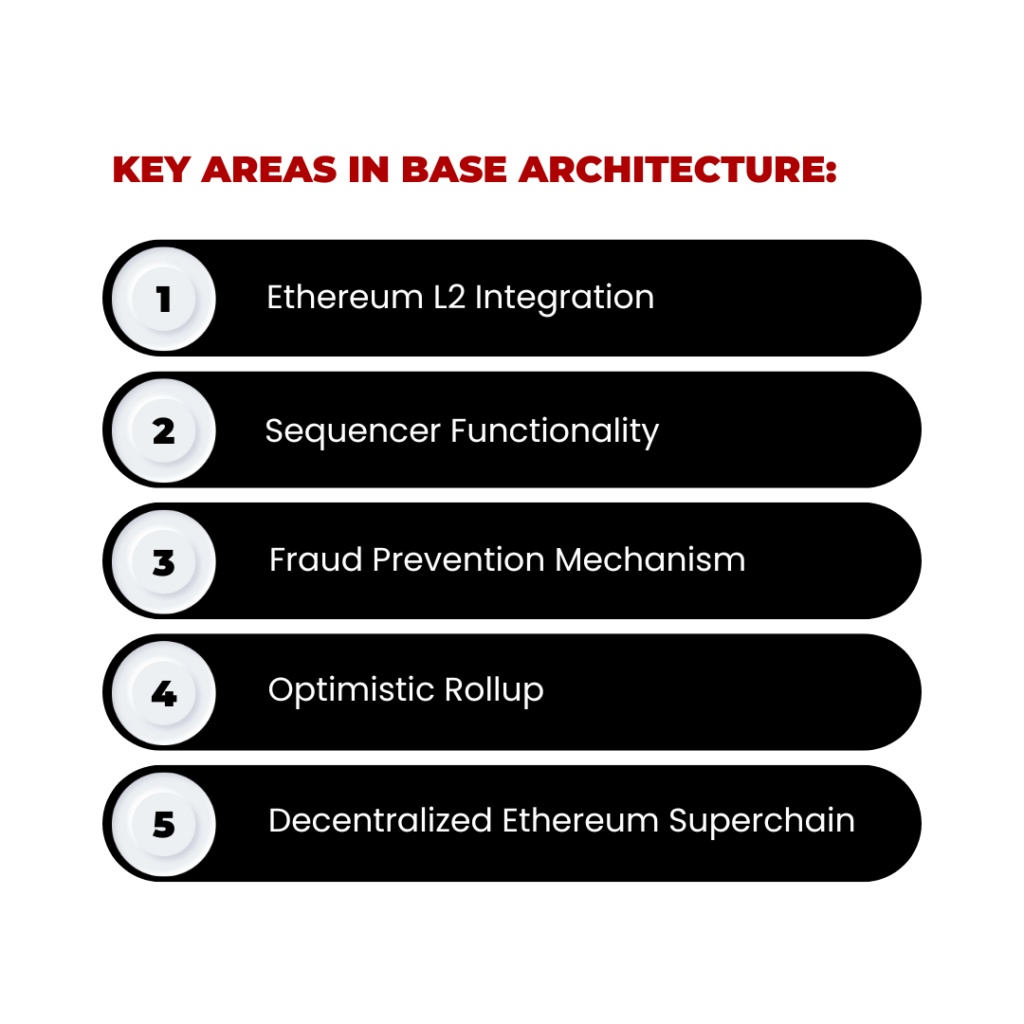
Let’s get some detailed insights into how the base ecosystem works and how it is built: 

  • Ethereum L2 Integration

Base functions as a second-layer solution constructed atop Ethereum’s foundational first layer. It aggregates transactions off-chain before relaying them to the Ethereum mainnet, drastically cutting costs and boosting transaction capacity. 

  • Sequencer Functionality 

Base has a sequencer that stacks the transactions and submits them to Ethereum L1. Coinbase initiates the sequencer and ensures the right execution of the transaction. However, the aim is to be decentralized, cut reliability on centralized entities, and boost the system’s resilience. 

  • Fraud Prevention Mechanism

A fraud proof mechanism is implemented by Base to check the transaction validity. When a user raises an objection regarding a transaction, the sequencer must provide proof of fraud to Ethereum L2, and after ensuring its validity, the transaction undergoes a reversal process. Hence, the security of transactions for the user is ensured. 

  • Operational Dynamics as an Optimistic Rollup

Base is an optimistic roll-up solution. As the term suggests, the base considers all the transactions to be valid until proven otherwise. Approval by more than two-thirds of the validators is required in order to get it accepted, and this promotes efficiency while maintaining security. 

  • Envisioning a Decentralized Ethereum Superchain 

Base ecosystem aims to build a super chain with a network of independent interconnected hubs. The goal is to facilitate seamless interaction across various L2 platforms, thereby increasing Ethereum’s scalability by transferring specific tasks to these specialized L2 platforms for execution before finalizing them on the main Ethereum blockchain. 

Looking at the bigger picture, Base provides scalability, efficiency, and security improvisations to the Ethereum ecosystem, leveraging layer 2 solutions to tackle the shortcomings of Ethereum layer 1. As the ecosystem evolves, decentralization, interoperability, and resilience will be the key factors in achieving the vision of a scalable and sustainable Ethereum superchain.

Why is the base ecosystem important? 

The flexibility the base ecosystem offers for blockchain is the main reason it is gaining so much popularity. To have a comprehensive understanding, let us look at the following points referring to the benefits of the base ecosystem: 

  • Enhanced Security 

As the base is secured by Ethereum, one of the most secured blockchain platforms, it offers robust security and a reliable environment for investments. 

  • Increased Scalability 

With high transactional speed and low costs compared to L1, the base offers high scalability for decentralized applications. It is used in a wide range of applications, including decentralized finance (DeFi), gaming, and non-fungible tokens (NFTs). 

  • Developer-Friendly 

The base is totally Ethereum Virtual Machine (EVM) friendly, offers seamless transactions for decentralized applications and provides effortless APIs for account abstraction. Developers can easily deploy their existing blockchain from ethereum smart contracts to base. 

  • Access to Coinbase’s Ecosystem 

Base is integrated with Coinbase, and hence, the projects that are built on Base get access to coinbase’s wide range of products, users, and tools. Users can utilize coinbase’s wallet to interact with base’s dApps.

  • Interoperability 

Base is built to provide easy access to Ethereum’s layer 1 and other L1s and L2s. This interoperability is important to enhance user experience and increase flexibility to expand the project markets and user bases. 

  • Economic Efficiency 

Base provides full EVM compatibility at lower costs (low gas fees), enabling smooth transactions and budget-friendly multichain application development. Thus, lower operational costs with higher returns make the base ecosystem attractive to investors. 

Projects on base ecosystem 

Following are some examples of the trending projects based on the base ecosystem: 

SeamlessFi (SEAM) 

SeamlessFi is the first decentralized finance (DeFi) project based on the base ecosystem that emphasizes lending and borrowing. It serves as the governance token of the seamless base protocol. Its protocol holds inputs from individuals with dealings in notable projects like Coinbase, Aave, etc which sets a strong foundation for its exponential growth. Seamless has unique lending solutions like under and over-collateralized loans that increase capital efficiency. Moreover, having integrated liquidity markets (ILMs) within the protocol enables customized borrowing strategies. 

Base God (TYBG) 

With a vision of an on-chain revolution, Base God is a meme-based project built on Base and Coinbase that focuses on community-driven principles. It prioritizes community engagement and prevents structured teams and product plans with an aim to create a decentralized and cooperative path ahead instead of traditional project approaches. TYBG encourages crucial roles like rewarding community involvement, providing payments within the ecosystem, and so on. Apart from this, the decentralized payments it offers facilitate enhanced security, increased scalability, and support tokenization of assets.  

DeFido (DFD)

DeFido is an emerging project based on a base ecosystem that is getting immense attention fueled by the distinctive French bulldog mascot and a goal to encourage community involvement and root for the growth of the base ecosystem. Its usage is linked to decentralized exchange trading, mainly on Uniswap V2 (Base), where DFD/WETH pairs are frequently traded. With a unique backstory and purpose, DFD combines decentralized finance with the widespread love for dogs and emphasizes community innovation and accessibility in DeFi. 

Thus, the projects based on the base ecosystem exemplify innovation and creativity in the decentralized finance space. With each project offering unique features and solutions, they contribute to the growth and diversity of the ecosystem. As they continue to evolve and garner community support, they have the potential to shape the future of decentralized finance and contribute to a more inclusive and accessible financial landscape for all.

Conclusion 

As advancements are coming in the world of decentralized finance (DeFi), the base ecosystem stands as the beacon of innovation and possibility. With strong foundations on Ethereum’s layer 2, it facilitates faster and more effective transactions, solving the problems of slower transactions and limited scalability that are faced by many blockchain networks. At the roots of the base ecosystem is the commitment to decentralization and community-driven governance, empowering investors to actively participate in shaping the direction and evolution of this transforming ecosystem.  

Moreover, projects like DeFido and SEAM, throw light on the diversity of offerings and creative potential of DeFi. As the ecosystem continues to expand and mature, more developments in interoperability, scalability, and usability will rise, paving the way for mainstream adoption of blockchain technology. With its focus on innovation, inclusivity, and collaboration, the Base ecosystem is poised to redefine the future of finance and usher in a new era of decentralized possibilities.

if you are looking for Base ecosystem developers , contact blocktechbrew

Categories
Web3 Gaming

Ubisoft Announces First Web3 Game

Ubisoft released the trailer for its first-ever Web3 game, which is set to change the dimension of Web3 gaming.

Last week, Ubisoft released a cinematic trailer for its first Web3 game – Champions Tactics – Grimoria Chronicles. The company calls the game its new “PVP Tactical RPG experimental” PC game.

The Assassin’s Creed game creator will be deploying its new game on the Oasys platform. 

The company has not released any screenshots of the game. However, the gaming company’s website only includes the trailer of the game. 

Though the trailer does not give much about the game itself, it’s a sneak peek of the Champions Tactics game theme. 

Further, the company’s website only reveals that players will “assemble a team of mythical champions, engage in thrilling tactical battles against other players and discover the legends of the dark and mystical world of Grimoria”.

Oasys being a partner in this web3 game development announced the launch at the Oasys Special Event in Japan. The event was a part of Japan Blockchain Week, sponsored by the Japanese government’s Ministry of Economy, Trade, and Industry.

Ubisoft has been experimenting with blockchain gaming for the past 10 years. 

In 2021, the company released limited edition NFT items on the Tezos blockchain for the PC version of Tom Clancy’s Ghost Recon Breakpoint.

Then, last year, Ubisoft made headlines by releasing NFTs on Rabbids characters in its metaverse game The Sandbox.

Previously, the company had stirred the gaming industry with NFT-based games like One Shot League.

The journey of Ubisoft from traditional games to Web3 games is inspiring.

Let’s track the company’s footsteps from Prince of Persia to Champions Tactics.

Ubisoft: An Unicorn In The Gaming Industry On The Path To Explore Blockchain Games

Gaming industry enthusiasts know the contributions of Ubisoft. 

The French Game publisher Ubisoft has created reputable brands in the industry. Some of its popular games include Prince of Persia, Rayman, Splinter Cell, Rainbow Six, Ghost Recon, Assassin’s Creed, Rabbids, Watch Dogs and more.

These are some of the finest games with millions of daily active players. Gamers and developers went gaga on the release of these games.

Ubisoft has been an undeniable force within the gaming industry. 

Now, with the entry of blockchain into the gaming scene, the company has been active in this gaming revolution.

Ubisoft has been experimenting with blockchain and NFT even before these terms became mainstream. 

Strategic Innovation Lab 

  • In 2017 the company formed Strategic Innovation Lab. 
  • The aim was to research, identify and build next-gen blockchain games. Further, the company was also focusing on integrating NFTs into its game titles.

Ubisoft’s director of Insights and Trends, Lidwine Sauer, said:

“When you put a one-of-a-kind digital asset on a blockchain, you can track exactly who owns it at a specific moment, and in a secure way. It’s like if you have a Picasso. It’s 100% unique, and if it’s yours, it’s yours. Thanks to the blockchain, you can now have the equivalent of digital Picassos with the advantage that they cannot be stolen from you.”
  • Shortly after, we see Ubisoft participating in blockchain conferences and summits. 
  • To kickstart its blockchain endeavours, the company went as far as founding Blockchain Game Alliance in 2018.

Hashcraft

  • 2018 was a crucial year for the gaming company. The Strategic Innovation Lab built a blockchain game, Hashcraft. 
  • Though they never officially released the game, it shows what the future of gaming could be.
  • Hashcraft is a prototype, an experimental game inspired by Minecraft. It is a treasure hunting and island exploration game powered by the computational power of its players.
  • The players can build teams or compete against each other individually on the gaming island. 
  • In Hascraft the players will have the freedom to make communities and define the rules of the game and gaming community themselves.
  • The brain behind the game was a team led by Ubisoft’s Blockchain Initiative Manager Nicolas Pouard and Senior R&D Programmer Robert Falce.
  • It might be that Ubisoft never releases the game to the public. 
  • But the gaming community is excited about the company’s experiments on blockchain and awaits what it could mean for the future of gaming.

Entrepreneurs Lab Program

  • At one time Ubisoft decided to move its entire backend to blockchain. It planned to license the microsoft-xbox-nft-guide Xbox Enterprise Blockchain Platform from Microsoft.
  • However, surprisingly, Ubisoft went on to introduce the Entrepreneurs Lab program within the Strategic Innovation Lab. 
  • The program envisioned identifying and supporting game startups in the Web3 space.
  • In the process of supporting startups, Ubisoft contributed to the development of game studios like Dapper Labs, Sky Mavis, Starchain Gazer and Sorare.
  • The company also partnered with Sorare to launch a fantasy NFT game based on Belgium’s Jupiter Pro League. It was One Shot League.

Ubisoft & Quartz

  • Ubisoft made a significant impact in the AAA games industry with the launch of its NFT-related project, Quartz, on December 7, 2021. Quartz, an NFT platform, introduced a new type of NFTs called Digits, taking the gaming community by surprise. 
  • However, the project had been in development for a long time before its official release.
  • Quartz was launched as a beta experiment, and Ubisoft initiated it with a limited run of three skin NFTs connected to the game Ghost Recon: Breakout. 
  • To prevent speculative trading, gamers had to play a substantial amount of the game before they could acquire a Ghost Recon NFT. 
  • The head of the product, Pouard, emphasized the platform’s aim to give players a stake in their games, creating a sustainable ecosystem where players could benefit from the value they generate through their time spent, in-game purchases, and content creation.
  • With Quartz as the first step, Ubisoft expressed its ambitious vision of building a true metaverse, bridging the gap between blockchain technology and gaming, and fostering a sustainable and player-centric gaming ecosystem.

Ubisoft & NFT Game Endeavors

  • The next milestone for Ubisoft was investing in Animoca Brands. It is a reputable Australian company making strides in NFT, blockchain and P2E gaming space. 
  • Then, in February 2022, Ubisoft partnered with Hedera to join Hedera governing council.
  • Ubisoft also invested in MMORPG Nine Chronicles and Dogami.


Conclusion

Undoubtedly, Ubisoft is all in to explore blockchain, NFTs, metaverse, and web3 integration in the games. With the company reaching every milestone, we are getting closer to an advanced gaming experience.

When it comes to AAA games, no one can beat Ubisoft.

If you are also looking to build blockchain games? Your trusted blockchain game development company is a call away!

Book your free consultation call with our experts today!

Categories
Web3 Artificial Intelligence

How Generative AI Is Game Changer For Web3 Developers: Exploring The Benefits

Everything from our dApps to metaverse to decentralized exchanges and online services platforms runs on codes. Even web3 games which are a hot trend in the digital world are completely dependent on codes. 

If the code is not correct and of standard quality then everything is in vain. 

That is why web3 game developers always strive to write the best codes to build the most exciting web3 game with outstanding features.

You may have the best web3 product but if your coding is not right you can never turn your project idea into reality.

Web3


Developers who write the code often struggle to write quality and error-free codes. Even the most experienced web3 developers spend hours finding a small error in their code.

Developers reach code perfection by investing hours of hard work into programming. That is why developers are always on the lookout for tools that will help them write better codes.

One of the tools that have caught the attention of the developers is Generative AI. Tools like ChatGPT powered by transformers, GANs and NLP have the potential to boost the efficiency of the tools.

Generative AI is here to improve code quality, increase productivity and meet user expectations.

In this blog, we will explore how Generative AI is helping developers with web3 development services.

What Is Generative AI?

Generative AI is a classification of Artificial Intelligence capable of producing text, images, photos, artwork and even code. Powered by AI models like Generative Adversarial Networks (GANs), Variational Autoencoders (VAEs) and Transformers, generative AI can process large chunks of data to understand the intent and relationship between the data sets.

It then uses the same data sets to produce similar content that follows the same pattern.These AI models not only function as per the fed data but also continuously learn from the new data. So, the AI model automatically learns, improves and optimizes its results as per the new environment.

The best thing about generative AI is that it can understand the true intent and meaning of human queries or commands and can respond or produce output based on that. 

Generative AI tools like ChatGPT can even produce human-like content in natural language. 

You will be surprised to know that generative AI models can curate a marketing strategy, product idea and even an email campaign for your business. It can even write blogs, emails, social media posts, product descriptions, and ad copies and summarize the content.

To everyone’s surprise, developers are using generative AI apps to write error-free codes. You just have to enter the right command and the AI app will write you the entire code for your website or dApp. 

Developers are using Generative AI for smart contract development. They are using AI tools to automate their coding processes like testing. For example, GitHub CoPilot suggests better codes to the developers, enhancing their productivity and code quality. However, to ensure the highest standards, many developers also turn to top QA companies.

The company has further announced the launch of GitHub CoPilot X which will help web3 developers with the editor, pull requests, documentation, CLI, and more.

 Now people are talking about how generative AI can even mint NFTs naming them generative NFTs. Further, as generative AI has the capability to initiate human-like conversation, it can be integrated into the metaverse.

It will enable virtual assistants in the metaverse to understand users’ queries, resolve customers’ issues and guide them.

Things Web3 Developers Should Know About Generative AI Development

Four types of machine learning models used for Generative AI development and can prove beneficial in web3 development services are:

Large Language Models (LLM)

Large Language Models are a type of machine learning model. It has the ability to process and produce text in natural language.

Numerous texts, including those found in books, blogs, and social media posts, were used to train these models. In a variety of scenarios, LLMs are able to predict and produce natural language responses. 

Even better, it can interpret the purpose of a human inquiry and deliver relevant results. They can be used as virtual assistants, chatbots, or text generators, among other useful applications.

Generative Adversarial Networks (GAN)

One of the most appreciated models for generative AI, generative adversarial networks, uses two separate neural networks: the discriminator and the generator. 

The discriminator is trained to differentiate between actual data from the training set and the data produced by the generator, while the generator network creates new data, such as images or sounds, from a random noise signal. 

The generator attempts to produce data during training in an effort to deceive the discriminator network into believing it is real.

Both networks become better at their respective duties thanks to this “adversarial” process, which ultimately produces data that is more accurate and of higher quality.

Transformer-Based Models

Transformer-Based Models work by tracking relationships between sequential data points to understand context and meaning.

Natural languages processing applications like question answering, language modelling, and machine translation benefit greatly from the use of these models. 

They have been extended for other tasks that call for the modelling of sequential data, like picture recognition, and have been utilised in well-known language models like GPT-4 (which stands for Generative Pre-trained Transformer 4).

Variational Autoencoder Models (VAEs)

 Encoders and decoders from two separate neural networks are used in variational autoencoder models.

With the help of these models, it is possible to create new data that is similar to the original data by taking a big amount of data and condensing it into a smaller representation. 

VAEs are frequently employed in the creation of images, videos, and audio. For instance, you may train a VAE to build whole new portraits of people who don’t exist using datasets like CelebA, which contains over 200,000 photographs of celebrities.

 Benefits Of Generative AI In Web3 Development

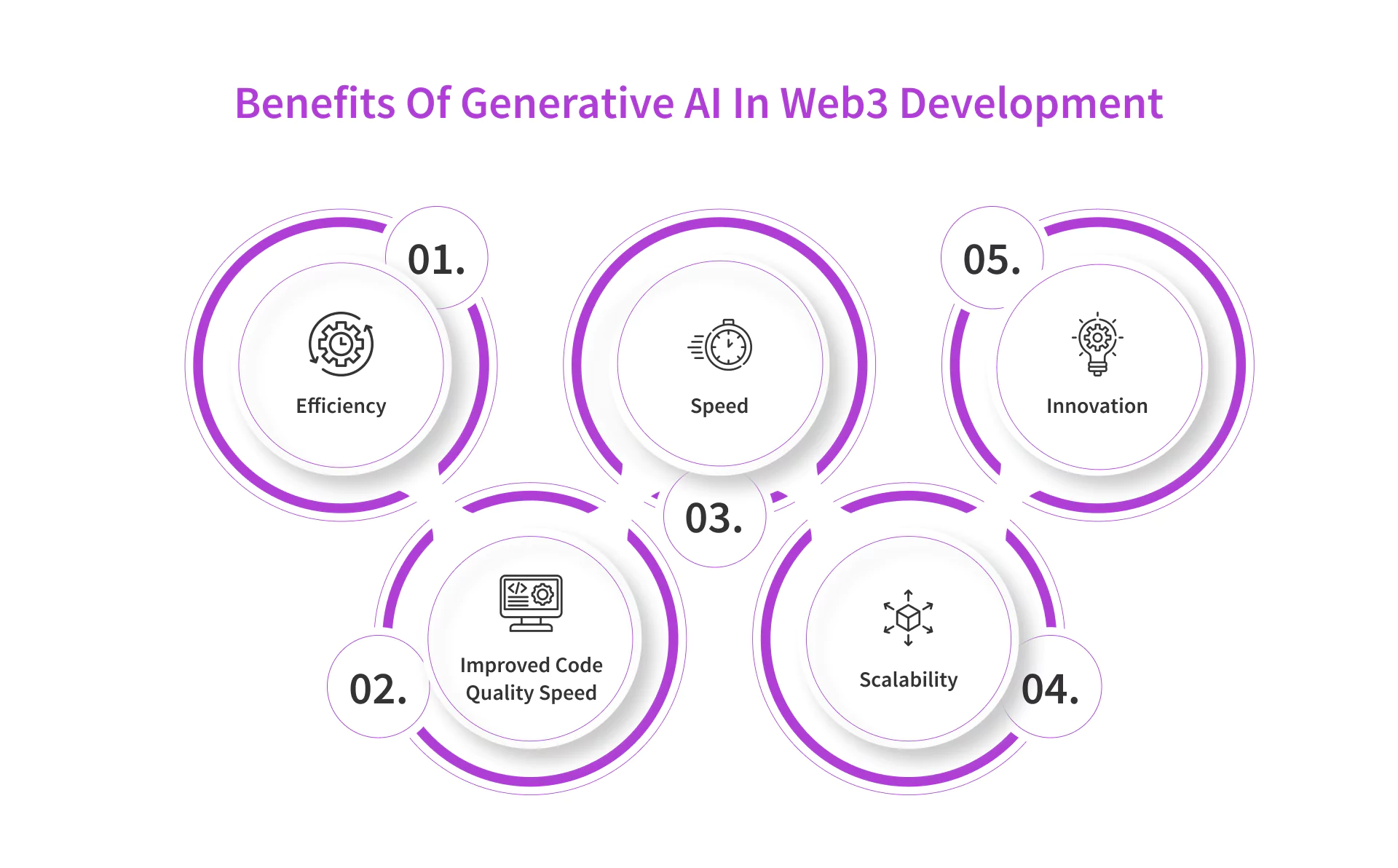
Generative AI is a powerful tool in the hands of web3 development companies, offering several advantages over traditional approaches. Here are some of the benefits of using generative AI in software development:

benefits-of-generative-ai-in-web3-development-

Efficiency

One of the most significant advantages of generative AI in software development is its ability to automate repetitive and time-consuming tasks. This allows developers to focus on more complex tasks, ultimately increasing productivity and reducing development time.

Improved Code Quality

Generative AI can help improve code quality by identifying potential errors and bugs before they become significant issues. It can analyze code quickly and suggest changes to improve efficiency, ultimately leading to better software products.

Speed

Generative AI can significantly speed up the software development process. By automating some aspects of code writing, developers can create applications more quickly, allowing businesses to bring their products to market faster.

Scalability

Generative AI can help developers create scalable applications that can handle large volumes of data and users. By using AI algorithms to optimize code, applications can be more efficient and better able to handle the demands of a growing user base.

Innovation

Generative AI can help developers create innovative new applications and software products quickly that push the boundaries of what is possible. By automating some tasks, developers can focus on creating new features and functionalities that can drive innovation.


How Generative AI Helps In Web3 Development Services?

Here are 3 ways Generative AI models can help in enhancing web3 development services.

Code Generation

It is possible to train generative AI to produce lines of code depending on predetermined criteria. Writing boilerplate code or doing repeated activities can benefit greatly from this technology. 

Using the functionality, design, and technical specifications of a new web application as an example, a developer can train a model to write a large percentage of the application’s code. Because of the time and effort savings, developers can concentrate on other areas of the application’s development.

Code Optimization

Code optimisation is another way that generative AI is assisting with web3 development services. With the use of this technology, developers may analyse old code and find places for improvement using machine learning algorithms.

The model can find unused code, boost efficiency, or use less memory. A generative AI model, for instance, might examine a piece of code and make modifications to increase its efficiency, such as simplifying the code or suggesting alternate strategies to achieve the same result with less code.

Debugging Assistance

By carefully analysing the code, generative AI can help developers find and repair errors. Although crucial to software development, debugging can be time-consuming and difficult. 

A generative AI model can pinpoint the source of the problem and offer potential solutions to remedy the error by an    alysing the code. This facilitates problem-solving and accelerates time to market for enterprises.

To sum up, generative AI is a transformative technology that is rapidly changing web3 development services by increasing efficiency and productivity gains. With code generation, code optimization, and debugging assistance, web3 developers can significantly reduce the time and effort required for dApp development tasks.

 Conclusion

Generative AI is transforming web3 development services via code generation, code optimization, and debugging assistance. By employing generative AI models, web3 developers can improve code efficiency, reduce memory usage, and identify and fix bugs, ultimately enhancing productivity gains for software developers, engineers, and testers.If you are also looking to leverage the advantage of generative AI development in your web3 product, contact us today!


Categories
Web3

How To Choose The Right Web3 Development Company For Your Project?

Do you know that 30% of web3 projects fail in the development phase?

Why do they fail? Where did they miss out? Was it the business idea or tech difficulty?

It is because they did not Choose the right web3 development company.

Save yourself from making the same mistake. By hiring a suitable web3 company you will ensure the success of your project. Moreover, you will also save from losing millions due to project failures.

So, how can you choose the right web3 development company? How will you ensure they have blockchain expertise?

Can you guess if their pricing is right? Here is a complete guide on selecting the best blockchain development company for your project. Let’s get started.


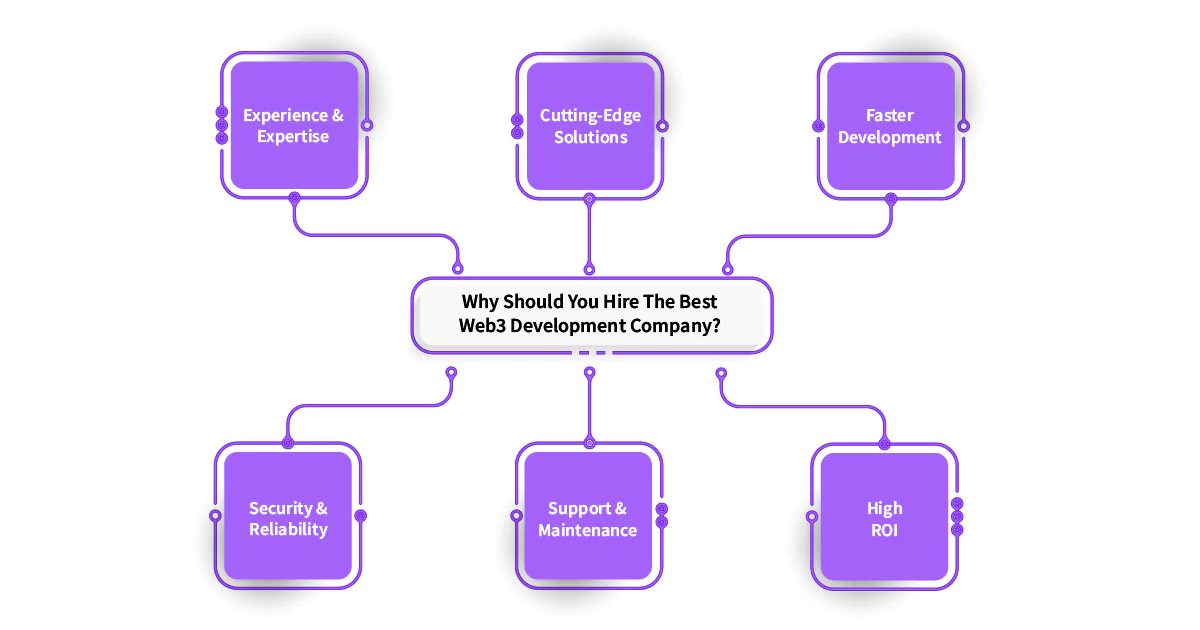
Why Should You Hire The Best Web3 Development Company?


Hiring the wrong tech partner for your web3 project can be disastrous. How?

Firstly, you can end up losing millions of dollars. Secondly, you will waste your precious time. Thirdly, even if the project succeeds, chances are it won’t meet your expectations.

On the other hand, hiring the right web3 development company can transform your idea into a full fledged business.

Some of the benefits of hiring a top blockchain development company are:

Experience & Expertise

You will get a team of web3 developers who have experience in handling web3 projects. They have expertise in cryptography, blockchain protocols, smart contracts and other web3 technologies.

They will be able to understand your web3 project idea. Most importantly, they can suggest customizations to make your web3 product better.

Cutting-Edge Solutions

Top blockchain development companies have access to elite tools, frameworks and the latest technologies.

They use these technologies to build a robust web3 dApp. Moreover, they ensure that your product is relevant in the blockchain space.

Most importantly, they ensure that your project tech stack is up to date in the rapidly changing tech world.

Faster Development

Hiring the right web3 development agency will accelerate your development process.

The development team builds a roadmap for your project.

How does that help?

Firstly, you get a streamlined development lifecycle. Secondly, you will know how your project is progressing.  Thirdly, you can monitor your project progress better.

Lastly, you can give your feedback at every step.

Overall it will result in faster project development and delivery.

Security & Reliability

Web3 projects are built on blockchain technology. Thus, they have high security standards.

However, your web3 project should use the blockchain protocols correctly to ensure full-proof security.

Any loophole in the architecture can open a door for hackers.

Hiring the tech company ensures the reliability of your web3 project. Their web3 developers use the best security standards to secure the platform or app.

Moreover, they do rigorous testing to identify bugs in the app. Once they find the bugs, they work to resolve them.

Further, the team also conducts audits to verify the integrity and security of the web3 app.

Support & Maintenance

If you have hired the right blockchain development company, they will not leave you after the product launch.

Your web3 company should offer regular technical support after the launch. Moreover, they also do timely system upgrades and maintenance to keep your app running smoothly.

High ROI

The right web3 consulting company will help you enter the web3 market the right way. With their help, you can enter the web3 market instantly.

Moreover, they will help you focus on your target audience. Further, the web3 consulting company will open ways to establish multiple revenue streams and multiply your ROI.

You can have all these benefits to make your web3 project a success.

How?

Simply, by hiring the right web3 development services.


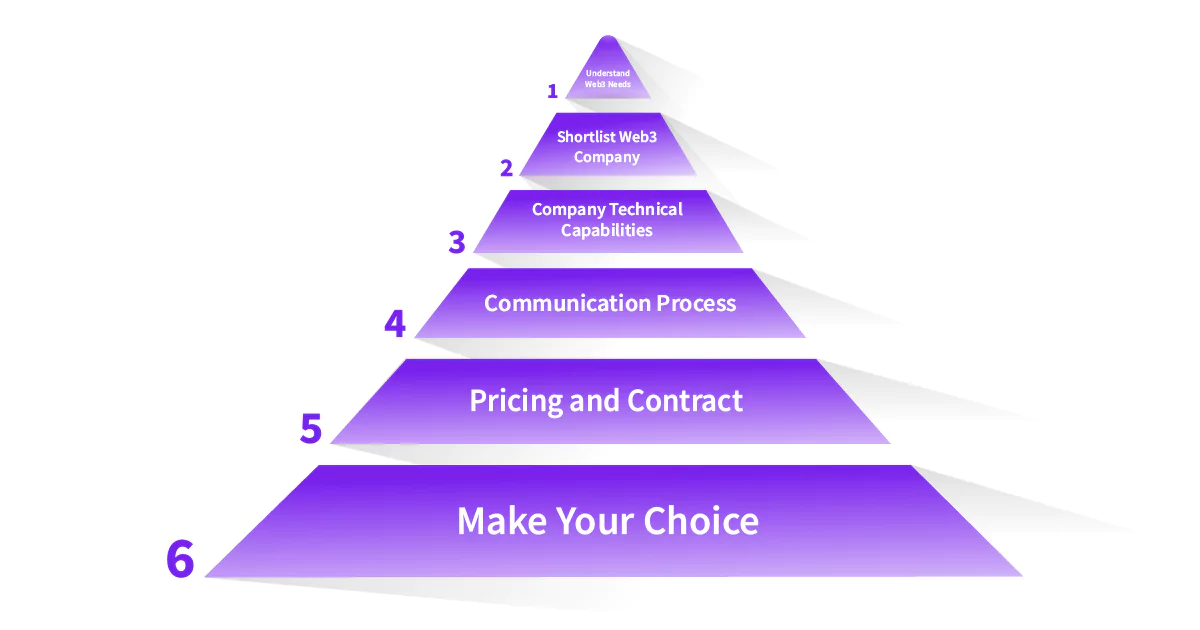
How To Choose The Right Web3 Development Company?


Now that you know the benefits of hiring the right web3 development company, let’s find out how to hire one.

Understand Your Web3 Needs

You might have the best web3 app idea. But if you don’t know what you require then it’s a waste.

Understanding your project requirements is more important than having a great business idea.

That is why you should have a clear picture of your business idea and needs.

How can you do so?

  • Firstly, start by coming up with a feasible web3 project idea.
  • Secondly, identify your target audience.
  • Thirdly, write down your project requirements.
  • Lastly, be open to suggestions.
  • Most importantly, you should convey ideas and needs clearly to the web3 development company.

Now how will you know what your project needs?

  • You can start by analyzing the scope of your project.
  • Listing the features and functions you wish to integrate
  • Assessing the app complexity
  • Defining your target audience
  • Planning your dApp infrastructure
  • Potential third party integrations
  • Cross chain features

Once you are done with these, you will have a great project idea and a clear understanding of your needs.

However, the next step is the most important part. No matter what you decide, sit down with your team and discuss everything in detail. Convey your project idea, thoughts and expectations. Most importantly, always be open to suggestions.

Don’t worry!

Web3 consulting company also offers discovery phase services to help you kickstart your web3 project.

Shortlist Potential Web3 Companies

You need to hire competent web3 developers to make your web3 business idea successful. For that, you need to find the best web3 firm. 

With so many blockchain development companies in the market, it has become difficult to find a reliable one. 

So, how can you select the right company?

  • Start by searching for the best web3 development companies online
  • Read client testimonials, feedback and reviews
  • Ask your network to suggest some of the best blockchain development companies.

Once you have a list of web3 companies, start researching them one by one.

  • See their portfolios
  • Analyze experience in web3 space
  • Look out for their tech stack expertise
  • Explore their services and cost

These points will help you narrow down your list. Once you have a list of 5 to 10 web3 development companies, reach out to them.

Book a call with their experts or mail them with your requirements. However, you should never convey your entire idea in detail on the first call.

On the first call, tell them about your requirements in brief. Then try to understand what they are offering. Also get to know their team size, experience and working style. If possible get a quote from them.

These factors will help you decide which is most suitable company for your project.

Along with choosing a web3 company, you should also look for a good marketing company. 

Choose a marketing company that offers:

  • Landing page optimizations
  • Page ads
  • Content creation
  • Social media marketing
  • Overall product marketing services

Understand The Web3 Company’s Technical Capabilities

One of the crucial factors in choosing the right blockchain development company is its technical capabilities.

Ask about the tools and technologies you use. Get to know their experience in programming languages, frameworks, smart contracts and more.

Moreover, it is equally important to find out if the company is willing to adapt to the latest technologies for your project.

Here is what makes a tier 1 crypto exchange reliable: 

  • See if your company has experience in web3 dApp development.
  • Find out if the company can work with specific blockchain platforms.
  • Inquire about their security strategy, testing and optimization process.

These will help you understand the technical potential of your company. Moreover, you can easily find out if they have the capability to work on your project or not.

Communication Process

Are you ready to start your web3 development project?

Well! Hold On!

While you think that’s all you require to select the right company, it’s not over.

The key to successful web3 project development is a smooth communication channel and seamless collaborations with involved partners.

Now, picture this: you want your interactions with the agency to be as smooth as silk throughout the entire project. No bumps in the road, no miscommunications.

To make that dream a reality, you need to pay close attention to how they engage with you right from the start.

Are they enthusiastic, bursting with ideas, and genuinely interested in your vision?

Don’t stop there. Take a deep dive into their testimonials.

What are other clients saying about their experience working with this agency?

Do they rave about the agency’s communication skills? That’s a big thumbs up!

And if you want to get the inside scoop, have a chat with some of their previous clients.

Get a feel for their communication style. Do they listen actively and respond promptly?

Can they adapt to different needs and preferences?

These are the things that matter!

Your web3 agency should be eager to incorporate your team’s genius ideas and work closely with you every step of the way. 

To make sure they’re the real deal, ask about their experiences with other clients. How do they handle feedback?

Are they adaptable when the project scope inevitably changes?

A true-blue collaborative agency sees your team as an extension of its own, creating an awesome work environment that sets the stage for success.

Pricing & Contract

Before starting with your web3 development project, ask your company to sign a contract.

You should request the following:

  • NDA contract
  • Detailed proposal
  • Pricing structure
  • Project expenses
  • Services they are offering

Once you have the quote or proposal, go through it very carefully. Review all the terms and conditions. Analyze the services and cost they are offering. And if possible compare those with other companies’ quotes.

You should choose the company with clear contract terms and the best pricing. However, low rates do not mean that the company is the best.

You should strike a balance between quality and cost while hiring web3 developers.

Analyzing pricing and contract terms will help you understand if the company has a transparent policy or not. Always stay away from shabby contracts and companies.

You should take your time to review services, cost, quality, technical expertise and other factors before deciding.

Make Your Choice

Once you have reviewed everything, it’s time to make your decision.

To choose the most suitable web3 development company, weigh the pros and cons of every company. Analyze every company on the following criteria:

  • Portfolio
  • Technical expertise
  • Services & cost
  • Contract terms
  • Client testimonials
  • Team expertise

Find the company that balances all the criteria. Other than these factors, you should hire a blockchain development company that can handle your specific project needs.

The right web3 consulting company by your side will help you establish your brand in the market and grow your business.


How Blocktech Brew Can Help You In Web3 Development?


You will hear people say that a perfect web3 company doesn’t exist. But we do.

Blocktech Brew is a leading blockchain development company helping entrepreneurs turn their web3 business ideas into reality.

We have the technical prowess and a professional development team to build smart, robust and scalable web3 apps and platforms.

We go out of the box to support your web3 project needs. Our smooth communication medium and transparent workflow makes us the most trusted web3 company.

At Blocktech Brew, we understand client priorities and make them ours. With access to state of the art tools and the latest technologies, we develop web3 dApps that become successful.

Our core strength lies in our transparent working system, clear contract terms and cost effective web3 services.

Join hands with the most trusted tech company to foster your business growth in the web3 space.

Web3 Use Cases

Use Case 1: Decentralized Application Development:

 BlockTech Brew, as a Web3 development company, can help you build decentralized applications (DApps) on blockchain platforms such as Ethereum, Polkadot, or Cardano. 

They can assist you in designing and implementing smart contracts, developing user interfaces, and integrating various blockchain features. 

This use case is ideal for businesses or startups looking to leverage blockchain technology to create innovative and secure applications for industries like finance, supply chain, gaming, or voting.

Use Case 2: Tokenization and NFT Development:

 BlockTech Brew can assist you in tokenizing assets or creating non-fungible tokens (NFTs) using blockchain technology. 

They can guide you through the entire process, from defining tokenomics and smart contracts to developing marketplaces or platforms for buying, selling, and trading tokens or NFTs. 

This use case is relevant for businesses or individuals interested in leveraging the unique properties of blockchain to create digital representations of assets or unique digital collectibles.

Use Case 3: Blockchain Consulting and Strategy:

 If you are unsure about how blockchain technology can benefit your business, BlockTech Brew can provide blockchain consulting services. They can analyze your specific needs and requirements, identify potential blockchain use cases, and develop a strategic roadmap for implementation. 

Whether you are considering integrating blockchain into your existing infrastructure, exploring partnerships with other blockchain projects, or evaluating the feasibility of a blockchain-based solution, BlockTech Brew can provide valuable insights and guidance.

Categories
Wallet

How to Build a Blockchain Wallet: A Beginner’s Guide

People are going to remember the 21st century as the era of cryptocurrency and blockchain. When we talk about cryptocurrencies or Decentralized finance, one of the things that no one misses out on is Blockchain wallets.

Imagine owning cryptocurrencies worth hundreds of dollars. Or buying an in-game asset using tokens in the metaverse. Where will you keep your cryptocurrencies? How will you pay or transfer your cryptocurrencies?

You will need a blockchain wallet to securely store, manage and transfer cryptocurrencies. A blockchain wallet app is software built on the blockchain network that protects your private and public keys. It also enables you to seamlessly transfer cryptocurrencies.

You need a blockchain wallet for accessing all Defi services, metaverse, web3 games, and other web3 services. It’s surprising that there were over 82 million crypto wallet users worldwide as of August 2022. That’s not all! The revenue from the crypto wallet development services and blockchain wallet app will reach $48.27 billion by 2030.

Entrepreneurs have realized the value of blockchain wallets and are eagerly looking for blockchain wallet development companies to build a blockchain wallet app.

While everyone is on the run to build a blockchain wallet, very few of them know how to build one. Most businesses jump into blockchain wallet development without considering important features to integrate, monetization models to apply and more.

Do not worry! We are here to help you with our ultimate guide on blockchain wallet app development.

What is a Blockchain Wallet?

A blockchain wallet is software where you can securely store and transfer your cryptocurrencies. However, unlike a physical wallet, you cannot actually store your cryptocurrencies. It is because cryptocurrencies are cryptographic codes.

So what does a blockchain wallet store?

A blockchain wallet stores your private keys. You must have heard the famous line “Not your keys, not your crypto”.

Your crypto private keys are like your bank password. Anyone who possesses your private keys will have the access to your cryptocurrencies.

That is why, we need blockchain wallets to keep our private keys safe. This eminent need to protect private and public keys has created a demand in the market for a secure blockchain wallet.

Entrepreneurs around the globe are looking to capitalize by meeting the demand of the crypto market. Businesses are actively engaging in blockchain wallet development to build feature-packed and highly secure blockchain wallets.

How does a Blockchain Wallet Work?

When you set up your blockchain wallet, it generates two keys:

  1. Public keys
  2. Private keys


You share your public keys with others to receive cryptocurrencies. While you must keep your private keys safe. You should note that you should never share your private keys with anyone in any circumstance.

When someone is sending you his cryptocurrencies, he will use your public keys. Further, he will use his private keys to sign off the transaction.

That’s not all! When you are sending cryptocurrency, the private keys of your crypto must match the public keys of the receiver. Only then the transaction will be successful.

Advantages of Blockchain Wallets

Blockchain wallets are also sometimes known as crypto wallets. These wallets offer a bundle of benefits to the users as well as the wallet entrepreneur.

Here are some notable advantages of a cryptocurrency wallet.

1. Secure

A blockchain wallet securely stores your public and private keys. Therefore, keeping your cryptocurrencies safe.

2. Instant transactions

You can instantly send and receive cryptocurrencies using a blockchain wallet. The best part is that the transactions are safe and secure.
That’s not all! Blockchain wallets facilitate transactions without the involvement of any third party. That’s why the transactions are cheaper and instant.

3. Easy To Use

Blockchain wallets are designed in a way that is very simple and convenient to use. It is similar to your payments app. Even sending and receiving crypto is also very much similar to how you make payments on the app. The only thing you need to be very careful about is the private and public keys.

4. Low Transaction Fees

Before the cryptocurrencies and wallets, cross border payments were very expensive. However, things have changed with blockchain wallets.
Now you can make cheaper and instant cross border payments in crypto via your blockchain wallet.

5. Support Multiple Cryptocurrencies

With the growing Defi trends, people are looking for multichain wallets. These wallets are compatible with multiple blockchains and their native currencies.

Thus, a wallet that supports multiple cryptocurrencies allows users to keep all their crypto in one place securely. In fact, users can also do easy currency conversions and transactions in multiple cryptocurrencies.

Why Should You Consider Blockchain Wallet App Development?

There are reasons why web3 brands and crypto associated companies are launching blockchain wallets. They have seen the immense growth of the crypto industry in the past few years and the demand for a user-friendly and secure crypto wallet.

These web3 brands are utilizing the market demands to build crypto wallet app that meets the preferences of the users.
Here are some of the reasons why you should build a blockchain wallet app.

  • The crypto industry is constantly growing and is a prominent part of the decentralized financial ecosystem.
  • The growing Defi trend is also pushing the crypto wallet market.
  • The mass blockchain adoption has promoted the growth of cryptocurrencies and digital tokens. This has simultaneously promoted the growth of the blockchain wallet market.
  • The rising metaverse trend and the NFTs’ popularity also support the crypto wallet industry.
  • As per Grand View Research, the market size of crypto wallets is $10.27 billion.
  • Experts predict that the value of the crypto wallet market will reach $48.27 billion by 2030.
  • In fact, the cryptocurrency wallet industry will have a CAGR of 24.8% in the predicted time frame.

To sum up, the current crypto market sentiment, Defi trend and metaverse popularity will only promote the growth of blockchain wallets.
Step into the crypto industry and capitalize on the trillion dollar market with an innovative and secure blockchain wallet. Collaborate with the best crypto wallet development company today!

How To Keep Your Blockchain Wallet Safe?

Though blockchain wallets are highly secure, you cannot blindly trust them. You should be very cautious of the security of your crypto wallet and your cryptocurrencies.

Here are some ways how you can ensure the safety of your blockchain wallet app.

1. Backup

You should not trust large crypto funds in your hot blockchain wallets. To be on the safer side, you should keep a small number of your cryptocurrencies in your online wallet. While you should store the bigger portion of your crypto funds in a hardware wallet like Ledger Nano.

2. Enhance Your Wallet Security

Firstly, you should always use wallet from a recognized company.
Secondly, you must secure your wallet with a long and complex password. Please note to never put your birthdays or names as passwords.
Thirdly, you should enable authentication features in your wallet. Some of the authentication features in trusted crypto wallets are 2FA, email authentication, sms authentication, multi-sign authentication and more.

3. Upgrade Your Wallet

Wallet companies constantly work to resolve bugs and upgrade new security features and tools.
While your current version of the wallet software can be the best one. You should always update and install the latest versions to enjoy newly added features and security tools.

Features To Include In Your Blockchain Wallet

If you are considering to build a blockchain wallet app, it’s important to include the latest features. It is the high-end features of the crypto wallet app that makes it a success.
Here are some key features of the crypto wallet app that you ask your blockchain wallet development company to integrate.

  • Cross platform compatibility
  • Multi-currency support
  • Instant transactions
  • KYC/AML verification
  • Automated conversions
  • User-friendly Interface
  • Buy crypto with credit cards
  • NFC support
  • QR Code scanner
  • Home screen customizations
  • 2 Factor Authentication
  • Multi-sign support
  • Session Logout
  • 12 word seed phrase

Blockchain Wallet Fees (Wallet Revenue Models)

As an entrepreneur, you should consider setting up monetization models for your blockchain wallet. The wallet monetization systems help to create multiple revenue streams and generate high ROI.

Here are some crypto wallet revenue models you should consider.

  • Transaction fees
  • Affiliate fees
  • Advertising fees
  • Token swapping fees
  • Staking fee
  • Consultation fee

How To Create A Blockchain Wallet App?

With the right plan in mind, you can build a blockchain wallet app that becomes popular among crypto users.
You will need to hire a blockchain wallet development company. But you should know the components and steps involved in developing a crypto wallet app.

Here is step by step guide to build a blockchain wallet.

Step 1 – Knowledge of Blockchain & Cryptocurrency

Before you start to build a crypto wallet, you should have a sound knowledge of blockchain and cryptocurrencies.
Here are a few things you should learn about blockchain and crypto:

  • Blockchain consensus
  • Blockchain platforms
  • Blockchain protocols
  • Cryptocurrency protocols

Step 2 – Market & Competitor Analysis

Before developing your wallet, you should research your market trends and competitors. Further, you should also analyse your customer pain points and preferences. This way you can launch a product that adheres to your customers and caters to their demands.
How can do you so?
Ask yourself these questions.

  • What is the current market trend in the crypto wallet industry?
  • How is the blockchain wallet industry doing?
  • What are your competitors doing?
  • What your competitors are offering to their customers?
  • What are the pain points of crypto wallet users?
  • Who are your target customers?
  • What are your target customers looking for in a blockchain wallet app?

By the time you find out answers to all these questions, you will have an idea of what your crypto wallet app should look like.

Step 3 – Use Open Source Libraries

The best part about cryptocurrency and blockchain wallets is that they are open source. It means that you can view their codes and make one yourself with its help.
BitcoinJ SDK or Coinbase SDK are the two most reputed libraries. You can use these libraries to build blockchain wallet app for IoS and Android devices.

Step 4 – Choose The Right Tech Stack

The key to achieving success with your app lies in selecting the appropriate technology stack.
If your goal is to develop a web app, consider utilizing Node.js or Angular.js, coupled with HTML5 and CSS3, to construct a crypto web application that is scalable.
When it comes to creating a native Android app, you have the option of using either Java or Kotlin, while Swift or Objective-C can be employed for iOS apps.

Step 5 – Incorporate Security protocols

You must keep the security of your crypto wallet app on priority. Users will use your crypto wallet only if it’s safe.
That is why, you should integrate security features like 2FA, biometric authentication, fingerprint, face ID and more. Further, you can also customize features like easy pin login, session log out and multi-sign authentication.
That’s not all! To protect your users from fraud and avoid money laundering, you should implement KCY & AML verification process.
Lastly, you should constantly look to upgrade security and add new features to your wallet app.

Step 6 – Hire The Right Blockchain Wallet App Development Company

Now to start the development process you need to hire a blockchain app development company.
A trusted company with expertise and experience in blockchain wallet development will build you a robust wallet app. They have a team of developers, programmers, subject experts, QA engineers and product managers to accelerate your crypto wallet app development.
Hire our blockchain wallet developers today to launch your wallet app within 2 weeks!

Make BlockTech Brew Your Trusted Blockchain Wallet Application Development Company

Join hands with the most trusted blockchain wallet development company to venture into the crypto industry. We are here to build you a blockchain wallet app that opens new revenue streams for you and caters to your customers.
Our speciality lies in developing robust, scalable, secure and feature-packed blockchain wallet development solutions.
Schedule a free consultation call with our experts now!

Categories
Wallet

How to Build a Multichain Crypto Wallet: The Ultimate Development Guide

The cryptocurrency market has witnessed major ups and downs in the last 2 years. While the flourishing crypto market made investors and blockchain development companies happy, the bear market trend didn’t disappoint them as much as the experts predicted.

The rising web3, metaverse, and Defi trends kept the crypto market alive. In fact, the web3 development and Defi development didn’t only support the cryptocurrency market but also gave a huge push to the digital wallet industry.

Why is it so?

It is because to you need digital tokens to use the Defi and web3 services. Whether you make payments, buy virtual land, or participate in DAO governance activities, you need tokens. Moreover, you even take loans and invest in staking using the tokens.

Now, here comes the interesting part. Like our everyday physical wallets, you need digital wallets to keep the tokens safe. That’s not all! You can also use digital wallets to send and receive payments.

Create Crypto Wallet App With Blocktech Brew!

Learn More

Further, these digital wallets are secured with high grade security protocols. So, on one hand, it protects your tokens and on the other hand, it enables you to seamlessly transact.

There are hundreds of digital wallets in the market. Most of them support only one blockchain network and its native token. However, with the emergence of Defi, people are looking for multichain wallets that support multiple blockchains.

Currently, the crypto wallet market size is $10.27 billion. In fact, experts predict that the digital wallet market will reach $48.27 billion by 2030. If that’s not promising enough for the rising wallet industry, then the survey sheds more light on the growth and revenue rate which is a whopping 24.8%.

These data are crucial for entrepreneurs looking to tap into the crypto industry with a successful product. One of the ways can be to build a multichain crypto wallet app and launch it.

If you are one of them, you can hire an experienced crypto wallet development company. They have skilled developers and blockchain experts who will guide you from multichain wallet ideation to development and deployment.

Still, confused about multichain crypto wallets?

Here is a step-by-step guide to build multichain wallets.

What Is A Multichain Wallet?

A multichain wallet is a cryptocurrency wallet that supports multiple blockchain networks. It means that you can store, send and receive multiple cryptocurrencies or tokens in one wallet.

Unlike other crypto wallets that are compatible with only one token standard, these wallets support major token standards for user convenience.

For instance, you do not need to have Ethereum, Polygon, and BSC wallets separately. You can set up a multichain wallet supporting all these blockchains where you can store ETH, MATIC, and BSC tokens in one place.

In the era of web3 and Defi, multichain wallets are a boon. One robust multichain wallet is sufficient to access all Defi and web3 services.

A multichain wallet has two vital components. They are:

Passphrase: A multichain wallet does not have a private key. instead, it has a passphrase that acts like your password to access your wallet and tokens.

Wallet address: Each blockchain in a multichain wallet has its own wallet address. You can use that wallet address to send and receive tokens on that specific blockchain network.

Building a multichain wallet requires a high level of blockchain expertise and programming skills. That is why you need a reliable wallet development company that will build a multichain crypto wallet packed with user-friendly features tailored to meet your business needs.

Get on a call with the best wallet app development company.

Benefits Of A Multichain Crypto Wallet

Here are some notable benefits of a multichain crypto wallet app.

Multiple blockchain Accessibility

The biggest advantage you will get with a multichain wallet is that you can access multiple cryptocurrencies and tokens over different blockchains with ease.

Convenience

A multichain wallet uses cross-chain bridges and cross-chain routers. The bridges allow you to transfer cryptocurrencies between two blockchain networks. While the router enables you to transfer between two or more blockchains.

NFT compatibility

Apart from storing and transferring major tokens, you can even store your NFTs in a multichain wallet.

So, this feature makes it quite useful for investors who are involved in all areas of web3.

Non-custodial Nature

Imagine having a digital wallet where you can store major tokens without worrying over private keys.

The biggest advantage of a multichain wallet is its non-custodial nature. Instead of private keys, you have a passphrase that is applicable for accessing tokens across all supported blockchain networks.

Ledger Connection

What’s more, you can even connect your multichain wallet with a hardware wallet or ledger. Hardware wallets are the most trusted digital wallet solutions for keeping your cryptocurrencies safe.

There are reasons behind the tremendous increase in the demand for multichain wallets. These advantages of multichain wallets give them an edge over other wallets.

Key Features Of Multichain Wallets

You must ask your wallet development company to integrate the latest features during the wallet development process. Elite features, tools, and utilities make a crypto wallet easy to use and lure in large crypto, Defi, and web3 users.

Have a look at the key features you must have in your multichain wallet to make it a success.

User-Friendly UX: The app should have an attractive and user-friendly interface that enables users to easily navigate through the app dashboard and functions.

Cross-Platform Support: Your app should function seamlessly and efficiently across all devices like mobile phones, tablets and computers.

Two-Factor Authentication The 2FA feature prevents fraud by restricting unauthorized access. It adds an extra layer of security and protects the accounts from being hacked.

Real-time Price Tracking: Your app should have a price tracking tool so that the users are able to view the updated value of the cryptocurrencies and be informed of the latest developments and trends in the crypto market.

Account Backup: Back up feature allows users to easily recover their account and funds in case of unintentional account logout.

Portfolio: The portfolio feature allows users to view their crypto holdings and assets at one place to efficiently plan their investments.

DEX Integration: You should integrate your crypto wallet app with decentralized crypto exchanges. It will enable users to buy and sell cryptocurrencies easily by connecting the wallet.

Multi-sign Support: To ensure security of your crypto wallet app, you must integrate a multi-sign feature. It allows users to give authorization and permission to process transactions.

Token Swap: The crypto wallet app should also have a token swapping feature to easily move funds and swap tokens through exchanges.

Automatic Updates: With automatic update feature, the app will automatically update itself to the latest version of the application with newly added features and tools.

Transaction History: By integrating a transaction tracking tool you will enable your users to view and verify the details of their transactions and keep a track of it.

Crypto-to-Fiat Conversion: For a crypto wallet app, crypto to fiat conversion feature is important. It enables users to easily and quickly convert their cryptocurrencies into fiat.

Cold Storage Support: You should also enable your users to integrate cold wallets or hardware wallets with your app. It is to ensure the maximum security of the large crypto funds on the users.

Multiple Language Support: Your crypto app must support multiple languages in order to cater to the users coming to your platform across the globe.

How To Build A Multichain Wallet?

Building a multichain crypto wallet is not a cake walk. You need the perfect product ideation, bring together a development team, monitor the development process, and get ready for the launch.

Your work does not end here. You also need to plan marketing strategies to promote your wallet. Further, even after the launch, you need consistent technical assistance to ensure high performance and undisrupted functioning of your wallet.

Let’s be honest here. You cannot manage everything yourself. That is why you should get help from a wallet development company.

They have a team of highly experienced developers, coders, Q&A experts, and product managers to handle everything perfectly. Right from analyzing your wallet ideation to market research, frontend & backend development to deployment, they will assist you at every step. What’s more, they also offer post launch technical assistance to ensure quality functioning and timely upgrade of your wallet.

Here are 6 steps to build a multichain wallet with robust features and high security standards.

Step 1: Strategy

The first step in multichain wallet development is defining the strategy. This phase involves determining the number of users, market trends, and competitor analysis.

Additionally, you will choose a platform for your application and consider the cost, which depends on the complexity and features you want to integrate.

The development time for a wallet is typically between 4 to 6 months.

Step 2: Product Roadmap

Once you have defined the strategy, the next step is to create a product roadmap that outlines the development process in detail.

This roadmap emphasizes wallet requirements and sets delivery milestones.

If you are developing a mobile solution, it is crucial to have a skilled and experienced development team by your side.

Step 3: UI/UX Design

The success of the wallet application depends on user adoption and the benefits offered by its features. Therefore, the wallet must have interactive and intuitive interfaces to boost user engagement.

During this stage, mockups are created, and the style guide is applied to application wireframes. The prototypes are shared with clients for feedback and undergo modification to meet their expectations.

Step 4: Wallet Development

The multichain wallet development process can be divided into two parts: development platform and transaction mechanism. Choosing the right platform is crucial for the success of the project.

You can incorporate the mechanism of your choice to authenticate transactions.

Hire a Crypto Wallet Developer for Free Demo!

Talk to our Consultant

Step 5: Testing

Errors and glitches are eliminated during the testing phase.

The multichain wallet undergoes user experience testing, functional testing, performance testing, security testing, and device and platform testing to ensure a smooth user experience.

Step 6: Deployment and Maintenance

After rigorous testing, the application is deployed on app stores. Apple iOS applications take several weeks to get approved, while Android applications usually appear in 4-5 business days.

Build Multichain Wallet With Blocktech Brew

Integrate your web3 business model with multichain wallets to boost your revenue and promote business growth.

Blocktech Brew is a blockchain development company offering a comprehensive set of crypto coin development, Defi, web3, metaverse platform development, and web3 gaming solutions.

One of their premium offerings is wallet development services which empower enterprises by building custom crypto wallets. They have proficient developers with the right set of skills and experience in developing multichain wallets.

Looking to build multichain wallets to tap into the Defi industry?

Get on a call with our experts today!

Our Trusted Partners

Meet Our Allies In Building Innovative Solutions Fuelling Growth & Unbeatable Results

Collaboration is key to building innovative solutions that deliver unbeatable results. Our trusted partners and allies share our vision and values, allowing us to work towards common goals. By leveraging each other's strengths and expertise, we can create a powerful force for growth and success.

haken
haken
haken
haken
haken
haken
haken
haken
haken
haken
haken
haken
haken
haken
haken
haken
haken
haken
haken
haken
haken
polygon
haken
haken
haken
haken
haken
bians
Lg-3
Lg-3
Lg-3
bians
Lg-3
Lg-3
bians
Lg-3
Lg-3

Have A Vision?

Share Your Idea Now & Step-Ahead With Innovative Blockchain Solutions.

Let’s Fire Up Your Business!

Team Up With Us Today For An Unforgettable Service Experience

Dubai

Level- 26, Dubai World Trade Centre Tower,
Sheikh Rashid Tower, Sheikh Zayed Rd, Dubai, UAE

business@blocktechbrew.com

+971 55 473 8790

India

Plot no I - 36, Sector 83 Alpha,
Mohali SAS Nagar 140308

business@blocktechbrew.com

+91 771-966-6171

Mexico

Av. Miguel Hidalgo y Costilla 1995, Arcos
Vallarta, 44600 Guadalajara, Mexico

business@blocktechbrew.com

+1 (332) 233-6033

USA

401 Park Avenue South, 10th Floor
New York, NY 10016

business@blocktechbrew.com

+1 (332) 233-6033

UK

2nd floor, College House, 17 King Edwards Rd,
London HA4 7AE, UK

business@blocktechbrew.com

+44 (20) 82644493